SLOTH VIDEO: Top 10 Reasons Sloths are Cooler Than You – Cute Overload

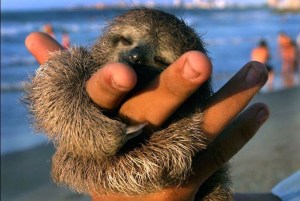
KS Naturebaby-slothSloths are drowsy tree-dwellers that spend most of their time eating and sleeping in the tropical rainforests of Central and South America. These adorable, mysterious creatures melted the hearts of millions way before Kristen Bell lost it on Ellen. I’ve crafted what I believe to be the most comprehensive video list explaining why sloths are the coolest (and cutest) mammals on the planet 🙂 Click away!

10 – They Rock Baby Sloth Onesies

9 – They Get the Hang of Things

8 – They Give Great Hugs

7 – They Play Well With Others – In Buckets!

6 – They Enjoy Bath Time

5 – People Don’t Make Memes About You

Disney Sloths to the Rescue!

4 – They Eat Their Vegetables

3 – They Don’t Rush Through Life

2 – Celebrities Cry Over Them

1 – They Make This Adorable Sound

Video

Top 10 Crazy New Species Found in 2014: A Cartwheeling Spider, Neon Sea-Slug, and the Bird From Hell

KS Strange ScienceScientific American shared a list of the top 10 most interesting new species discovered last year. The fascinating list was published by the International Institute for Species Exploration (IISE) at the State University of New York College of Environmental Science and Forestry on May 21. Explore the new creatures below!

Gallery

Incredible Time-Lapse of a Bee’s Birth: From Egg to Flight in 60 Seconds

KS NatureScreen Shot 2015-05-23 at 12.39.26 PMNational Geographic Japan shared this amazing time-lapse video of a bee being born. I love when science videos get over 1,653,803 views on YouTube 🙂 Click here for more information about a bee’s life cycle!

Over the course of 21 days, you can watch this bee egg hatch into a larva – the larva swims in its cell, feeding on liquid food from the queen bee – the legs and head evolve as it develops into a pupa – the tissue reorganizes in its body and the eyes form – then, the skin shrivels and it sprouts hair. BOOM. Bee time.

This video is the work of biologist turned photographer, Anand Varma.

Video

VIDEO: Watch This Chameleon Hatch and Take Its First Steps – Amazing!

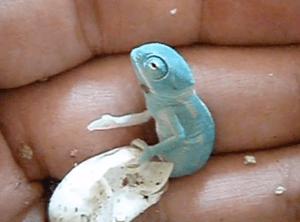
KS NatureScreen Shot 2015-05-14 at 11.50.39 AMThere is a reason this video of a chameleon hatching – posted in 2008 – has over 1,715,098 views. I could do without the epic music, but overall this video is absolutely captivating; it starts changing colors within minutes. You can watch its tiny two-toed zygodactylous feet and independently mobile eyes experience the world for the first time. Click below to watch the incredible footage!

Chameleon Reproduction


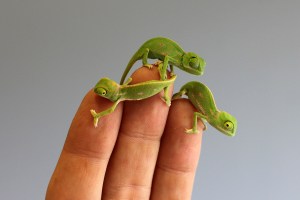
veiled-chameleonMost chameleon species lay eggs (oviparous), while a few give birth to live young (ovoviviparous).

The oviparous species lay eggs three to six weeks after mating takes place. The female will dig a hole in the ground and deposit her eggs, covering them with dirt, keeping them warm and safe. The mom then leaves the eggs to hatch and fend for themselves – which can take anywhere from 4-12 months, even longer for some species. Chameleon babies are independent at birth and must find their own food and shelter.

A batch of chameleon eggs is referred to as a ‘clutch.’ Clutch sizes vary greatly depending on the species. Click here to view an African Flapneck chameleon burrow her eggs and wait for the babies to hatch and catch their first snack!

The ovoviviparous species, like Jackson’s chameleons, have a five to seven-month gestation period. Each young chameleon is born within the sticky transparent membrane of its yolk sac. Once the membrane bursts, newly hatched chameleon babies free themselves and climb away for their first feeding.

Video

Keeva the Baby Chimp Paired with Surrogate Mom for a Mother’s Day to Remember

KS NatureA baby female chimpanzee by the name of Keeva, born to the Maryland Zoo in Baltimore on March 12th, has been given the best Mother’s Day present – a new surrogate mom!

Once the Maryland Zoo realized Keeva’s birth mother couldn’t care for her, they teamed up with Tampa’s Lowry Park Zoo to find a surrogate mother to raise her properly. You can view the big announcement on the Maryland Zoo’s website and Facebook page 🙂

IMAGE: Facebook - The Maryland Zoo in Baltimore
Baby Keeva (IMAGE: Facebook – The Maryland Zoo in Baltimore)

The tiny primate was born at 2.6 pounds to first time mother ‘Carole,’ who has been with the chimp troop at the Maryland Zoo for 27 years. Unfortunately, Carole could not care for Keeva properly, and the Zoo was forced to make a tough decision.

“The birth seemed to be without complication and the baby appeared to be healthy,” stated Mike McClure, general curator at The Maryland Zoo. “However, it soon became apparent that Carole was not adapting to motherhood appropriately and we made the difficult decision to remove and hand-rear the baby while searching for a suitable home with a nurturing surrogate.”

Maryland Zoo staff felt it was important to familiarize Keeva with the sights, smells, and sounds of the troop. The infant spent several weeks in a behind-the-scences section of the Zoo’s Chimpanzee Forest, receiving round-the-clock care.

While Keeva was experiencing her first few weeks of life, the Zoo knew they needed to find her a surrogate. They worked with the Chimpanzee Species Survival Plan (SSP) of the Association of Zoos and Aquariums (AZA) to find an adult female chimpanzee ready to take on the task. Luckily, they found an experienced surrogate named ‘Abby.’

“We know Abby has the instincts and skills to raise a baby chimp – she has been successful twice before,” noted Lee Ann Rottman, general curator of Tampa’s Lowry Park Zoo. “We have every reason to believe that she will raise Keeva as her own, when given the opportunity.”

Keeva is now 5 pounds, can hold her head up, has started to speak, and is beginning to teethe! But, it will be 4-6 months before she is introduced to Abby. She will be integrated slowly, as chimpanzees live in complex social groups with a strict hierarchal structure. We wish her the best of luck.

Humans tend to have a soft spot when it comes to chimpanzees. This is most likely due to the fact that they are our closest relatives, sharing 98 percent of our genes! Sadly, these great apes are endangered and still threatened by poachers, disease, and habitat destruction.

Keeva the Baby Chimp Paired with Surrogate Mom for a Mother’s Day to Remember

Beetle Butt, Beetle Butt, Beetle Butt! – This Insect Shoots Hot Nasty Liquid Out of Its Abdomen

KS Nature

Bombardier beetles are famous in the insect world, not because they have colorfully patterned wings or a nasty bite, but because they have a very unique defense mechanism: When disturbed or attacked, the beetles produce an internal chemical explosion in their abdomen and then expel a jet of boiling, irritating liquid toward their attackers.

Photo: Charles Hedgcock

The liquid they eject is called benzoquinone, and they heat it to the temperature of boiling water before they shoot it out in an intense, pulsating jet. They are not the only insect to use this liquid, but they are the only ones to make it steaming hot. Not only that, they are the only ones to emit a pulsating stream, forcing out the liquid with unique precision five times faster!

Researchers were baffled as to how these beetles could produce this spray without causing themselves any physical damage. But, the question has now been answered! Researchers at MIT used high-speed synchrotron X-ray imaging to look inside the abdomens of living bombardier beetles during their chemical explosions. Check out the video below to see the X-ray footage in action!

The key is that they synthesize the chemical at the instant of use, mixing two chemical precursors in a protective chamber in their hindquarters. As the materials combine to form the irritant, they also give off intense heat that brings the liquid almost to the boiling point — and, in the process, generates the pressure needed to expel it in a jet.

The findings are published this week in the journal Science by MIT graduate student Eric Arndt, professor of materials science and engineering Christine Ortiz, Wah-Keat Lee of Brookhaven National Laboratory, and Wendy Moore of the University of Arizona.

Bombardier beetles lives on every continent except Antarctica and have virtually no predators. Sounds like a good life to me 🙂 Spray on, little dudes.

Beetle Butt, Beetle Butt, Beetle Butt! – This Insect Shoots Hot Nasty Liquid Out of Its Abdomen

Crazy X-Ray Images Show Python Digesting an Alligator Whole – And it Only Took 7 Days!

KS Strange Science

Have you ever wondered what it looks like when snakes digest their prey? As humans, we tend to eat certain parts of animals… while snakes eat and digest whole animals.

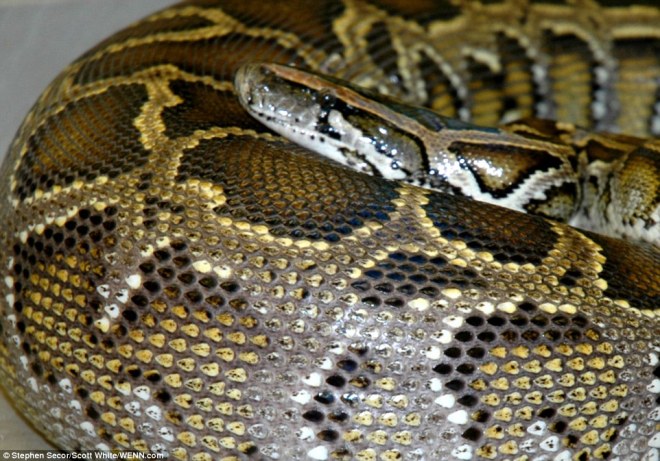
Below are a series of X-Ray images that reveal just what happens when a Burmese python swallows an entire alligator.

Burmese pythons are one of the five largest snakes in the world. Their body’s response to eating such large prey is what makes them a model species for digestive physiology. After they ingest their prey, their digestive system goes into hyper-drive. Each meal triggers dramatic increases in metabolism, upregulation of tissue function and tissue growth. Their organs literally supersize themselves!

Dr. Steven Secor, Professor at the University of Alabama, is obsessed with ‘the integrative design of gastrointestinal morphology and function.’ Who isn’t, right? 😉

Dr Secor said: ‘For the Burmese python, native to southeastern Asia, the next meal could range from a monitor lizard or ground-dwelling bird to a prey as formidable as a pangolin, deer or leopard… When it does eventually capture a prey and feed, the python’s previously dormant gut rapidly resumes function to tackle the difficult task of digesting a prey that may exceed half of the python’s own body mass. Upon the completion of digestion, these postprandial responses are thrown into reverse; tissue function is collectively downregulated and tissues undergo atrophy.’

Dr. Secor and his colleagues discovered that the snake’s heart increased by 40%, it’s pancreas increased by 94%, it’s kidney’s increased by 72%, and the reptile’s liver more than doubled in size.

Want more information? Check out Dr. Stephen Secor’s 2008 submission to the Journal of Experimental Biology.

Day 1- Here, you can see the alligator’s snout, torso, legs, and tail, snuggly stuffed in the python’s gut.

281794D400000578-3058837-Day_1_Scientists_have_taken_x_ray_images_of_a_python_as_it_diges-m-32_1430216606865

Day 2 – The soft tissue is dissolving and the skeleton has begun to break down. The python floods its small intestine with powerful enzymes and acid, while its metabolic rate increases – forty times!

281794DD00000578-3058837-Day_2_The_soft_tissue_has_been_dissolved_away_and_the_skeleton_i-m-33_1430216616579

Day 3 – The bones continue to be broken down, it’s scaly skin disappearing. The snake is essentially immobile during such a large meal, making it vulnerable to predators.

281794FB00000578-3058837-Day_3_The_bones_and_scaly_skin_of_the_alligator_are_now_being_di-m-34_1430216625446

Day 4 – Only the hardest parts of the alligator remain as the python begins its final stages of digestion.

2817963800000578-3058837-Day_4_Only_the_hardest_parts_of_the_alligator_remain_and_they_pa-m-37_1430216645826

Day 5 – Almost finished. The snake must digest quickly before the alligator rots.

281794EE00000578-3058837-Day_5_Just_a_few_fragments_of_the_large_meal_remain_The_python_h-a-39_1430216668708

Day 6 – Little is left of the alligator. By day 7 the python’s large snack will be completely digested. 

2817950C00000578-3058837-image-a-41_1430216976530

Day 7 – ALL GONE! Nom nom nom.

2817959B00000578-3058837-Burmease_Python_s-a-28_1430216491902

Image

New Species of See-Through Frog May Give Kermit a Run for His Money!

KS Nature

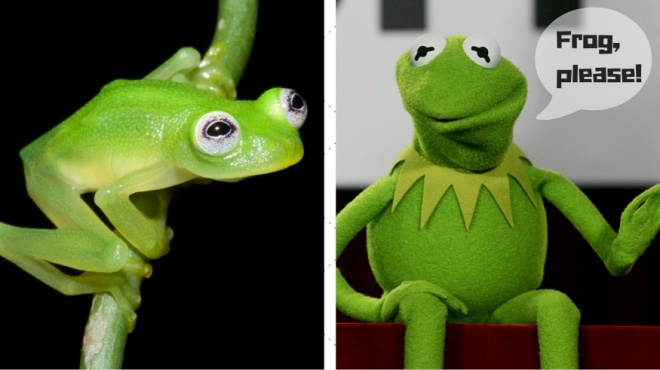
You thought Kermit the Frog was the cutest? Look at this little guy’s eye-popping lime-green skin, bulging white eyes, and perfectly shaped black pupils. Kermit may be rich, and he clearly he has better luck with assertive pigs, but this newly discovered glass frog has put the internet into a tizzy with its cuteness.

Brian Kubicki, founder of the Costa Rican Amphibian Research Center, discovered the frog in Costa Rica. He decided to name the tiny amphibian after his mother.

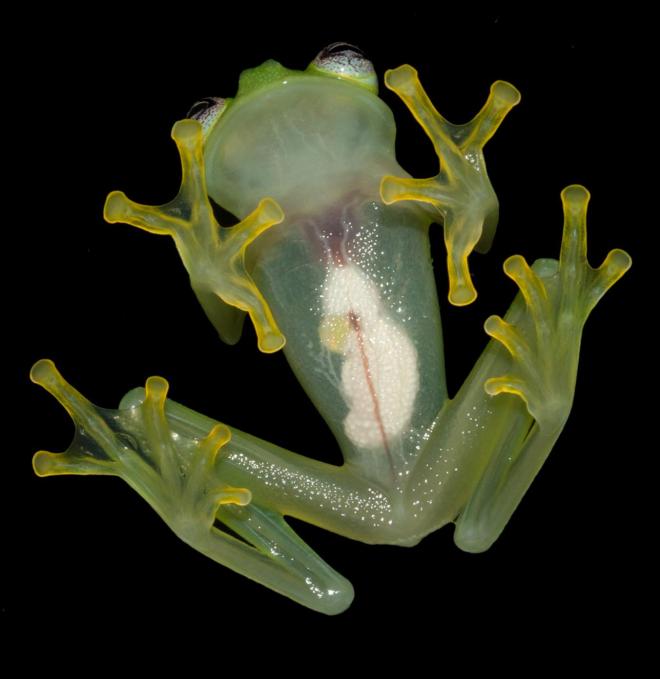
The Diane’s Bare-hearted glass frog (Hyalinobatrachium dianae) has a translucent belly and a very distinctive call. It lets out a high pitched whistle like that of an insect, which may help it find a mate.

Frog, please!

Diane’s Bare-hearted glass frog rocks a see-through underbelly, leaving its organs completely visible! The reason for this lack of pigmentation remains a mystery to scientists.

Somehow this Kermit look-a-like managed for fly under the radar and evade researchers – which could be due to its whistle.

“The advertisement call that the males of this species produce are very unique, no other known species of frog has a similar call, and this was indeed one of the traits that we used for the justification of it being a completely new species,” and it “could have played a role in its going undetected prior,” said Kubicki.

This is the first glass frog discovered in Costa Rica since 1973.

PHOTOGRAPH BY BRIAN KUBICKI, COSTA RICAN AMPHIBIAN RESEARCH CENTER

Glass Frogs – According to National Geographic, ‘Glass frogs, found in Central and South America rain forests, live high in tree canopies near streams and creeks, descending when it’s time to breed. The glass frog’s name originates from its translucent, organ-revealing bellies. Their green coloration, on the other hand, helps the nocturnal frogs stay camouflaged on the undersides of leaves during the day.’

The Diane’s Bare-hearted glass frog is discussed in the February 19 journal Zootaxa.

New Species of See-Through Frog May Give Kermit a Run for His Money!

I Dare You To Ignore These Adoptable Pups Once They Hit The Photo Booth

KS_LOGOs2_PopCultureThe Humane Society of Utah started putting their adoptable dogs in front of the camera and the results are too cute!

Humane Society 1
Ciara the 3 year old Black Mouth Cur mix CREDIT: Humane Society of Utah Facebook

The mastermind behind the photo booth project is photographer Guinnevere Shuster, who is the Social Media Coordinator at the Humane Society.

This campaign puts adoptable dogs in front of the lens, letting them show off their unique personalities. The Humane Society uses their popular Facebook page to constantly post new pics of puppies, and updates those photos once the pup has been happily adopted.

The best part about this new photo booth campaign is that it’s working! According to the Humane Society, the placement rate of dogs has reached a whopping 93.26%.

All the dogs you see below have been adopted! Click through a selection of the dog portraits and enjoy 🙂

This slideshow requires JavaScript.

It’s not all going to the dogs. The Human Society of Utah also has a bunch of adorable cats and other animals to adopt. They make frequent appearances on social media as well.

Humane Society 2
Credit: Humane Society of Utah Facebook


Gallery

Hope You’re Not Afraid of Spiders, Because This Species Can Change Color!

KS Strange ScienceA species of crab spider has the ability to slowly change color based on its background. More specifically, the female whitebanded crab spider changes from white to yellow (and the reverse) to ambush prey when hunting.

The crab spider’s color-changing abilities have been detailed for the first time in a new scientific paper, published this week in the journal Ecological Entomology.

Gary Dodson, a Ball State biology professor, and Alissa Anderson, who graduated with a master’s degree in 2012 from Ball State, were the first to measure the rate of color change in the whitebanded crab spider (Misumenoides formosipes).

‘This species of spider crab is one of the few that can reversibly change their body colour in a manner that to the human eye results in a match to the flowers on which they ambush prey,’ Dodson said. ‘We knew that females, but not males, can switch between white and yellow depending on the background. But we did not how quickly that happened.’

Using Adobe Photoshop, researchers measured the color-changing process of various female whitebanded spider crabs. They discovered that white spiders had a much easier time switching to yellow, versus yellow spiders changing to white. It is possible morphing from white to yellow is less physiologically damaging than the reverse.

FUN FACT: This species of crab spider exhibits one of the most extreme examples of sexual size dimorphism across all animals. Females, which are the size of a ‘fat kernel of corn,’ are 20 times larger in mass than males.

Hope You’re Not Afraid of Spiders, Because This Species Can Change Color!