I’d like to introduce you to two very special amphibians. One gives birth through its mouth, and was brought back from the dead. The other has given me terrifying nightmares since I was a kid. This is mainly due to the fact that it gives birth to live young from its back. Scroll down if you dare.
The Gastric-Brooding Frog
The gastric-brooding frog is famous for two reasons; it gives birth out of its mouth, and it was literally brought back from extinction.
This unique species of frog is native to Queensland in eastern Australia. The female swallows her fertilized eggs and incubates them in her stomach for roughly six weeks. Don’t worry, she doesn’t digest them! Chemicals released by the eggs tells her stomach to stop producing acid and she stops eating. Around 20 to 25 tadpoles hatch inside her and the mucus from their gills continues to keep the acid at bay. Over the next six weeks, as the hatchlings grow and her stomach bloats, mom’s lungs collapse and she is forced to breathe through her skin. She then ‘vomits’ out her fully formed frog babies.
The gastric-brooding frog went extinct in 1983, but researchers in Australia brought it back! Click here to learn more about the “Lazarus Project” and ‘de-extinction’ technology 🙂
Illustration: Bram Keast
The Suriname Toad
Image: sandiegozoo.org
The Suriname sea toad is flat and gives birth out of its back! The female toad’s offspring develop from eggs to frogs underneath her skin. No joke, the video below could actually make me vomit, so I’m just going to leave it below for your creepy viewing pleasure.
This species is famous for its reproductive abilities. The female Suriname toad can carry up to 100 eggs in her back – forming an irregular honeycomb design.
The male toad produces a sharp clicking noise by snapping the hyoid bone in its throat, which attracts a nearby partner. The female rises from the floor –> the male mounts her back –> they begin flipping through the water –> the female releases eggs with each flip –> the male fertilizes them before he helps embed the eggs in her skin.
Once the eggs are implanted, a film forms over them, creating protective pockets (gross). Four months later, the fully grown frogs punch their way through the skin to freedom.
Scientific American shared a list of the top 10 most interesting new species discovered last year. The fascinating list was published by the International Institute for Species Exploration (IISE) at the State University of New York College of Environmental Science and Forestry on May 21. Explore the new creatures below!
CHICKEN FROM HELL Anzu wyliei is a bird like dinosaur that inhabited North American 66 million years ago. Because its relatives are chicken-size and the fossils were discovered at the Hell Creek Formation in South Dakota, A. wyliei received the nickname “chicken from hell.” Its genus name, Anzu, derives from the feathered demon “Anzû” of Babylonian mythology. Illustration by Mark A. Klingler
THE X-PHYLA: Residing on the sea floor off the coast of Australia, Dendrogramma enigmatica is notable for its tiny size and mushroomlike shape. It resembles members of the phyla Cnidaria (jellyfish, corals, sea anemones and hydras) and Ctenophora (comb jellies) but lacks key evolutionary traits of both. Consequently, scientists have proposed that D. enigmatica might be a member of its own new phylum. Photograph by Jørgen Oleson
WALKING STICK Measuring at 23 centimeters long—yes, as long as a human forearm—Phyganistria tamdaoensis is a member of the family of “giant stick” insects, the largest insects in the world. The creature’s stick like body makes it a master of camouflage, which helps explain how it eluded discovery in its habitat in Vietnam—until now. Photograph by Jonathan Brecko
BONE-HOUSE WASP: A wasp found in the Gutianshan National Nature Reserve in eastern China, Deuteragenia ossarium has gained notoriety for its morbid nesting habits. It builds its nests in hollow plant stems made of cells separated by soil walls, with each cell hosting an individual egg. To prepare the nest, it kills and deposits a spider in a cell as food for the larva when it hatches, lays an egg in that cell, then repeats the process for each consecutive cell. The wasp fills the last cell with up to 13 dead ants, which serve as a chemical barrier to the nest by camouflaging it with the odor of decay. Photograph by Merten Ehmig
INDONESIAN FROG: Limnonectes larvaepartus is a small fanged frog found in forests on the island of Sulawesi in Indonesia. It is unique in that the female’s eggs are fertilized internally and she gives birth to live tadpoles. Of the 6,455 known species of frogs, fewer than a dozen undergo internal fertilization. And apart from this new species, all frogs either lay eggs or give birth to froglets. Photograph by Jimmy A. McGuire
WHITE-SPOTTED PUFFERFISH: In 1995 scientists described an underwater phenomenon akin to crop circles on the sea floor off the coast of Japan’s Amami-Oshima Island. Marine exploration led to the discovery that these large geometric designs are actually the nests of a pufferfish known as Torquigener albomaculosus. The fact the culprits who made them eluded scientists for 10 years earned T. albomaculosus a place on the list. Male pufferfish build these intricate nests by wriggling around in the sand on the ocean floor. The nests are intended to attract females and designed to minimize ocean current at the center of the nest to protect the eggs. Photograph by Yoji Okata
CARTWHEELING SPIDER Meet the arachnid world’s top gymnast. Cebrennus rechenbergi is a hunting spider found in the deserts of Morocco. This spider is the only species to “cartwheel,” which allows it to move two times faster than running when escaping from danger. Its unique movement inspired a biomimetic robot that walks and rolls. Photograph by Ingo Rechenberg, Technical University Berlin
SOLITARY BROMELIAD: Tillandsia religiosa, a solitary flowering plant with rose-colored spikes and flat green leaves, grows in rocky terrain in Morelos, Mexico. T. religiosa has long been known to native people of the region, who incorporated it into nacimientos (altar scenes depicting the birth of Christ) at Christmas. Yet scientists have only recently described it. Photograph by A. Espejo
CORAL PLANT: Found only on the southwestern slopes of Mount Mignan in the Philippines, Balanophora coralliformis is an endangered plant that parasitizes the roots of other plants. Its rough, elongated, repeatedly branching, aboveground tubers set it apart from other species of its kind. Photograph by P.B. Pelser & J.F. Barcelona
PHOTOGENIC SEA SLUG: This gastropod, Phyllodesmium acanthorhinum, sports vivid shades of blue, red and gold. Its discovery helped scientists understand the symbiosis that occurs in members of this genus. Algae called zooxanthellae typically exist symbiotically with coral, where they exchange nutrients via cycles of respiration and photosynthesis. In sea slugs a type of tri-species symbiosis occurs when algae residing in a slug’s gut draw nutrients from coral its host consumes, in turn furnishing the slug with the nutrient products of photosynthesis. Photograph by Robert Bolland
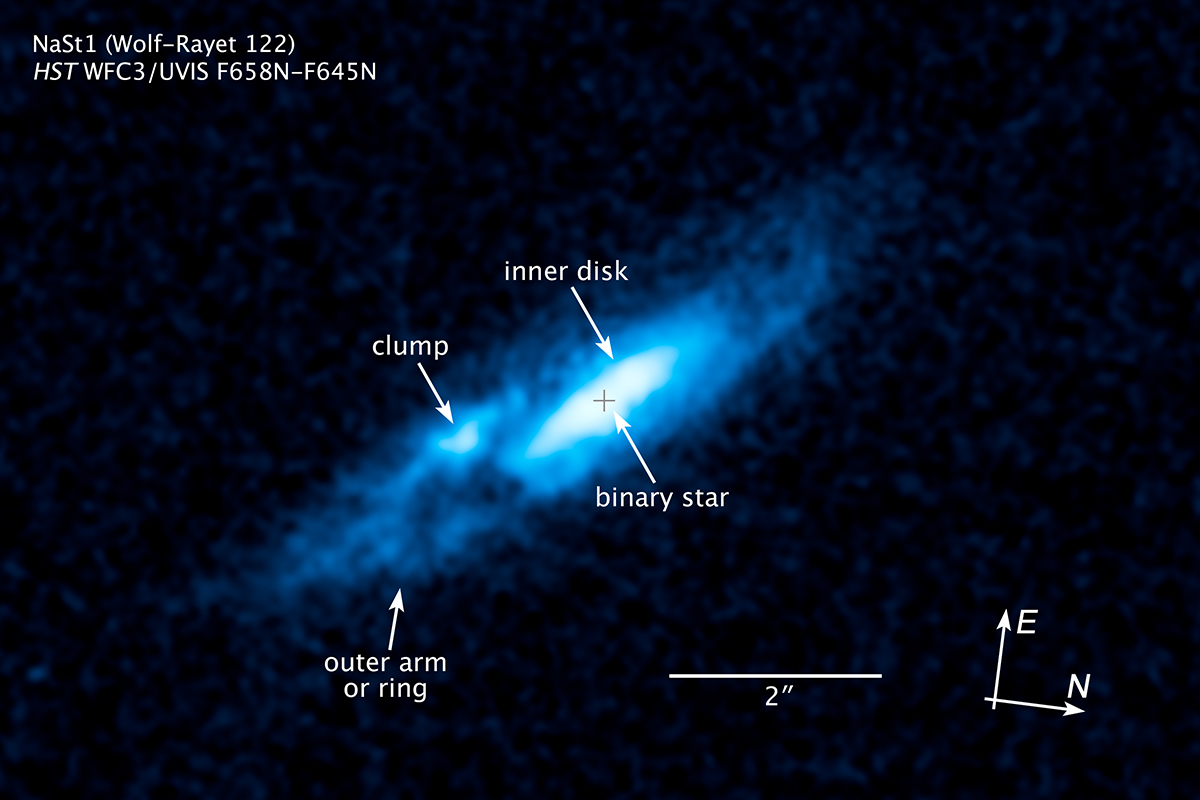
Astonomers using NASA’s Hubble Space Telescope have discovered surprising new information regarding a massive, one-of-a-kind star, whose behavior has never been seen before in our Milky Way galaxy. The star’s new nickname, ‘Nasty 1,’ is a play on its official catalog name, ‘NaSt1’ – because the rapidly aging star is just that weird.
The star’s catalogue name, NaSt1, is derived from the first two letters of each of the two astronomers who discovered it in 1963, Jason Nassau and Charles Stephenson. Credits: NASA/HubbleImage: Hubble Site
Nasty 1 was originally identified as a Wolf-Rayet star when it was first discovered several decades ago. Wolf-Rayet stars are incredibly hot, massive stars (20x larger than our sun) with a high rate of mass loss – some believe they represent a final burst of activity before a huge star begins to die.
The thing is, Nasty 1 doesn’t look like your usual Word-Rayet star. Astronomers expected to see twin lobes of gas flowing from opposite sides of the star. Instead, they saw a pancake shaped disc of gas encircling the star that is nearly 2 trillion miles wide! This disc could be the result of a binary interaction – which there are very few examples of in the galaxy because this phase is so short-lived.
The Team’s Scenario:A massive star evolves very quickly, and as it begins to run out of hydrogen, it swells up. Its outer hydrogen envelope becomes more loosely bound and vulnerable to gravitational stripping, or a type of stellar cannibalism, by a nearby companion star. In that process, the more compact companion star winds up gaining mass, and the original massive star loses its hydrogen envelope, exposing its helium core to become a Wolf-Rayet star.
But the mass transfer process in mammoth binary systems isn’t always efficient. Some of the stripped matter can spill out during the gravitational tussle between the stars, creating a disk around the binary.
“That’s what we think is happening in Nasty 1,” Mauerhan said. “We think there is a Wolf-Rayet star buried inside the nebula, and we think the nebula is being created by this mass-transfer process. So this type of sloppy stellar cannibalism actually makes Nasty 1 a rather fitting nickname… what evolutionary path the star will take is uncertain, but it will definitely not be boring”
The team’s results will appear May 21 in the online edition of the Monthly Notices of the Royal Astronomical Society.
It looks and feels human. It’s even made of salt, water, and fiber – just like you and me. But, this incredible replica of the human body isn’t human; it’s SynDaver Lab’s synthetic human patient.
Human cadavers can cost up to $10,000, and that doesn’t take into account transportation and disposal fees, as well as the need for specialized storage facilities and trained staff. Plus, you can only use them once! The SynDaver ultra-realistic human is meant to be educational and reusable.
According to their official website, The SynDaver Synthetic Human is ‘the most elaborate and sophisticated full-body surgical simulator ever devised. An exquisite 3D jigsaw puzzle; every muscle, bone, vascular component and organ is removable and replaceable.’
This synthetic human can be used in the medical industry to replace live animals, human cadavers, and even human patients – mainly for trauma training, sugerical training, and medical device development.
‘It is obviously good not only for ethical reasons, but also because avoiding animal use saves a great deal of time and money,’ said SynDaver Labs founder Dr Sakezles. ‘So, I started designing synthetic organs to test devices and over time they became very elaborate.’
This slideshow requires JavaScript.
How much does all of this cost?
The SynDaver Anatomy “base model,” which has all of the organs, muscles and bones a human cadaver has, sells for $25,000 and is used worldwide at hospitals with simulators and at universities and community colleges teaching anatomy.
The SynDaver Patient is the newest addition to the SynDaver Synthetic Human (SSH) product line. In addition to all of the existing features that have made the Synthetic Human world-famous, the SynDaver Patient also includes an open-source physiology engine that controls body motions and all aspects of synthetic biology.
The SynDaver Patient can be used for practicing ultrasound, fluoroscopy, X-ray and CT imaging, along with surgical procedures involving tools such as lasers, plasma knives and sonic blades. According to GizMag, it’s available now, for $85,000.
Later this year, the company should be releasing a Basic version of its existing Synthetic Human – the latter model not only features full human anatomy, but also functioning circulatory and respiratory systems – along with Preemie and Newborn models. All three should be priced at about $15,000.
Even the ‘Product Description’ on the website gave me chills!
Product Description
SynDaver synthetic tissues have been validated over the last two decade to simulate the mechanical and physico-chemical properties of live tissue. With this technology, our products have created an entirely new field known as live tissue replacement. The SSH is capable of standing in for a human cadaver in medical procedure training but unlike a cadaver, the SSH can last forever.
Features
The model pumps heated synthetic blood (pulsed flow away from the heart and drainage toward the heart) and can be used to simulate procedures with ventilation, insufflation and intubation.
Anatomical attributes include:
Skin with fat and fascia planes (Optional)
Every bone, muscle, tendon and ligament
Fully articulating joints
Functioning respiratory system
Complete digestive and urinary tracts
Visceral and reproductive organs
Circulatory system
Muscles, bones, organs and vasculature are all removable and replaceable to allow onsite servicing and upgrades.
Customization
A variety of pathologies and injuries are available based on patient images, CAD drawings or simple descriptions. Client may also select gender and skin tone.
Included Services
Onsite installation and training, one full year of anatomy and tissue upgrades and a three-year warranty. Annual service contracts covering every aspect of the body are also available.
Imaging Equipment
Compatible with all known imaging techniques including MRI, CT, fluoroscopy and ultrasound.
Surgical Equipment
System is compatible with all known surgical devices including lasers, RF ablation, plasma knives, sonic blades and cryocatheters as well as bipolar, monopolar and harmonic devices.
System Components
Full body with storage and display container, stainless-steel table, deluxe battery-powered heart pump and all required plumbing. The model may be skinless or covered with either the standard SynDaver synthetic human skin (pure wet chemistry) or our new organosilicate-synthetic human hybrid skin (polymer outer – wet inner).
Shark Tank Let Down
SynDaver Labs was awarded a $3 million dollar deal on ABC’s Shark Tank, but unfortunately the deal fell through.
Dr. Christopher Sakezles accepted the deal last week from investor Robert Herjavec in an episode of the hit show. The agreement would have given Herjavec 25 percent equity and equal board representation.
Erin McLean, vice president of marketing for the Herjavec Group, said she could not comment on a deal that hadn’t closed. “We were not able to progress through our due diligence process,” she said, “but we wish them well.”
Dr. Sakezles views this not as a setback, but as an opportunity. “With the exposure that we’ve recently received, we’re looking at much more lucrative opportunities with other investors,” he said.
Click below to see the full video of SynDaver Labs on Shark Tank.
I have to admit, I’m a bit terrified of deep sea creatures. I mean, 95% of the ocean floor remains unexplored. That is A LOT of room for giant squid to roam. Lucky for me, NOAA decided to explore the waters off of Puerto Rico in search of the deep sea life that haunts my dreams.
From April 9 to April 30, 2015, NOAA Ship Okeanos Explorer explored largely uncharted deep-sea ecosystems and seafloor in the vicinity of Puerto Rico and the U.S. Virgin Islands. What they found – using state of the art technology – will amaze you!
Quartz posted this incredible video to their Facebook page, using footage gathered from NOAA. Some of these creatures are so new – they don’t even have names.
Océano Profundo 2015
Legs 1 and 2 of the mission focused on mapping the seafloor where primarily only low-resolution satellite or topographic data existed previously. Leg 3 of the expedition featured some of the deepest remotely operated vehicle (ROV) dives ever conducted in the region and collected critical deep-water environmental data that will improve ecosystem understanding and inform federal and local resource managers.
Why Puerto Rico?
According to NOAA, a diversity of seafloor features lie just offshore Puerto Rico and the U.S. Virgin Islands that include trenches, seamounts, numerous submarine canyons, valleys, and troughs. These features likely contain valuable and vulnerable ocean resources, but very little is known about them, making this an important area to survey.
It is crucial to explore this area for several reasons:
It is tectonically active, with seismic hazards
It includes a large section of U.S. Exclusive Economic Zone
One of the major fisheries in the area is deepwater snapper, but little is known about snapper populations there
It is of potential interest for marine protected area managers, those creating ocean usage planning maps, and sanctuary managers
Mission map showing the operating areas, with priority areas outlined in black, for Leg 3 of Océano Profundo 2015: Exploring Puerto Rico’s Seamounts, Trenches, and Troughs. Map created with ESRI ArcMap software and data displayed is provided by ESRI, Delorme, GEBCO, USGS, NOAA NGDC, and other contributors. Image courtesy of NOAA Okeanos Explorer Program.
Communication Technology
NOAA did a fantastic job of documenting their journey, allowing scientists and the public access to mission logs, daily reports, photos, video, and live underwater video feeds.
During the dives, Okeanos Explorer’s two-body ROV system continuously captured high-definition video, which the ship transmitted to the Office of Ocean Exploration and Research’s website, www.oceanexplorer.noaa.gov, where anyone could follow along in near-real time!
NOAA Ship Okeanos Explorer uses telepresence technology to transmit data in real-time to a shore-based hub where the video is then transmitted to a number of Exploration Command Centers located around the country as well as to any internet enabled device. Access to the video and a suite of Internet-based collaboration tools allow scientists on shore to join the operation in real-time and allows the general public to follow along with the expedition. Image courtesy of the NOAA Okeanos Explorer Program.
Okeanos Explorer
NOAA Ship Okeanos Explorer, “America’s Ship for Ocean Exploration,” is the only federally funded U.S. ship assigned to systematically explore our largely unknown ocean for the purpose of discovery and the advancement of knowledge. Telepresence, using real-time broadband satellite communications, connects the ship and its discoveries live with audiences ashore. Visit the NOAA Marine Operations Center Okeanos Explorer page for operations and crew information 🙂
Bombardier beetles are famous in the insect world, not because they have colorfully patterned wings or a nasty bite, but because they have a very unique defense mechanism: When disturbed or attacked, the beetles produce an internal chemical explosion in their abdomen and then expel a jet of boiling, irritating liquid toward their attackers.
Photo: Charles Hedgcock
The liquid they eject is called benzoquinone, and they heat it to the temperature of boiling water before they shoot it out in an intense, pulsating jet. They are not the only insect to use this liquid, but they are the only ones to make it steaming hot. Not only that, they are the only ones to emit a pulsating stream, forcing out the liquid with unique precision five times faster!
Researchers were baffled as to how these beetles could produce this spray without causing themselves any physical damage. But, the question has now been answered! Researchers at MIT used high-speed synchrotron X-ray imaging to look inside the abdomens of living bombardier beetles during their chemical explosions. Check out the video below to see the X-ray footage in action!
The key is that they synthesize the chemical at the instant of use, mixing two chemical precursors in a protective chamber in their hindquarters. As the materials combine to form the irritant, they also give off intense heat that brings the liquid almost to the boiling point — and, in the process, generates the pressure needed to expel it in a jet.
The findings are published this week in the journal Science by MIT graduate student Eric Arndt, professor of materials science and engineering Christine Ortiz, Wah-Keat Lee of Brookhaven National Laboratory, and Wendy Moore of the University of Arizona.
Bombardier beetles lives on every continent except Antarctica and have virtually no predators. Sounds like a good life to me 🙂 Spray on, little dudes.
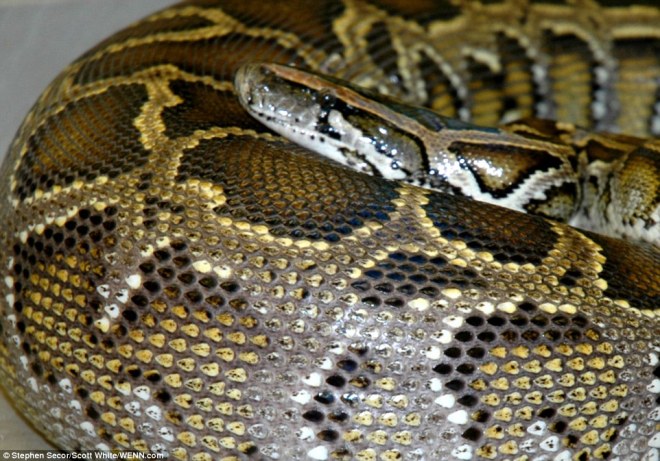
Have you ever wondered what it looks like when snakes digest their prey? As humans, we tend to eat certain parts of animals… while snakes eat and digest whole animals.
Below are a series of X-Ray images that reveal just what happens when a Burmese python swallows an entire alligator.
Burmese pythons are one of the five largest snakes in the world. Their body’s response to eating such large prey is what makes them a model species for digestive physiology. After they ingest their prey, their digestive system goes into hyper-drive. Each meal triggers dramatic increases in metabolism, upregulation of tissue function and tissue growth. Their organs literally supersize themselves!
Dr. Steven Secor, Professor at the University of Alabama, is obsessed with ‘the integrative design of gastrointestinal morphology and function.’ Who isn’t, right? 😉
Dr Secor said: ‘For the Burmese python, native to southeastern Asia, the next meal could range from a monitor lizard or ground-dwelling bird to a prey as formidable as a pangolin, deer or leopard… When it does eventually capture a prey and feed, the python’s previously dormant gut rapidly resumes function to tackle the difficult task of digesting a prey that may exceed half of the python’s own body mass. Upon the completion of digestion, these postprandial responses are thrown into reverse; tissue function is collectively downregulated and tissues undergo atrophy.’
Dr. Secor and his colleagues discovered that the snake’s heart increased by 40%, it’s pancreas increased by 94%, it’s kidney’s increased by 72%, and the reptile’s liver more than doubled in size.
Day 1- Here, you can see the alligator’s snout, torso, legs, and tail, snuggly stuffed in the python’s gut.
Day 2 – The soft tissue is dissolving and the skeleton has begun to break down. The python floods its small intestine with powerful enzymes and acid, while its metabolic rate increases – forty times!
Day 3 – The bones continue to be broken down, it’s scaly skin disappearing. The snake is essentially immobile during such a large meal, making it vulnerable to predators.
Day 4 – Only the hardest parts of the alligator remain as the python begins its final stages of digestion.
Day 5 – Almost finished. The snake must digest quickly before the alligator rots.
Day 6 – Little is left of the alligator. By day 7 the python’s large snack will be completely digested.
“Bonk” author Mary Roach delves into obscure scientific research, some of it centuries old, to make 10 surprising claims about sexual climax, ranging from the bizarre to the hilarious. (This talk is aimed at adults. Viewer discretion advised.)
It has been viewed on TED.com over 15,438,578 times. Mary Roach’s lecture on orgasm is both engaging, humorous, and smart . I learned more than I ever wanted to know about orgasm. You can conceivably, if the conditions are right, give a dead person an orgasm. A DEAD PERSON. Orgasm might cure your hiccups. Oh, and you’ll see a video involving a female pig you wish you could un-see. I highly suggest you take 16 minutes out of your day to watch the whole talk.
Click here for the full transcript and more information about Mary Roach. I’ve typed out the full list below, but trust me, there is much more interesting information in the video!
Ten Things You Didn’t Know About Orgasm
#1 – A fetus can masturbate in utero.
#2 – You don’t need genitals.
#3 – You can have them when you’re dead.
#4 – They can cause bad breath.
#5 – They can cure hiccups.
#6 – Doctors once prescribed them for fertility.
#7 – Pig farmers still do.
#8 – Female animals are having more fun than you think.
#9 – Studying human orgasm in a lab is not easy.
#10 – But it sure is entertaining.
Kinsey conducted, for lack of a better term, jerk-off in which he lined men up next to each other and had them ejaculate in order to study how far semen can shoot.
Her name is Rambo, she lives in New Zealand, she takes pictures, and, oh yeah… she is an octopus! In a new viral video released by Sony, you can see Rambo in action, snapping pics of excited guests in exchange for treats – using Sony’s underwater Cyber Shot TX30 camera.
Rambo, who was given the name based on the amount of destruction she caused the first few camera set-ups, lives at the Kelly Tarlton’s Sea Life Aquarium in Auckland. Rambo may be the world’s first professional ‘octographer,’ given the fact each photo costs $1.50 a pop!
The truth is, octopuses are highly intelligent. They open jars, make daring escapes from their tanks, and even dismantle high tech equipment! Click here to watch an octopus break apart a camera.
Mark Vette, Rambo’s trainer, told Cult of Mac, “When we first tried to get her to take a photo, it only took three attempts for her to understand the process. That’s faster than a dog… Actually, it’s faster than a human in some instances.”
Octopuses learn quickly and are highly motivated by food. Rambo was first taught to respond to a buzzer – which meant snack time. Then Vette had to teach her the buzzer meant to take a picture, which resulted in food.
Vette told NPR the hard part wasn’t training Rambo to shoot pictures; the hard part was creating an underwater set-up for the tank that the curious cephalopod wouldn’t destroy.
He told NPR, “She took the camera, ripped it off its hinges, ripped it off everything, smashed it to bits and spat it out.” Hence the name Rambo 🙂
Screenshot: Krystian Science
How Does the Octopus Seamlessly Co-ordinate Its Eight Arms?
Good thing octopuses don’t dance, because according to a new study, they have no rhythm.
Scientists found that the octopus moves by shortening and elongating its arms, which creates a pushing thrust. The animal does not move by bending or pulling its arms, as previously thought.
Octopuses have bilateral body symmetry, which means their left side is a mirror image of their right. Most bilateral-symmetric animals face forward when they are moving (except the crab, which walks sideways.) But, octopuses can move in ANY direction without needing to turn their bodies. They just push off a surface and propel themselves wherever they’d like.
“So the octopus only has to decide which arm to use for the pushing – it doesn’t need to decide which direction this arm will push,” explained Dr Levy. “[It has] found a very simple solution to a potentially complicated problem – it just has to pick which arm to recruit.”
While, the octopus clearly has some rad moves, researchers have not been able to spot a pattern, or rhythm to their movement. Levy believes there either is no pattern to discover, or their movement is too complicated for the studies they conducted.
The findings are published in the journal Current Biology.
Push-pull: The footage, captured by Dr Guy Levy, reveals how each arm moves the animal in a particular direction
A species of crab spider has the ability to slowly change color based on its background. More specifically, the female whitebanded crab spider changes from white to yellow (and the reverse) to ambush prey when hunting.
Credit: Ball State University
Credit: Prince William Conservation Alliance
Flickr: JasonMiles
Flickr: TGIQ
Credit: Carolina Nature
The crab spider’s color-changing abilities have been detailed for the first time in a new scientific paper, published this week in the journal Ecological Entomology.
Gary Dodson, a Ball State biology professor, and Alissa Anderson, who graduated with a master’s degree in 2012 from Ball State, were the first to measure the rate of color change in the whitebanded crab spider (Misumenoides formosipes).
‘This species of spider crab is one of the few that can reversibly change their body colour in a manner that to the human eye results in a match to the flowers on which they ambush prey,’ Dodson said. ‘We knew that females, but not males, can switch between white and yellow depending on the background. But we did not how quickly that happened.’
Using Adobe Photoshop, researchers measured the color-changing process of various female whitebanded spider crabs. They discovered that white spiders had a much easier time switching to yellow, versus yellow spiders changing to white. It is possible morphing from white to yellow is less physiologically damaging than the reverse.
FUN FACT: This species of crab spider exhibits one of the most extreme examples of sexual size dimorphism across all animals. Females, which are the size of a ‘fat kernel of corn,’ are 20 times larger in mass than males.
 I’d like to introduce you to two very special amphibians. One gives birth through its mouth, and was brought back from the dead. The other has given me terrifying nightmares since I was a kid. This is mainly due to the fact that it gives birth to live young from its back. Scroll down if you dare.


 Astonomers using NASA’s Hubble Space Telescope have discovered surprising new information regarding a massive, one-of-a-kind star, whose behavior has never been seen before in our Milky Way galaxy. The star’s new nickname, ‘








 Krystian Science