
science
Japanese Distillery Sends Delicious Whiskey to Space to Age in Zero Gravity
 It’s a good thing I’m not a trusted astronaut aboard the International Space Station, because instead of conducting important experiments and exploring our universe I’d probably be the first person to get drunk in space. Japanese distillery Suntory announced it’s shipping booze to Kibo, Japan’s module on the ISS – you know… for science.

Suntory’s award-winning whiskey will be off limits to astronauts, the group is just curious how zero gravity might effect the aging process.
H-II Transfer Vehicle No. 5, commonly known as “Kounotori5” or HTV5, launched from JAXA’s Tanegashima Space Center on August 19 carrying alcohol produced by Suntory to the ISS, where experiments on the “development of mellowness” will be conducted. Suntory hopes to find a scientific explanation for what ‘mellows’ alcohol over time.
A company spokesman said that the samples will include both a 21-year-old single malt whiskey (YUM) and a beverage that has just been distilled. The first samples will return to Earth after one year, while the other group of samples will remain in space for at least two years.
Do you want to get your hands on space-aged whiskey? Me too… but, Suntory says they have no plans to make the unique specimens available for public purchase.

World’s First Two-Headed Neon ‘Toxic’ Sea Slug Discovered in Borneo
 This neon two-faced sea slug might look like something you’d find in a sci-fi movie, but it was just found right here on Earth! 🐛

The nudibranch – a soft-bodied, marine gastropod mollusk – was discovered by a diver and a team of film-makers at Kapalai, a sandbar off the coast of Sabah in eastern Malaysian Borneo.
These slugs are part of the species nembrotha kubaryana, but are commonly known as neon sea slugs due to their bright orange and green pattern – which warns predators of their toxicity.
The two-headed oddity was found by dive master Nash Baiti while making a new film series called ‘Borneo from Below.’ This amazing slug’s alien malformation was most likely caused by a gene mix up or damage from pollution.
Clay Bryce, a nudibranch expert and marine biologist at the Western Australian Museum in Perth said, ‘I have never seen another two headed marine creature like this before and I have spent 10,000 hours underwater chasing nudibranchs.’
Maybe it’s just me, but I think this one-of-a-kind neon slug is pretty cute! 😝


Credit: Caters News Agency

Credit: Caters News Agency

Credit: Caters News Agency

Credit: Caters News Agency
Los Angeles Drops 96 Million ‘Shade Balls’ into the LA Reservoir Turning it into a Massive Ball Pit
 If you asked a 4th grade class how they might solve California’s historic drought crisis, one kid might yell – “turn the water into a Chuck E. Cheese ball pit!” Well, Los Angeles did just that, and the video is pretty fun to watch. Give your inner child a high five and watch the video below. 😎
California is in the middle of its worst drought on record and the Los Angeles Department of Water and Power is doing its part to conserve water. This week, the city finished the final phase of its ‘shade ball’ initiative. LA dropped 96 million plastic black balls onto the surface of its 175 acre water reservoir, which is expected to save them $250 million and prevent the annual loss of over 300 million gallons of water. The shade balls are a cheaper alternative to LA’s other conservation ideas, which included splitting the basin in half or installing massive floating covers.
The LADWP said in a press release, “The small, black plastic balls protect water quality by preventing sunlight-triggered chemical reactions, deterring birds and other wildlife, and protecting water from rain and wind-blown dust.”
The reservoir, located in LADWP’s Van Norman Complex in Sylmar, holds 3.3 billion gallons of water – enough to supply the entire city of Los Angeles with water for three weeks.

The project cost a total of $34.5 million, but, at $0.36 each, the shade balls require no construction, parts, labor or maintenance aside from occasional rotation. They are designed to reduce evaporation, cool the water, and make the reservoir less susceptible to algae, bacterial growth, and chemical reactions.
The shade balls are made of black polyethylene and filled with water so they don’t blow away. According to the manufacturers, the balls should last up to 25 years.
Dr. Brian White, a now-retired LADWP biologist, was the first person to think of using shade balls for water quality. The idea came to him when he learned about the application of “bird balls” in ponds along airfield runways.

CREDIT: Gerd Ludwig, National Geographic

CREDIT: Gerd Ludwig, National Geographic

CREDIT: Gerd Ludwig, National Geographic

CREDIT: Gerd Ludwig, National Geographic

CREDIT: Gerd Ludwig, National Geographic
Crew Members on ISS Make History by Eating Salad: From Lettuce Grown and Prepared in Space!
Three crew members aboard the ISS made history this week when they snacked on a salad grown, harvested, and eaten IN SPACE! 🎉🍃
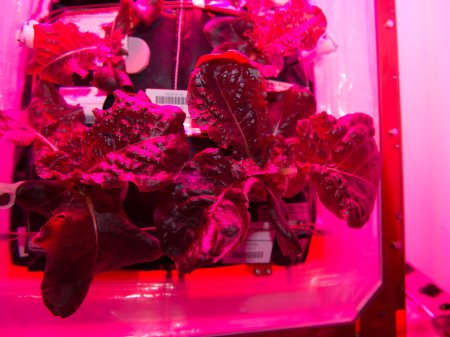
Published August 10th 2015 via YouTube by NASA Johnson – ‘That’s one small bite for a man, one giant leaf for mankind. Fresh food grown in the microgravity environment of space officially is on the menu for the first time for NASA astronauts on the International Space Station. Astronauts Scott Kelly, Kjell Lindgren and Kimiya Yui of Japan sample the fruits of their labor after harvesting a crop of “Outredgeous” red romaine lettuce from the Veggie plant growth system on the International Space Station.‘
SCIENCE VIDEO WRAP UP: Colossal Squid Sighting, Cosmic Photobomb, and Peacock Spiders Dance!
 KSTV WEEKLY SCIENCE WRAP UP
1) Colossal Squid Caught on Camera!
2) The ‘Dark Side’ of the Moon Photobombs Earth
3) New Peacock Spiders Discovered in Australia
4) The Winner of Nat Geo’s Latest Photo Contest
First Known Venomous Frogs Uses Spiky Faces To Deliver Deadly Headbutt
Don’t try to butt heads with these little guys – it just might kill you! The first known venomous frogs have been discovered Brazil. They use small spines on their head, and a vicious head thrash, to inject their potent venom. Yikes! 🐸

Poisonous frogs are nothing new, but ‘truly’ venomous frogs are. Traditionally, venomous creatures bite, sting or stab you to do their damage, while you have to bite or touch poisonous critters to feel their effects. I suppose the venomous variety are a bit more proactive with their toxins. 🐍
“Discovering a truly venomous frog is nothing any of us expected, and finding frogs with skin secretions more venomous than those of the deadly pit vipers of the genus Bothrops was astounding,” co-author Edmund Brodie, Jr., of Utah State University said in a press release.
Brodie and his colleague Carlos Jared of Instituto Butantan in São Paulo, Brazil, study Corythomantis greeningi (Greening’s frog) and Aparasphenodon brunoi (Bruno’s casque-headed frog). Jared learned the frogs were venomous the hard way after a Greening’s frog ‘stung’ his hand, which resulted in excruciating pain that spread up his arm – lasting five hours!
According to NBC News, a single gram of the venom from the more toxic frog species, Aparasphenodon brunoi, could kill more than 300,000 mice, or about 80 humans, while a gram of the venom from Corythomantis greeningi could kill more than 24,000 mice, or about six humans.
The frogs release a white, toxic mucus from glands in their skin when they feel threatened. Then they use the spines on their skull to drive the toxins into its enemy’s flesh. No thanks…

Bruno’s casque-headed frog. Credit: Carlos Jared/Butantan Institute

The skull of Greening’s frog. Credit: Carlos Jared/Butantan Institute

Corythomantis greeningi frogs carry potent venom. Credit: Carlos Jared
The “Dark Side” of the Moon Photobombs Earth From One Million Miles Away

It’s not often you get to see the fully illuminated “dark side” of the moon – but, thanks to a NASA camera aboard the Deep Space Climate Observatory (DSCOVR) satellite, we received a unique view of the moon as it moved in front of the sunlit side of Earth last month. SO cool!
The animation below features actual satellite images of the far side of the moon, illuminated by the sun, as it crosses between the DSCOVR spacecraft’s Earth Polychromatic Imaging Camera (EPIC) and telescope, and the Earth – one million miles away.
EPIC’s job is to constantly monitor the fully illuminated Earth as it rotates. It provides observations of vegetation, cloud height, ozone, and aerosols in the atmosphere. Once EPIC begins regular observations next month, NASA will post daily color images of Earth to a dedicated public website. 🌍
These images were taken between 3:50 p.m. and 8:45 p.m. EDT on July 16, showing the moon moving over the Pacific Ocean near North America. The North Pole is in the upper left corner of the image, reflecting the orbital tilt of Earth from the vantage point of the spacecraft.

DSCOVR is a partnership between NASA, NOAA and the U.S. Air Force. For more information visit: http://www.nesdis.noaa.gov/DSCOVR
Humpback Whales, Camel Racing, and a Sauna in the Sky: View the Winners of National Geographic’s 2015 Traveler Photo Contest
The winners of the 27th annual National Geographic Traveler Photo Contest have just been announced! 🎉
First place went to Anuar Patjane for his photo of divers swimming with a humpback whale and her newborn calf off the coast of Mexico. He won an eight-day photo expedition for two to Costa Rica and the Panama Canal. Not a bad deal!
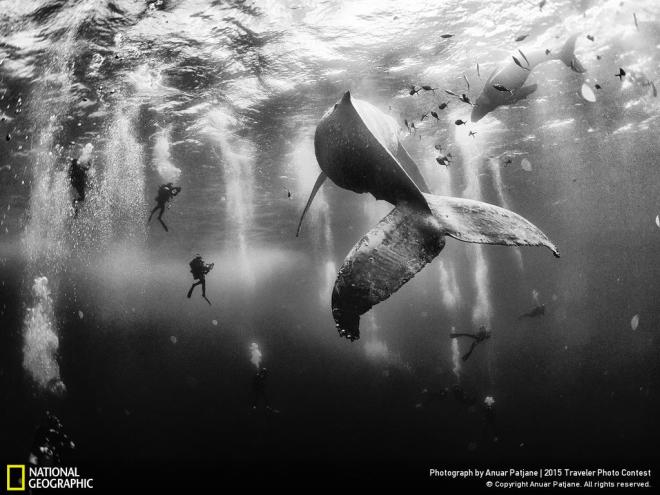
The 2015 Traveler Photo Contest judges reviewed nearly 18,000 photographs, and ten pictures won top prizes. Photographers entered pictures into four categories: Travel Portraits, Outdoor Scenes, Sense of Place, and Spontaneous Moments. You can view the top ten below – click here to browse all of the entries and pick your favorites!

2) [This] gravel-crush working place remains full of dust and sand. Three gravel workmen are looking through the window glass at their working place. Chittagong, Bangladesh. Photo and caption by faisal azim

3) Camel Ardah, as it [is] called in Oman, is one of the traditional styles of camel racing … between two camels controlled by expert men. Photo and caption by Ahmed Al Toqi

4) A sauna at 2,800 meters high in the heart of Dolomites. Monte Lagazuoi, Cortina, eastern Italian Alps. Photo and caption by Stefano Zardini

5) Romania, land of fairy tales. White frost over Pestera village. Photo and caption by Eduard Gutescu

6) The night before returning to Windhoek, we spent several hours at Deadvlei. The moon was bright enough to illuminate the sand dunes in the distance, but the skies were still dark enough to clearly see the Milky Way and Magellanic Clouds. Photo and caption by Beth McCarley

7) The night before this photo, we tried all day to get a good photo of the endangered white rhino. Skulking through the grass carefully, trying to stay 30 feet away to be safe, didn’t provide me the photo I was hoping for. In the morning, however, I woke up to all three rhinos grazing in front of me. Ziwa Rhino Sanctuary, Uganda. Photo and caption by Stefane Berube

8) Kushti is the traditional form of Indian wrestling. Wearing only a well-adjusted loincloth (langot), wrestlers (pelwhans) enter a pit made of clay, often mixed with salt, lemon, and ghee (clarified butter). Photo and caption by alain schroeder

9) Two boys are trying to catch a duck at the stream of the waterfall. Nong Khai Province, Thailand. Photo and caption by sarah wouters

10) Traditional haymaking in Poland. Many people continue to use the scythe and pitchfork to sort the hay. Photo and caption by Bartłomiej Jurecki
NASA’s Newest Robot Prepares to Build Largest Composite Rocket Parts Ever Made

NASA’s Marshall Space Flight Center in Huntsville, Alabama, just received a very sophisticated tape dispenser. The latest addition to Marshall’s Composites Technology Center is one of the largest composites manufacturing robots created in America. It will help NASA build the biggest, lightweight composite parts ever made for space vehicles.

According to NASA, composites are the materials of the future for aerospace because they are lighter and cheaper than traditional materials, like metals.
“Marshall has been investing in composites for a long time,” said Preston Jones, deputy director of Marshall’s Engineering Directorate. “This addition to Marshall’s Composites Technology Center provides modern technology to develop low-cost and high-speed manufacturing processes for making large composite rocket structures. We will build and test these structures to determine if they are a good fit for space vehicles that will carry humans on exploration missions to Mars and other places.”
Lightweight composites have the potential to increase the amount of payload that can be carried by a rocket – the lighter the rocket, the more crew, food, equipment, and science instruments the rocket can ferry into space. NASA is doing research to determine whether composites can be part of their new Space Launch System and other exploration spacecraft, such as rovers and landers.
In order to make large composite structures, the robot travels down a 40-foot-long track, placing carbon fibers onto a tooling surface in precise patterns. The head at the end of its 21-foot robot arm holds up to 16 spools of carbon fibers that are as thin as human hairs! The robot will build structures larger than 26 feet (8 meters) in diameter, which are some of the largest composite structures ever built for space.
Click the video below to see the new robotic system in action. 🚀
 Krystian Science