Crazy X-Ray Images Show Python Digesting an Alligator Whole – And it Only Took 7 Days!

KS Strange Science

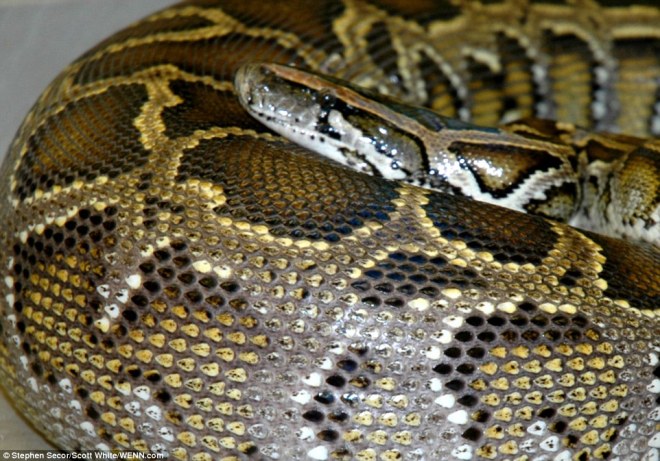
Have you ever wondered what it looks like when snakes digest their prey? As humans, we tend to eat certain parts of animals… while snakes eat and digest whole animals.

Below are a series of X-Ray images that reveal just what happens when a Burmese python swallows an entire alligator.

Burmese pythons are one of the five largest snakes in the world. Their body’s response to eating such large prey is what makes them a model species for digestive physiology. After they ingest their prey, their digestive system goes into hyper-drive. Each meal triggers dramatic increases in metabolism, upregulation of tissue function and tissue growth. Their organs literally supersize themselves!

Dr. Steven Secor, Professor at the University of Alabama, is obsessed with ‘the integrative design of gastrointestinal morphology and function.’ Who isn’t, right? 😉

Dr Secor said: ‘For the Burmese python, native to southeastern Asia, the next meal could range from a monitor lizard or ground-dwelling bird to a prey as formidable as a pangolin, deer or leopard… When it does eventually capture a prey and feed, the python’s previously dormant gut rapidly resumes function to tackle the difficult task of digesting a prey that may exceed half of the python’s own body mass. Upon the completion of digestion, these postprandial responses are thrown into reverse; tissue function is collectively downregulated and tissues undergo atrophy.’

Dr. Secor and his colleagues discovered that the snake’s heart increased by 40%, it’s pancreas increased by 94%, it’s kidney’s increased by 72%, and the reptile’s liver more than doubled in size.

Want more information? Check out Dr. Stephen Secor’s 2008 submission to the Journal of Experimental Biology.

Day 1- Here, you can see the alligator’s snout, torso, legs, and tail, snuggly stuffed in the python’s gut.

281794D400000578-3058837-Day_1_Scientists_have_taken_x_ray_images_of_a_python_as_it_diges-m-32_1430216606865

Day 2 – The soft tissue is dissolving and the skeleton has begun to break down. The python floods its small intestine with powerful enzymes and acid, while its metabolic rate increases – forty times!

281794DD00000578-3058837-Day_2_The_soft_tissue_has_been_dissolved_away_and_the_skeleton_i-m-33_1430216616579

Day 3 – The bones continue to be broken down, it’s scaly skin disappearing. The snake is essentially immobile during such a large meal, making it vulnerable to predators.

281794FB00000578-3058837-Day_3_The_bones_and_scaly_skin_of_the_alligator_are_now_being_di-m-34_1430216625446

Day 4 – Only the hardest parts of the alligator remain as the python begins its final stages of digestion.

2817963800000578-3058837-Day_4_Only_the_hardest_parts_of_the_alligator_remain_and_they_pa-m-37_1430216645826

Day 5 – Almost finished. The snake must digest quickly before the alligator rots.

281794EE00000578-3058837-Day_5_Just_a_few_fragments_of_the_large_meal_remain_The_python_h-a-39_1430216668708

Day 6 – Little is left of the alligator. By day 7 the python’s large snack will be completely digested. 

2817950C00000578-3058837-image-a-41_1430216976530

Day 7 – ALL GONE! Nom nom nom.

2817959B00000578-3058837-Burmease_Python_s-a-28_1430216491902

Image

I Dare You To Ignore These Adoptable Pups Once They Hit The Photo Booth

KS_LOGOs2_PopCultureThe Humane Society of Utah started putting their adoptable dogs in front of the camera and the results are too cute!

Humane Society 1
Ciara the 3 year old Black Mouth Cur mix CREDIT: Humane Society of Utah Facebook

The mastermind behind the photo booth project is photographer Guinnevere Shuster, who is the Social Media Coordinator at the Humane Society.

This campaign puts adoptable dogs in front of the lens, letting them show off their unique personalities. The Humane Society uses their popular Facebook page to constantly post new pics of puppies, and updates those photos once the pup has been happily adopted.

The best part about this new photo booth campaign is that it’s working! According to the Humane Society, the placement rate of dogs has reached a whopping 93.26%.

All the dogs you see below have been adopted! Click through a selection of the dog portraits and enjoy 🙂

This slideshow requires JavaScript.

It’s not all going to the dogs. The Human Society of Utah also has a bunch of adorable cats and other animals to adopt. They make frequent appearances on social media as well.

Humane Society 2
Credit: Humane Society of Utah Facebook


Gallery

Frostbite, Amputation, and Adoption: This Rottweiler Was Given a New Lease on Life with Four Prosthetic Paws

KS Nature

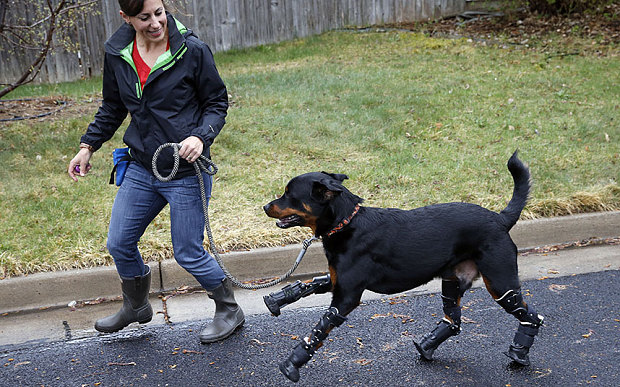
This adorable 2-year-old Rottweiler’s name is Brutus, and he gets around using four specially designed prosthetic paws!

Brutus

Brutus was left out in the freezing cold as a puppy and developed frostbite. His owner decided to amputate all four paws, and eventually gave him up for adoption.

Lucky for Brutus, someone noticed him in a store parking lot in Colorado, where he was looking for a new home. Hundreds of people donated money to give Brutus a new lease on life and four new paws! Brutus’ new owner, Laura Aquilina, says she just wants to give Brutus the gift of being a regular dog.

brutus 2

Felix Deurr, an orthopedics professor at Colorado State University, says prosthetics like Brutus’ have only been around for about 15 years and not all dogs get used to them. A study reviewing their effectiveness is due out later this year.

According to NBC News, Brutus is the second dog in history to receive four prosthetic limbs.

Aquilina says if Brutus doesn’t take to the prosthetics, she will move on without them, but by the looks of this video, Brutus is doing just fine!

Brutus video

Frostbite, Amputation, and Adoption: This Rottweiler Was Given a New Lease on Life with Four Prosthetic Paws

This ‘Punk Rock’ Frog Can Change Its Skin From Spiky To Silky Smooth

KS Strange ScienceWe are familiar with amphibians and reptiles that can change color, but this frog can actually change the texture of its skin! This unique feature makes it the only vertebrate known to do so.

Dubbed the ‘Punk Rocker’ frog, or Pristimantis mutabilis, the marble-sized amphibian lives in the rain forest of Ecuador. It was discovered by scientist Katherine Krynak in 2009. According to National Geographic, Krynak spotted the frog while on a nighttime walk, and decided to bring the thorny specimen back for closer observation. Once she got home, she saw the frog was slimy and smooth, not what she expected! Eventually, the spines reemerged, and Krynak realized she had made an incredible discovery.

Scientists believe the shifting skin texture serves as a form of camouflage in the wild, helping the frog blend into its mossy environment.

PHOTOGRAPHS BY JUAN M. GUAYASAMIN (RIGHT) AND LUCAS BUSTAMANTE (LEFT), THE ZOOLOGICAL JOURNAL OF THE LINNEAN SOCIETY

After 9 years, Krynak and her colleagues finally gathered enough data to prove it was a new species. Now, the frog finally has a formal name: the mutable rainfrog, or Pristimantis mutabilis. But, we’re going to keep calling it the ‘Punk Rocker’ frog 🙂

This ‘Punk Rock’ Frog Can Change Its Skin From Spiky To Silky Smooth

Baby Sloth Bear Birth Sneaks Under the Radar in Germany

KS NatureA baby sloth bear was born at NaturZoo Rheine in Germany in December, but it was kept under wraps so the newborn could bond with its mother in peace.

Little Niko, born to his mother Devi and father Franz, greeted the world on December 6, 2014.

The first few months of a sloth bear’s life are crucial. According to NaturZoo Rheine’s Facebook page, newborn sloth bears are blind, nearly hairless, and about the size of a guinea pig. Niko spent the first few months of his life alone with his mother in a dark, sound-proof room, under the watchful eye of a hidden camera. At that age, his father is kept separate because he is considered a threat to the baby’s health.

Sloth bear births in zoos are very rare and caring for them can be challening. According to NaturZoo Rheine, there are just 25 sloth bears currently living in European zoos.

Niko is just now beginning to explore his outdoor surroundings, so stay tuned to the NaturZoo Rheine Facebook page for updates!

This slideshow requires JavaScript.

Photo: National Geographic

The reclusive sloth bear lives in the forests of South Asia, feeding on fruits, flowers, termites, ants, and other insects. They have special long, curved claws that allow them to dig deep into nest mounds to find food.

These nocturnal animals tend to keep to themselves. They usually rock a shaggy black coat with a cream-colored snout, and their chest is occasionally marked with a light ‘V’ or ‘Y’ design.

Sloth bears can live up to 40 years in the wild and grow to be nearly 300 pounds! Unfortunately, sloth bears are incredibly vulnerable, threatened by habitat loss and sometimes capture.

Fun Fact: Sloth bears carry their cubs on their back! This is considered a unique trait among bears.

Gallery

Science Fix on Netflix: Top 7 Picks to Watch Tonight

KS TechnologyIf you are anything like me, chances are you spend hours streaming on Netflix. So, before you start season 7 of Gilmore Girls, check out these seriously awesome science-y movies and shows available right now! You might even learn something.

#1 – Particle Fever (2013) 1hr39min

‘The creation of the Higgs boson particle, an elusive key to unlocking secrets of the universe, unfolds on camera in this landmark documentary.’

Particle Fever


I got chills the first time I saw the trailer for Particle Fever. I remember hearing these words: “It could be nothing, other than just understanding everything.” Watch these intelligent and fiercely dedicated people explore the unknown and tackle the largest machine every built.

#2 – Brain Games (2011-2013) 2 Seasons

‘This interactive series uses games, illusions and experiments to illustrate how our brains manufacture our reality and often play tricks on us.’

Brain Games

You think you have a firm grasp on reality, but you have no idea. Brain Games is a truly mind-bending show. It reveals a new way to perceive your world with games, tricks, and eye-opening experiments. Fun for the whole family!

#3 – Nature: Snow Monkeys (2014) 53min

‘In Japan’s frigid Shiga Highlands, a troop of snow monkeys functions in a complex society of rank and privilege where each knows its place.’

Nature: Snow Monkeys

This episode of Nature follows a tribe of snow monkeys through central Japan, showing how they keep friends and family close in order to survive. The shots are absolutely breathtaking, and there is nothing more adorable than snow monkeys relaxing in the arctic hot springs.

Side Note: This episode is narrated by Liam Neeson, which is rad! His voice is soothing and engaging. More like Love Actually Liam, not so much Taken, Taken 2, or Taken 3 – or his new movie Run All Night, which might as well be Taken 4.

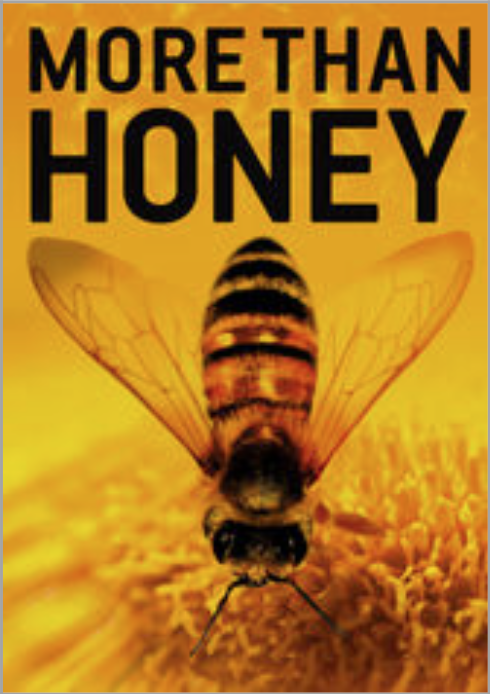
#4 – More Than Honey (2012) 1hr35m

‘Already hailed as a definitive work on the subject, this comprehensive documentary examines the disappearance of honeybee populations worldwide.’

More Than Honey

Bees are dying all over the world and they say it’s a mystery. 1/3 of our food wouldn’t even exist without bees. This beautiful documentary is slow-paced but it takes a fascinating look at the dynamics of the hive, pollination, diseases, parasites, the business of bees and their disappearance.

#5 – Cosmos: A Spacetime Odyssey (2014) 1 Season

‘Astrophysicist Neil deGrasse Tyson presents new revelations about time and space in this reboot of the original “Cosmos” documentary series.’

Cosmos

Carl Sagan’s original 1980’s TV show Cosmos: A Personal Voyage made scientific documentaries cool. Tyson is willing to take you on a new Cosmos adventure if you follow his strict rules: “Follow the evidence wherever it leads and question everything. Accept these terms and the cosmos is yours.”

Cosmos: A Spacetime Odyssey can be a little cheesy at times, but for the most part, it is educational, visually stimulating and extremely interesting.

Seth MacFarlaneFun Fact: Animator Seth MacFarlane was instrumental in obtaining network funding for Cosmos: A Spacetime Odyssey and also serves as an executive producer. At the time MacFarlane told Tyson, “I’m at a point in my career where I have some disposable income … and I’d like to spend it on something worthwhile.”


#6 – Nature: Love in the Animal Kingdom (2013) 53m

‘Animals compete with everything they’ve got to find and secure a mate. For many, the all-important bonds they share as a couple are what enable the next generation to survive.’

Nature: Love in the Animal Kingdom

Parts of this episode of Nature actually made me uncomfortable, like I shouldn’t be watching. Mainly, the male sea dragon giving birth, the female gorilla creepily flirting with every male in sight, and the young wolves mating just to be ‘painfully’ interrupted by the female’s angry father.

That being said, what makes this episode so great is probably also what made me squirm. You get a very private, inside look at the way these wild animals dance, sing, flirt, and compete in order to find a mate. It’s highly entertaining.

#7 – Mankind: The Story of All of Us (2012) 1 Season

‘This miniseries charts the rise of civilization, from the first flourishing of life in Mesopotamia through the discovery of America.’

Mankind

Josh Brolin narrates this 12-hour mini-series that provides an in-depth look at the evolution of mankind. I think we often overlook just how incredible we are as a species.

Mankind may try to fit too much into the series, and at times it can feel like a high school history lecture, but it’s also informative and fun to watch. Prepare to learn about our earliest ancestors, farming, tools, weapons, man’s best friend, warfare, the plague, and much more!

Science Fix on Netflix: Top 7 Picks to Watch Tonight