Crazy X-Ray Images Show Python Digesting an Alligator Whole – And it Only Took 7 Days!

KS Strange Science

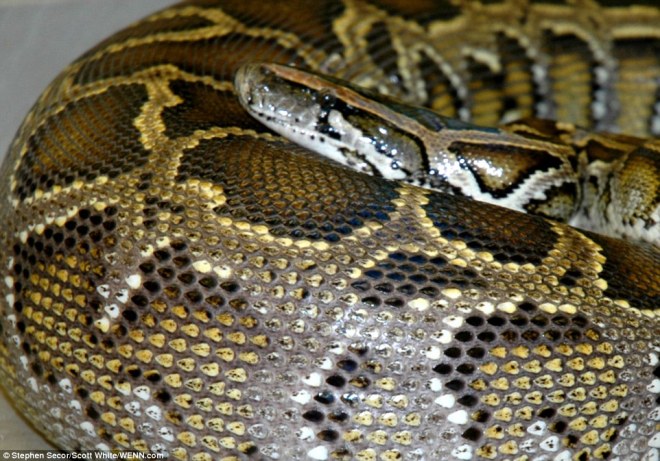
Have you ever wondered what it looks like when snakes digest their prey? As humans, we tend to eat certain parts of animals… while snakes eat and digest whole animals.

Below are a series of X-Ray images that reveal just what happens when a Burmese python swallows an entire alligator.

Burmese pythons are one of the five largest snakes in the world. Their body’s response to eating such large prey is what makes them a model species for digestive physiology. After they ingest their prey, their digestive system goes into hyper-drive. Each meal triggers dramatic increases in metabolism, upregulation of tissue function and tissue growth. Their organs literally supersize themselves!

Dr. Steven Secor, Professor at the University of Alabama, is obsessed with ‘the integrative design of gastrointestinal morphology and function.’ Who isn’t, right? 😉

Dr Secor said: ‘For the Burmese python, native to southeastern Asia, the next meal could range from a monitor lizard or ground-dwelling bird to a prey as formidable as a pangolin, deer or leopard… When it does eventually capture a prey and feed, the python’s previously dormant gut rapidly resumes function to tackle the difficult task of digesting a prey that may exceed half of the python’s own body mass. Upon the completion of digestion, these postprandial responses are thrown into reverse; tissue function is collectively downregulated and tissues undergo atrophy.’

Dr. Secor and his colleagues discovered that the snake’s heart increased by 40%, it’s pancreas increased by 94%, it’s kidney’s increased by 72%, and the reptile’s liver more than doubled in size.

Want more information? Check out Dr. Stephen Secor’s 2008 submission to the Journal of Experimental Biology.

Day 1- Here, you can see the alligator’s snout, torso, legs, and tail, snuggly stuffed in the python’s gut.

281794D400000578-3058837-Day_1_Scientists_have_taken_x_ray_images_of_a_python_as_it_diges-m-32_1430216606865

Day 2 – The soft tissue is dissolving and the skeleton has begun to break down. The python floods its small intestine with powerful enzymes and acid, while its metabolic rate increases – forty times!

281794DD00000578-3058837-Day_2_The_soft_tissue_has_been_dissolved_away_and_the_skeleton_i-m-33_1430216616579

Day 3 – The bones continue to be broken down, it’s scaly skin disappearing. The snake is essentially immobile during such a large meal, making it vulnerable to predators.

281794FB00000578-3058837-Day_3_The_bones_and_scaly_skin_of_the_alligator_are_now_being_di-m-34_1430216625446

Day 4 – Only the hardest parts of the alligator remain as the python begins its final stages of digestion.

2817963800000578-3058837-Day_4_Only_the_hardest_parts_of_the_alligator_remain_and_they_pa-m-37_1430216645826

Day 5 – Almost finished. The snake must digest quickly before the alligator rots.

281794EE00000578-3058837-Day_5_Just_a_few_fragments_of_the_large_meal_remain_The_python_h-a-39_1430216668708

Day 6 – Little is left of the alligator. By day 7 the python’s large snack will be completely digested. 

2817950C00000578-3058837-image-a-41_1430216976530

Day 7 – ALL GONE! Nom nom nom.

2817959B00000578-3058837-Burmease_Python_s-a-28_1430216491902

Image

Rambo the Octopus Knows How to Snap Your Picture – as New Research Reveals How These Creatures Move

KS_LOGOs2_UnderwaterHer name is Rambo, she lives in New Zealand, she takes pictures, and, oh yeah… she is an octopus! In a new viral video released by Sony, you can see Rambo in action, snapping pics of excited guests in exchange for treats – using Sony’s underwater Cyber Shot TX30 camera.

Rambo, who was given the name based on the amount of destruction she caused the first few camera set-ups, lives at the Kelly Tarlton’s Sea Life Aquarium in Auckland. Rambo may be the world’s first professional ‘octographer,’ given the fact each photo costs $1.50 a pop!

The truth is, octopuses are highly intelligent. They open jars, make daring escapes from their tanks, and even dismantle high tech equipment! Click here to watch an octopus break apart a camera.

Mark Vette, Rambo’s trainer, told Cult of Mac, “When we first tried to get her to take a photo, it only took three attempts for her to understand the process. That’s faster than a dog… Actually, it’s faster than a human in some instances.”

Octopuses learn quickly and are highly motivated by food. Rambo was first taught to respond to a buzzer – which meant snack time. Then Vette had to teach her the buzzer meant to take a picture, which resulted in food.

Vette told NPR the hard part wasn’t training Rambo to shoot pictures; the hard part was creating an underwater set-up for the tank that the curious cephalopod wouldn’t destroy.

He told NPR, “She took the camera, ripped it off its hinges, ripped it off everything, smashed it to bits and spat it out.” Hence the name Rambo 🙂


How Does the Octopus Seamlessly Co-ordinate Its Eight Arms?

Good thing octopuses don’t dance, because according to a new study, they have no rhythm.

Researchers from the Hebrew University of Jerusalem used high speed cameras to film octopuses moving around their tank – then analyzed the footage frame-by-frame. What they discovered surprised them.

Scientists found that the octopus moves by shortening and elongating its arms, which creates a pushing thrust. The animal does not move by bending or pulling its arms, as previously thought.

Octopuses have bilateral body symmetry, which means their left side is a mirror image of their right. Most bilateral-symmetric animals face forward when they are moving (except the crab, which walks sideways.) But, octopuses can move in ANY direction without needing to turn their bodies. They just push off a surface and propel themselves wherever they’d like.

“So the octopus only has to decide which arm to use for the pushing – it doesn’t need to decide which direction this arm will push,” explained Dr Levy. “[It has] found a very simple solution to a potentially complicated problem – it just has to pick which arm to recruit.”

While, the octopus clearly has some rad moves, researchers have not been able to spot a pattern, or rhythm to their movement. Levy believes there either is no pattern to discover, or their movement is too complicated for the studies they conducted.

The findings are published in the journal Current Biology.

Push-pull: The footage, captured by Dr Guy Levy, reveals how each arm moves the animal in a particular direction
Video

Hope You’re Not Afraid of Spiders, Because This Species Can Change Color!

KS Strange ScienceA species of crab spider has the ability to slowly change color based on its background. More specifically, the female whitebanded crab spider changes from white to yellow (and the reverse) to ambush prey when hunting.

The crab spider’s color-changing abilities have been detailed for the first time in a new scientific paper, published this week in the journal Ecological Entomology.

Gary Dodson, a Ball State biology professor, and Alissa Anderson, who graduated with a master’s degree in 2012 from Ball State, were the first to measure the rate of color change in the whitebanded crab spider (Misumenoides formosipes).

‘This species of spider crab is one of the few that can reversibly change their body colour in a manner that to the human eye results in a match to the flowers on which they ambush prey,’ Dodson said. ‘We knew that females, but not males, can switch between white and yellow depending on the background. But we did not how quickly that happened.’

Using Adobe Photoshop, researchers measured the color-changing process of various female whitebanded spider crabs. They discovered that white spiders had a much easier time switching to yellow, versus yellow spiders changing to white. It is possible morphing from white to yellow is less physiologically damaging than the reverse.

FUN FACT: This species of crab spider exhibits one of the most extreme examples of sexual size dimorphism across all animals. Females, which are the size of a ‘fat kernel of corn,’ are 20 times larger in mass than males.

Hope You’re Not Afraid of Spiders, Because This Species Can Change Color!

Arkansas Man’s Kidney Failure Likely Linked to His 16-Glass a Day Iced Tea Habit

KS Health

Iced Tea

An Arkansas man went to the hospital last May complaining of nausea, fatigue, weakness, and body aches. After doctors conducted a kidney biopsy, they realized his kidneys were failing due to a high number of oxalate crystals found in the tissue.

Black tea is a significant source of oxalate, which is naturally found in many foods, and the 56-year-old man admitted to drinking 16 glasses of iced tea a day!

Researchers believe his excessive beverage habit could be the cause of his kidney failure, but can’t prove iced tea was the culprit.

“There are reports about kidney stones related to high oxalate intake attributed to tea, but to our knowledge there are no reports of biopsy-proven nephropathy [kidney damage] associated with excessive consumption of iced tea,” said one of the report’s co-authors, Dr. Alejandra Mena-Gutierrez, of the University of Arkansas for Medical Sciences in Little Rock.

Although it can’t be proven that iced tea led to this man’s condition, doctors often put kidney stone patients on low-oxalate diets. Beverages that are considered high-oxalate drinks include black tea, dark beer, instant coffee, and Ovaltine.

Unfortunately, the man needed dialysis, and remained on it because the damage to his kidneys was so severe.

Researchers reported the man’s case in the April 1 New England Journal of Medicine.


Arkansas Man’s Kidney Failure Likely Linked to His 16-Glass a Day Iced Tea Habit

Biohackers Test Eye Drops That Give You NIGHT VISION – And They Look Super Creepy

KS Strange ScienceHave you ever wanted to be recruited by Xavier’s School for Gifted Youngsters? Well, that’s not terribly realistic, but you can totally LOOK like an X-Men!

New night enhancement eyedrops were tested by a group of independent researchers known as Science for the Masses, based in California, with lead researcher Gabriel Licina as their guinea pig.


These liquid black drops are a simple combination of Chlorin e6 (Ce6) and insulin in saline, with the addition of dimethlysulfoxide (DMSO). The drops were based on a patent filed in 2012 that claimed this mixture, when applied to the eye, will absorb to the retina and act to increase vision in low light.

Eyedrop Chemical Breakdown: Ce6 has light amplification properties, and has been used as a therapy agent in cancer treatment. The insulin is used to allow absorption of the Ce6 into the chamber of the eye. DMSO is used in cell preservation and in medication application. In this case, its primary ability is to cause increased permeability of the cellular membrane, allowing free passage for the chemicals in the eye drops to reach the eye.

Licina’s eyes were flushed with saline to remove any micro-debris or contaminants. Then they were actually pinned open to remove the ability to blink. Ce6 was then added to the eye via micropippette. After the drops disappeared he was given special lenses and black sunglasses to ensure increased low light conditions and reduce the potential for bright light exposure.

The drops began to work in as little as one hour, with the effects lasting for many hours afterwards. Licina was able to see more than 164 feet (50 meters) in almost total darkness. And it looks like it didn’t even hurt! Licina told Mic, “To me, it was quick, greenish-black blur across my vision, and then it dissolved into my eyes.”


Nightcrawler - Marvel's X-Men

Licina and four subjects from the control group (people who did not use the drops) were taken to a ‘darkened area’ for testing. Three forms of subjective testing were performed. These consisted of symbol recognition by distance, symbol recognition on varying background colors, and the ability to identify moving subjects.

Turns out, Licina’s special vision allowed him to recognize symbols the control group couldn’t see! The Ce6 drops allowed Licina to identify distant figures 100% of the time, while the control group got it right just 33% of the time.

But, as cool as this experiment sounds, these revolutionary drops have people worried. Increased light amplification may cause damage to the eye if used improperly. Science for the Masses stresses the fact they conducted this experiment for research and informative purposes only. So don’t try this at home.

CLICK HERE to view the full report from Science for the Masses.

Biohackers Test Eye Drops That Give You NIGHT VISION – And They Look Super Creepy

This ‘Punk Rock’ Frog Can Change Its Skin From Spiky To Silky Smooth

KS Strange ScienceWe are familiar with amphibians and reptiles that can change color, but this frog can actually change the texture of its skin! This unique feature makes it the only vertebrate known to do so.

Dubbed the ‘Punk Rocker’ frog, or Pristimantis mutabilis, the marble-sized amphibian lives in the rain forest of Ecuador. It was discovered by scientist Katherine Krynak in 2009. According to National Geographic, Krynak spotted the frog while on a nighttime walk, and decided to bring the thorny specimen back for closer observation. Once she got home, she saw the frog was slimy and smooth, not what she expected! Eventually, the spines reemerged, and Krynak realized she had made an incredible discovery.

Scientists believe the shifting skin texture serves as a form of camouflage in the wild, helping the frog blend into its mossy environment.

PHOTOGRAPHS BY JUAN M. GUAYASAMIN (RIGHT) AND LUCAS BUSTAMANTE (LEFT), THE ZOOLOGICAL JOURNAL OF THE LINNEAN SOCIETY

After 9 years, Krynak and her colleagues finally gathered enough data to prove it was a new species. Now, the frog finally has a formal name: the mutable rainfrog, or Pristimantis mutabilis. But, we’re going to keep calling it the ‘Punk Rocker’ frog 🙂

This ‘Punk Rock’ Frog Can Change Its Skin From Spiky To Silky Smooth