Women in STEM are awesome. For those of you who don’t know, STEM = an acronym referring to the academic disciplines of science, technology, engineering, and mathematics. While most people respect and support women in STEM, there are still a select few who are determined to undermine their smarts and hard work.
One of these people happens to be Nobel Prize-winning biochemist Sir Tim Hunt, who made headlines this week for discussing the ‘problem’ with women in the lab. He allegedly said, “let me tell you about my trouble with girls … three things happen when they are in the lab … You fall in love with them, they fall in love with you and when you criticize them, they cry.”
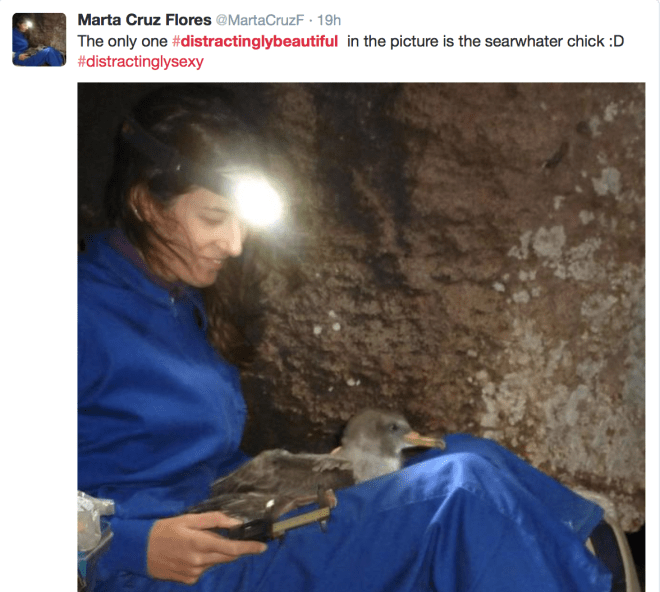
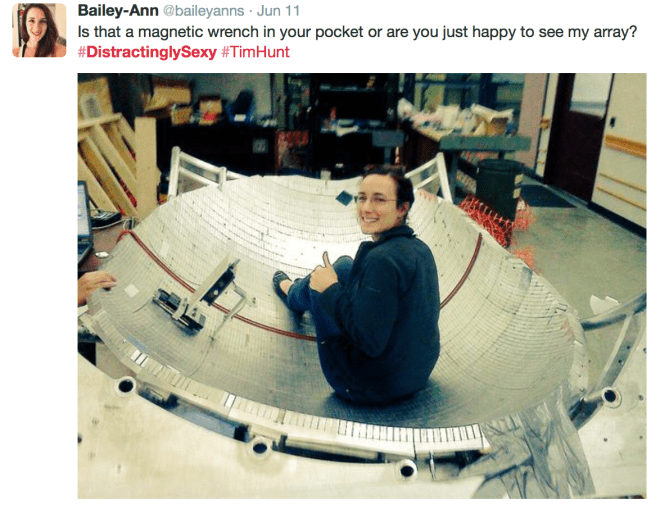
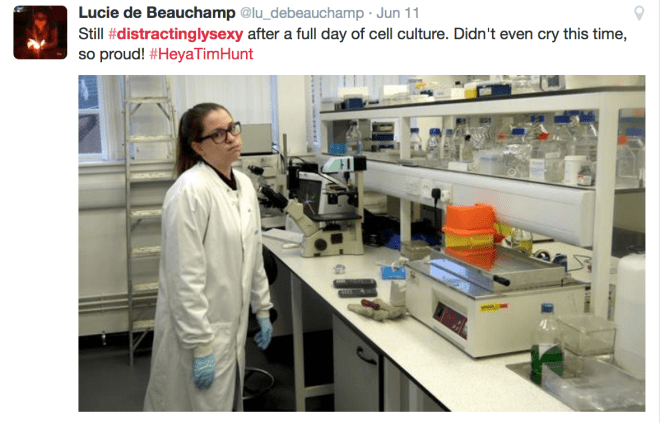
In response, rad lab ladies around the world decided to take to Twitter to share their thoughts about their jobs and the lovely Tim Hunt. The hashtags below have proven to be both enlightening and highly entertaining. I’ve selected a few of my favorites – in no particular order. Enjoy! 👏
A bio-inspired robot is under development at the University of Adelaide that has insect vision. In hopes of improving robot visual systems, researchers have applied the way insects see and track their prey. Insects have this amazing ability to detect and follow small objects against complex backgrounds, which is no easy task.
UNIVERSITY OF ADELAIDE PH.D. STUDENT ZAHRA BAGHERI AND SUPERVISOR PROFESSOR BENJAMIN CAZZOLATO (SCHOOL OF MECHANICAL ENGINEERING) WITH THE ROBOT UNDER DEVELOPMENT. CREDIT: THE UNIVERSITY OF ADELAIDEIn a new paper published in the Journal of The Royal Society Interface, researchers describe how the abilities of both insects and humans can be applied in a model virtual reality simulation, allowing artificial intelligence to literally ‘pursue’ an object. Lead author of the study, Mechanical Engineering PhD Student Zahra Begheri, explains the human connection.
“Consider a cricket or baseball player trying to take a match-winning catch in the outfield. They have seconds or less to spot the ball, track it and predict its path as it comes down against the brightly coloured backdrop of excited fans in the crowd – all while running or even diving towards the point where they predict it will fall… Robotics engineers still dream of providing robots with the combination of sharp eyes, quick reflexes and flexible muscles that allow a budding champion to master this skill,” she said.
Dragonflies have excellent vision, making them the key insect for this project. They have the ability to chase mates or prey in the presence of distractions, like swarms of insects. They can do this despite their low visual acuity and tiny brain. According to Bagheri, the dragonfly chases prey at speeds of up to 60 km/h, capturing them with a success rate of over 97%.
How do you convince a robot to view the world like a dragonfly?
A team of neuroscientists and engineers have developed a unique algorithm to emulate the visual tracking system found in flying insects. Instead of trying to center the target in the robots field of view, this “active vision” system locks on to the background and waits for the target to move against it. This keeps the background from being a big distraction and gives the robot time to adjust its gaze, rotating towards the target, keeping it front and center.
Dr Steven Wiederman, who is leading the project, is currently transferring the algorithm to a hardware platform… a bio-inspired, autonomous robot. DUH DUH DUH!
Each of the Apollo missions that touched down on the Moon planted an American flag in the soil. What if, instead of planting a flag that represented our country, we planted a flag that represented our WORLD? 🌎
Oskar Pernefeldt of the Beckmans College of Design in Stockholm, Sweden, has proposed one simple blue flag to represent all of planet Earth as part of his graduation project.
Here is the symbolic explanation, according to Pernefeldt: “Centered in the flag, seven rings form a flower – a symbol of the life on Earth. The rings are linked to each other, which represents how everything on our planet, directly or indirectly, are linked. The blue field represents water which is essential for life – also as the oceans cover most of our planet’s surface. The flower’s outer rings form a circle which could be seen as a symbol of Earth as a planet and the blue surface could represent the universe.”
Pernefeldt’s flag is designed to represent planet Earth and help remind people that we all share this planet, regardless of national boundaries. I’m in love with this idea! It is part of the reason I love following the International Space Station. The ISS is one of those magical places where multiple nationalities come together to work towards a common goal, no matter what country they call home.
These photos provide a glimpse into the future if Pernefeldt’s vision ever became a reality.
This slideshow requires JavaScript.
Click the video below for a more detailed explanation of how the International Flag of Planet Earth was constructed.
Construction video of The International Flag of Planet Earth.
The video is a part of the graduation project by Oskar Pernefeldt, 2015.
The space community has fully embraced social media and sharing online, which is truly a treat for the world! Day-to-day life on the International Space Station is something very few people get to experience. Plus, the view from up there is simply one-of-a-kind. NASA’s flickr account is updated frequently, pulling from Twitter, Facebook, Instagram, and other internet accounts. I’ve decided to post a few of my favorites in honor of the three space station members set to return to earth in a few days! 🚀
NASA astronaut Terry Virts (left) Commander of Expedition 43 on the International Space Station along with crewmates Russian cosmonaut Anton Shkaplerov (center) and ESA (European Space Agency) astronaut Samantha Cristoforetti on May 6, 2015 perform a checkout of their Russian Soyuz spacesuits in preparation for the journey back to Earth. Credits: NASA
The three ISS crew members pictured above are scheduled to depart the orbiting laboratory on Thursday, June 11, after more than six months in space performing scientific research and technology demonstrations. We will be welcoming back Russian cosmonaut Anton Shkaplerov, NASA astronaut Terry Virts, and my girl crush, Italian born ESA astronaut Samantha Cristoforetti. For a full schedule of their anticipated departure/arrival click here.
NASA Television will air converge of their departure and return to Earth. Coverage begins at 10:40 a.m. EDT Wednesday, June 10, when Expedition 43 Commander Terry Virts of NASA hands over command of the space station to cosmonaut Gennady Padalka of the Russian Federal Space Agency (Roscosmos).
(05/02/2015) — This image of the American upper Midwest and parts of Canada was captured by NASA astronaut Terry Virts on the International Space Station on May 2, 2015. Virts made this comment with the tweet: “It’s great to see the #GreatLakes with no snow”! (Flickr: nasa2explore)
(12/23/2014) — ESA astronaut Samantha Cristoforetti on the International Space Station captured this warm water image of the aquamarine and turquoise waters around the Bahamas down to the central American countries of Honduras and Nicaragua. (Flickr: nasa2explore)
(04/24/2015) — NASA astronaut Scott Kelly on the International Space Station shows off his personal living quarters in space. Scott tweeted this image out with the comment: ” My #bedroom aboard #ISS. All the comforts of #home. Well, most of them. #YearInSpace”. (Flickr: nasa2explore)
(05/31/2015) — Expedition 43 Commander and NASA astronaut Terry Virts is seen here in the International Space Station’s Cupola module, a 360 degree Earth and space viewing platform. The module also contains a robotic workstation for controlling the station’s main robotic arm, Canadarm2, which is used for a variety of operations including the remote grappling of visiting cargo vehicles. (Flickr: nasa2explore)
(05/20/2015) — Earth observation of South America from the International Space Station on May 20, 2015. NASA astronaut Terry Virts tweeted this image with the remark of: “Farm fields in central #Brazil #SouthAmerica”. (Flickr: nasa2explore)
(05/14/2015) — SpaceX’s Dragon cargo capsule is seen here docked to the Earth facing port of the Harmony module. SpaceX’s sixth commercial resupply flight to the International Space Station launched on April 14th and arrived three days later. It will depart with over 3,100 pounds of research samples and equipment and splashdown in the Pacific Ocean on May 21. (Flickr: nasa2explore)
(05/04/2015) — ESA (European Space Agency) astronaut Samantha Cristoforetti glides through supply containers packed onboard the International Space Station. (Flickr: nasa2explore)
(05/08/2015) — This image of Tropical Storm Anna taken from the International Space Station displays the view looking south-southeastward from western Virginia towards storm about 200 miles east of Savannah, Georgia, Bahamas and Florida in the distance. (Flickr: nasa2explore)
(04/09/2015) — NASA astronauts Terry Virts (bottom) and Scott Kelly (top) are seen here inside the Destiny Laboratory performing eye exams as part of ongoing studies into crew vision health. (Flickr: nasa2explore)
(05/29/2015) — This nighttime image from the International Space Station shows the Soyuz TMA-15M which carried NASA astronaut Terry Virts, Russian cosmonaut Anton Shkaplerov and ESA astronaut Samantha Cristoforetti to the station and will return them in early June. (Flickr: nasa2explore)
These newly discovered mini-frogs are so small they barely fit on your fingernail – but, they do come in some flashy colors!
Brachycephalus (Anura: Brachycephalidae) is a remarkable genus of miniaturized frogs that call the Brazilian Atlantic Rainforest home. The first Brachycephalus species was found in 1824, but most of the species have been discovered over the past 15 years.
Brachycephalus leopardus is dark yellow with black spots – looks like its hitting the gym! IMAGE: MARCIO R. PIE, CC BY SA
A new species of Brachycephalus from Brazil IMAGE: LUIZ FERNANDO RIBEIRO, CC BY SA
The seven new species live on seven distinct mountaintops in south eastern Brazil. Their habitats are known as ‘cloud forests.’ Each species is cut off from one another due to dips and valleys with varying climates that act as environmental barriers.
Brachycephalus are a group of frogs known for their bright colors and miniscule size – some are the smallest terrestrial vertebrates on record (less than 1cm). Their tiny frog anatomy has shrunk to their size, but one thing has changed. These amphibians typically have three toes and two fingers, instead of the five toes and four fingers found in most frogs.
Their skin is what sets them apart. They vary in color and texture; some are rough and bumpy, while others are quite smooth. Their bright colors alert predators to the poisonous toxins in their skin. Those with brighter colors often reflect higher levels of the deadly chemical tetrodotoxin.
The severe isolation experienced by these frogs has produced 21 known species of Brachycephalus – and a new study has pushed that count to 28.
Brachycephalus comes in a variety of bright colors IMAGE: MARCIO R. PIE, CC BY SA
Marcio Pie, a professor at the Universidade Federal do Paraná in Brazil, led researchers into the remote misty rainforest in search of these tiny critters. Following extensive fieldwork, treacherous hikes, and hours of sifting through dirt and leaves, they found a surprising seven new species of Brachycephalus!
Marcio Pie’s findings were published June 4 in thejournal PeerJ.
The Center for Science in the Public Interest surveyed the menus of more than 200 restaurant chains in search of high-calorie, high-fat gut bombs. They found the drinks, meals, sides, desserts, and ridiculous combos that are unbearably high in calories, sugar, saturated fat, and sodium. Nine items topped the list – view them below! I’m embarrassed proud to admit one of my top guilty pleasure treats (#2) made the list this year. Eat up 😉
The full list of “winners” was published in the June issue of CSPI’s flagship publication, Nutrition Action Healthletter.
Xtreme Eating 2015 Winners!
‘It’s not easy to win an Xtreme Eating award. For starters, most restaurant meals pack around 1,000 calories, so anything in that neighbor-hood is a yawner. To stand out in the crowd, you’ve got to hit around 2,000 calories—an entire day’s worth of food—even if it’s just dessert.
But our winners have what it takes…a total disregard for the obesity epidemic and the coming diabetes tsunami. Of course, you can’t blame restaurants for that. That would be so unfair.’
#10) Red Lobster’s Lobsterita (890 calories) A 24 oz. Traditional Lobsterita (with its 860 mg of sodium). IMAGE: Instagram – Red Lobster
9) IHOP’s Chorizo Fiesta Omelette (1,300 calories) IHOP’s Chorizo Fiesta Omelette, which is loaded with spicy chorizo sausage, roasted peppers, onions and pepper jack cheese, then topped with a citrus chili sauce and sour cream and served with a fresh grilled serrano pepper…will have you holding your stomach. A 1,300-calorie sausage omelette alone would strike many as a tad on the heavy side. But this one comes with three buttermilk pancakes (or hash browns, toast, or fruit) for MORE added calories! IMAGE: IHOP website
8) Steak ‘n Shake’s 7×7 Steakburger (1,330 calories) The 7X7 Steakburger ‘n Fries (available from midnight to 6 a.m. on the “Up All Night” menu) squeezes seven beef patties between its buns. The 1,330 calories in the burger make the 240 calories in the small side of fries seem puny. But what’s puny about the plate’s 47 grams of sat fat and 4,570 mg of sodium? IMAGE: Steak ‘n Shake website
7) Outback Steakhouse’s 16 oz. Herb Roasted Prime Rib (1,400 calories) The 16 oz. prime rib is 1,400 calories alone. For sides, let’s say you get the dressed baked potato and the classic blue cheese wedge (it’s a “premium side salad,” so it’ll cost you a buck), and that you eat just half the loaf of bread and use just a light schmear of butter. The tab: 2,400 calories, 71 grams of sat fat (31⁄2 days’ worth), and enough sodium (3,560 mg) for today and tomorrow. IMAGE: CSPI website
6) Uno’s 6” Chicago Classic Deep Dish Pizza (1,470 calories) A Chicago Classic Deep Dish Pizza (“a small plate version of their famous Chicago Classic Deep Dish with sausage, mozzarel- la, chunky tomato sauce and romano”). IMAGE: CSPI website
5) The Cheesecake Factory’s Warm Apple Crisp (1,740 calories) Between the apples, “delicious crispy nutty topping,” two scoops of ice cream, small mountain of whipped cream, and caramel sauce, you’re looking at 1,740 calories—more than any cheesecake on the menu. In fact, you can eat TWO slices of the original cheesecake instead. Gross. IMAGE: Cheesecake Factory website
4) Dickey’s Barbecue Pit’s 3 Meat Plate (2,500 calories) With a whole 3 meat plate, including two sides, sweet tea, and a half cup of ice cream in a cone (and no re- fills), your meal comes to roughly 2,500 calories, 49 grams of sat fat and 4,700 mg of sodium (21⁄2 to 3 days’ worth of each), plus 29 teaspoons of (mostly added) sugar. It’s like having three Big Macs with five Vanilla Cones. IMAGE: Twitter – Dickeys
3) Sonic’s Large Pineapple Upside Down Master Blast (2,020 calories) “SONIC’s real, vanilla ice cream perfectly mixed with pineapple, salted caramel & pie crust pieces” comes in a 32 oz. cup topped with several inches of whipped cream. That’s for a large, which fires 2,020 calories at your midsection, and 61 grams (three days’ worth) of sat fat and 41⁄2 grams (two days’ worth) of trans fat (from the pie crust) at your arteries. And it comes with some 29 teaspoons of added sugar. One Master Blast has the calories of roughly four Dairy Queen Banana Splits. IMAGE: Sonic website
2) The Cheesecake Factory’s Louisiana Chicken Pasta (2,370 calories) The Louisiana Chicken Pasta, which weighs an impressive 1.5 pounds, comes topped with four slices of heavily breaded chicken. Add the New Orleans sauce (butter and heavy cream), and your plate is up to 2,370 calories (more than a day’s worth), plus 80 grams of saturated fat (a four-day supply) and 2,370 milligrams of sodium (11⁄2 days’ worth). IMAGE: Cheesecake Factory website
1) Red Lobster’s “Create Your Own Combination” (2,710 calories) For CSPI’s Create Your Own Combination at Red Lobster, they picked three shrimp dishes (Parrot Isle Jumbo Coconut, Walt’s Favorite, and Linguine Alfredo). With french fries as the side, Caesar as the salad, and just one Cheddar Bay Biscuit, the total came to 2,710 calories, 37 grams (two days’ worth) of sat fat, and 6,530 mg (a four day supply) of sodium. IMAGE: CSPI website
Baby otters are a lot of work. But, if its as cute as this little thing, its probably totally worth it! Chicago’s Shedd Aquarium has a new resident; an orphaned southern otter pup known as Pup 681. Watch as her handlers try to teach her to swim 🙂 SO FLUFFY!
The tiny newborn was discovered orphaned on a California beach in September. She spent the first four weeks of her life at the Monterey Bay Aquarium trying to survive. Once her health improved, she was moved to Shedd in Chigaco.
As of November, Pup 681 weighed just under 6 pounds and was 23 inches long – and raising her hasn’t been easy! Stranded sea otter pups require extensive round-the-clock care. Six to eight animal care experts work on a rotating schedule in order to provide care and attention 24 hours a day, all week long. During this crucial period, she is taught how to develop certain behaviors, such as grooming, feeding, and foraging, as well as regulating her body temperature and swimming.
“It truly takes a village to rehabilitate a young sea otter. Our animal care team is teaching the pup how to be an otter,” said Tim Binder, vice president of Animal Collections for Shedd
Hopefully this is a chance for the world to learn a little more about the otter population, which is constantly under attack. According the the Monteray Bay Aquarium, sea otters once thrived from Baja California to the Pacific Northwest of North America through Alaskan and Russian waters and into Japan before hunters nearly exterminated them in the 1700s and 1800s. Shedd Aquarium wants Pup 681 to raise awareness and melt people’s hearts.
“This rescued animal provides an opportunity for us to learn more about the biological and behavioral attributes of this threatened species and to encourage people to preserve and protect them in the wild,” said Binder.
MIT’s lifelike DARPA-funded cheetah robot has picked up a few new skills! The slightly terrifying 70 pound robotic creature can now land a running jump and gauge obstacles in its path at varying heights. The new viral footage shows the ‘cheetah’ running at 5 mph on a treadmill and on solid ground, jumping over various hurdles – some up to 18 inches tall!
Published on May 28th – In a leap for robotic development, the MIT researchers who built a robotic cheetah have now trained it to see and jump over hurdles as it runs — making this the first four-legged robot to run and jump over obstacles autonomously.
According to WIRED, MIT will hold a live demonstration of the robot’s running jump at the DARPA Robotics Challenge Finals in June, and present the findings from this latest round of tests at robotics conference in July.
The video below explains the technology behind MIT’s Cheetah and the latest testing process. Click here to watch the cheetah playing outside 🙂
I’d like to introduce you to two very special amphibians. One gives birth through its mouth, and was brought back from the dead. The other has given me terrifying nightmares since I was a kid. This is mainly due to the fact that it gives birth to live young from its back. Scroll down if you dare.
The Gastric-Brooding Frog
The gastric-brooding frog is famous for two reasons; it gives birth out of its mouth, and it was literally brought back from extinction.
This unique species of frog is native to Queensland in eastern Australia. The female swallows her fertilized eggs and incubates them in her stomach for roughly six weeks. Don’t worry, she doesn’t digest them! Chemicals released by the eggs tells her stomach to stop producing acid and she stops eating. Around 20 to 25 tadpoles hatch inside her and the mucus from their gills continues to keep the acid at bay. Over the next six weeks, as the hatchlings grow and her stomach bloats, mom’s lungs collapse and she is forced to breathe through her skin. She then ‘vomits’ out her fully formed frog babies.
The gastric-brooding frog went extinct in 1983, but researchers in Australia brought it back! Click here to learn more about the “Lazarus Project” and ‘de-extinction’ technology 🙂
Illustration: Bram Keast
The Suriname Toad
Image: sandiegozoo.org
The Suriname sea toad is flat and gives birth out of its back! The female toad’s offspring develop from eggs to frogs underneath her skin. No joke, the video below could actually make me vomit, so I’m just going to leave it below for your creepy viewing pleasure.
This species is famous for its reproductive abilities. The female Suriname toad can carry up to 100 eggs in her back – forming an irregular honeycomb design.
The male toad produces a sharp clicking noise by snapping the hyoid bone in its throat, which attracts a nearby partner. The female rises from the floor –> the male mounts her back –> they begin flipping through the water –> the female releases eggs with each flip –> the male fertilizes them before he helps embed the eggs in her skin.
Once the eggs are implanted, a film forms over them, creating protective pockets (gross). Four months later, the fully grown frogs punch their way through the skin to freedom.
Jupiter’s moon Europa has excited the space community with its bizarre icy surface and thick frozen crust. NASA’s Galileo mission in the late 1990’s provided strong evidence that a large ocean exists under its surface. If this ocean exists, it could have more than twice as much water as Earth – even though its roughly the size of Earth’s moon! It’s the perfect place to look for present day life beyond the planet we call home – given the right tools, of course.
Thirty-three proposals were submitted by researchers for instruments to study Europa. NASA selected nine for a mission that will launch in 2020.
Strange features on Europa’s icy surface suggest a warm interior. NASA’s Galileo mission obtained this unique view of the surface. Galileo was only able to survey a small fraction of the surface in color at high resolution; high-resolution imaging on a future mission to Jupiter’s moon could capture way more! Credits: NASA/JPL-Caltech
NASA’s fiscal year 2016 budget request includes $30 million to formulate a mission to Europa, including the payload of scientific instruments announced yesterday (May 26).
“This is a giant step in our search for oases that could support life in our own celestial backyard,” said Curt Niebur, Europa program scientist at NASA Headquarters in Washington. “We’re confident that this versatile set of science instruments will produce exciting discoveries on a much-anticipated mission.”
The NASA selectees are… drumroll, please!
Plasma Instrument for Magnetic Sounding (PIMS) — principal investigator Dr. Joseph Westlake of Johns Hopkins Applied Physics Laboratory (APL), Laurel, Maryland. This instrument works in conjunction with a magnetometer and is key to determining Europa’s ice shell thickness, ocean depth, and salinity by correcting the magnetic induction signal for plasma currents around Europa.
Interior Characterization of Europa using Magnetometry (ICEMAG) — principal investigator Dr. Carol Raymond of NASA’s Jet Propulsion Laboratory (JPL), Pasadena, California. This magnetometer will measure the magnetic field near Europa and – in conjunction with the PIMS instrument – infer the location, thickness and salinity of Europa’s subsurface ocean using multi-frequency electromagnetic sounding.
Mapping Imaging Spectrometer for Europa (MISE) — principal investigator Dr. Diana Blaney of JPL. This instrument will probe the composition of Europa, identifying and mapping the distributions of organics, salts, acid hydrates, water ice phases, and other materials to determine the habitability of Europa’s ocean.
Europa Imaging System (EIS) — principal investigator Dr. Elizabeth Turtle of APL. The wide and narrow angle cameras on this instrument will map most of Europa at 50 meter (164 foot) resolution, and will provide images of areas of Europa’s surface at up to 100 times higher resolution.
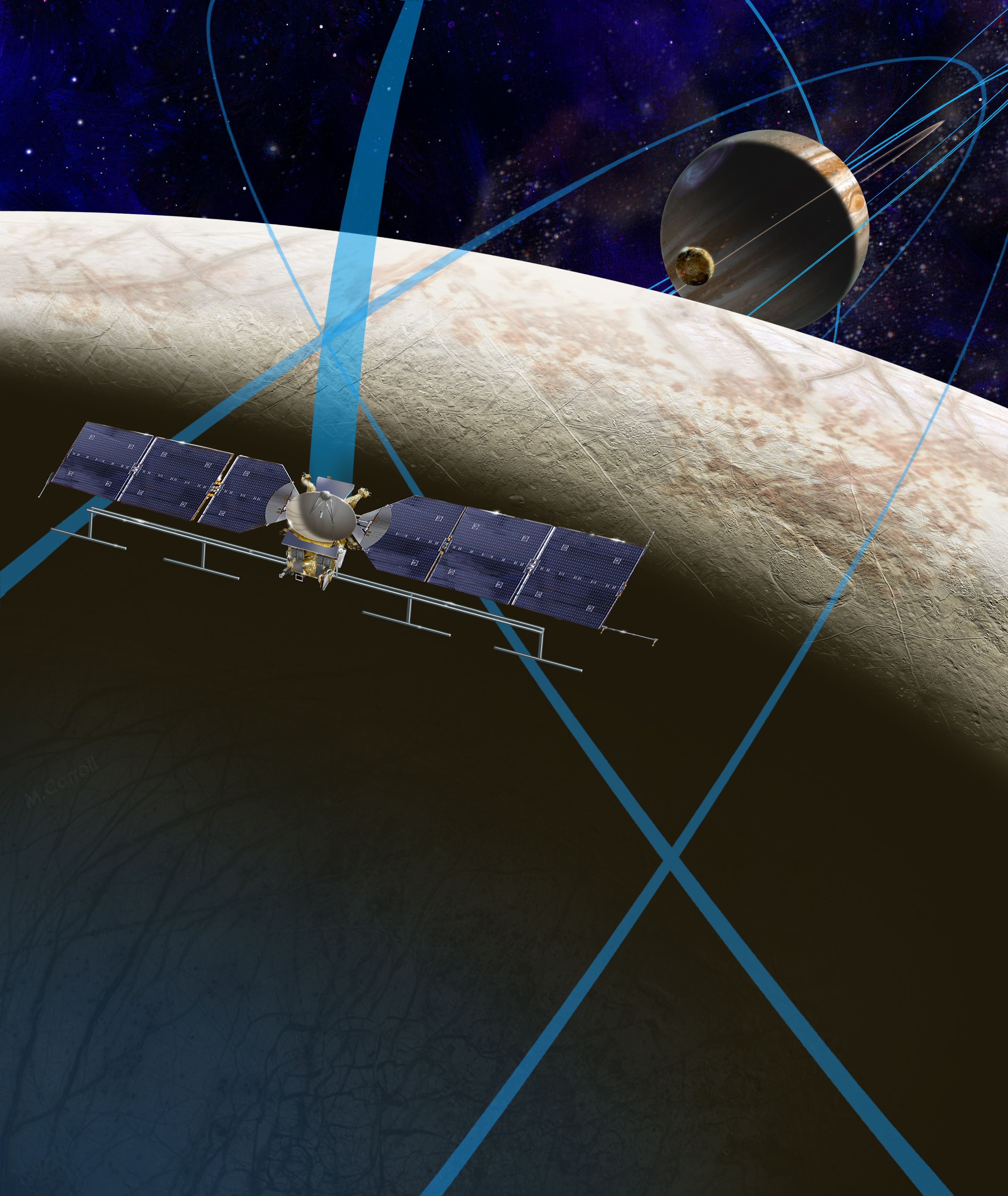
This artist’s rendering shows a concept for a future NASA mission to Europa in which a spacecraft would make multiple close flybys of the icy Jovian moon, thought to contain a global subsurface ocean. Credits: NASA/JPL-Caltech
Radar for Europa Assessment and Sounding: Ocean to Near-surface (REASON) — principal investigator Dr. Donald Blankenship of the University of Texas, Austin. This dual-frequency ice penetrating radar instrument is designed to characterize and sound Europa’s icy crust from the near-surface to the ocean, revealing the hidden structure of Europa’s ice shell and potential water within.
Europa Thermal Emission Imaging System (E-THEMIS) — principal investigator Dr. Philip Christensen of Arizona State University, Tempe. This “heat detector” will provide high spatial resolution, multi-spectral thermal imaging of Europa to help detect active sites, such as potential vents erupting plumes of water into space.
MAss SPectrometer for Planetary EXploration/Europa (MASPEX) — principal investigator Dr. Jack (Hunter) Waite of the Southwest Research Institute (SwRI), San Antonio. This instrument will determine the composition of the surface and subsurface ocean by measuring Europa’s extremely tenuous atmosphere and any surface material ejected into space.
Ultraviolet Spectrograph/Europa (UVS) — principal investigator Dr. Kurt Retherford of SwRI. This instrument will adopt the same technique used by the Hubble Space Telescope to detect the likely presence of water plumes erupting from Europa’s surface. UVS will be able to detect small plumes and will provide valuable data about the composition and dynamics of the moon’s rarefied atmosphere.
SUrface Dust Mass Analyzer (SUDA) — principal investigator Dr. Sascha Kempf of the University of Colorado, Boulder. This instrument will measure the composition of small, solid particles ejected from Europa, providing the opportunity to directly sample the surface and potential plumes on low-altitude flybys.
Can’t get enough of Europa? Click here for the latest news on the Europa mission!


 Women in STEM are awesome. For those of you who don’t know, STEM = an acronym referring to the academic disciplines of science, technology, engineering, and mathematics. While most people respect and support women in STEM, there are still a select few who are determined to undermine their smarts and hard work.













 A bio-inspired robot is under development at the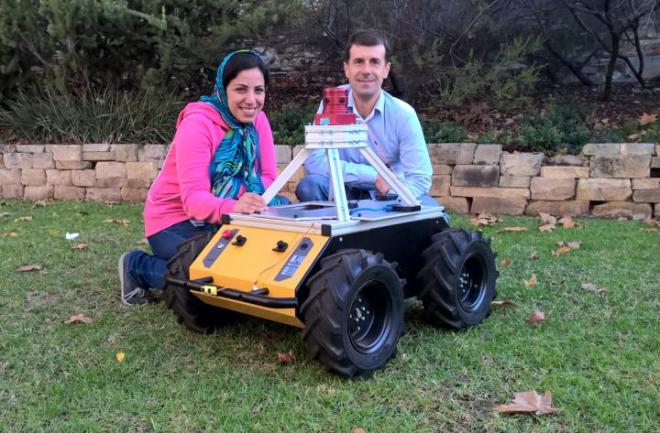











 Krystian Science