Synthetic Cadaver Breathes, Bleeds, and Moves – Totally Awesome or Totally CREEPY?

KS Health

It looks and feels human. It’s even made of salt, water, and fiber – just like you and me. But, this incredible replica of the human body isn’t human; it’s SynDaver Lab’s synthetic human patient.

Human cadavers can cost up to $10,000, and that doesn’t take into account transportation and disposal fees, as well as the need for specialized storage facilities and trained staff. Plus, you can only use them once! The SynDaver ultra-realistic human is meant to be educational and reusable.

SynLabs

According to their official website, The SynDaver Synthetic Human is ‘the most elaborate and sophisticated full-body surgical simulator ever devised. An exquisite 3D jigsaw puzzle; every muscle, bone, vascular component and organ is removable and replaceable.’

This synthetic human can be used in the medical industry to replace live animals, human cadavers, and even human patients – mainly for trauma training, sugerical training, and medical device development.

‘It is obviously good not only for ethical reasons, but also because avoiding animal use saves a great deal of time and money,’ said SynDaver Labs founder Dr Sakezles. ‘So, I started designing synthetic organs to test devices and over time they became very elaborate.’

This slideshow requires JavaScript.

How much does all of this cost?

The SynDaver Anatomy “base model,” which has all of the organs, muscles and bones a human cadaver has, sells for $25,000 and is used worldwide at hospitals with simulators and at universities and community colleges teaching anatomy.

The SynDaver Patient is the newest addition to the SynDaver Synthetic Human (SSH) product line. In addition to all of the existing features that have made the Synthetic Human world-famous, the SynDaver Patient also includes an open-source physiology engine that controls body motions and all aspects of synthetic biology.

The SynDaver Patient can be used for practicing ultrasound, fluoroscopy, X-ray and CT imaging, along with surgical procedures involving tools such as lasers, plasma knives and sonic blades. According to GizMag, it’s available now, for $85,000.

Later this year, the company should be releasing a Basic version of its existing Synthetic Human – the latter model not only features full human anatomy, but also functioning circulatory and respiratory systems – along with Preemie and Newborn models. All three should be priced at about $15,000.

Even the ‘Product Description’ on the website gave me chills!


 Product Description

SynDaver synthetic tissues have been validated over the last two decade to simulate the mechanical and physico-chemical properties of live tissue. With this technology, our products have created an entirely new field known as live tissue replacement. The SSH is capable of standing in for a human cadaver in medical procedure training but unlike a cadaver, the SSH can last forever.

Features
The model pumps heated synthetic blood (pulsed flow away from the heart and drainage toward the heart) and can be used to simulate procedures with ventilation, insufflation and intubation.

Anatomical attributes include:

  • Skin with fat and fascia planes (Optional)
  • Every bone, muscle, tendon and ligament
  • Fully articulating joints
  • Functioning respiratory system
  • Complete digestive and urinary tracts
  • Visceral and reproductive organs
  • Circulatory system

Muscles, bones, organs and vasculature are all removable and replaceable to allow onsite servicing and upgrades.

Customization
A variety of pathologies and injuries are available based on patient images, CAD drawings or simple descriptions. Client may also select gender and skin tone.

Included Services
Onsite installation and training, one full year of anatomy and tissue upgrades and a three-year warranty. Annual service contracts covering every aspect of the body are also available.

Imaging Equipment
Compatible with all known imaging techniques including MRI, CT, fluoroscopy and ultrasound.

Surgical Equipment
System is compatible with all known surgical devices including lasers, RF ablation, plasma knives, sonic blades and cryocatheters as well as bipolar, monopolar and harmonic devices.

System Components
Full body with storage and display container, stainless-steel table, deluxe battery-powered heart pump and all required plumbing. The model may be skinless or covered with either the standard SynDaver synthetic human skin (pure wet chemistry) or our new organosilicate-synthetic human hybrid skin (polymer outer – wet inner).


Shark Tank Let Down


SynDaver Labs was awarded a $3 million dollar deal on ABC’s Shark Tank, but unfortunately the deal fell through.

Dr. Christopher Sakezles accepted the deal last week from investor Robert Herjavec in an episode of the hit show. The agreement would have given Herjavec 25 percent equity and equal board representation.

Erin McLean, vice president of marketing for the Herjavec Group, said she could not comment on a deal that hadn’t closed. “We were not able to progress through our due diligence process,” she said, “but we wish them well.”

Dr. Sakezles views this not as a setback, but as an opportunity. “With the exposure that we’ve recently received, we’re looking at much more lucrative opportunities with other investors,” he said.

Click below to see the full video of SynDaver Labs on Shark Tank.

Synthetic Cadaver Breathes, Bleeds, and Moves – Totally Awesome or Totally CREEPY?

NASA Wants to Build a ‘Robo-Squid’ to Search for Life on Other Planets – I Say Make a Movie!

KS Technology

NASA’s latest proposal looks like a sci-fi film in the making. The project calls for the use of a soft-robotic rover that resembles a squid -tentacles included- for missions that can’t be accomplished with conventional power systems.

The ‘robosquid’ looks like an eel with a short antenna on its back. The antenna harvests power from locally changing magnetic fields. Ideally, NASA would like to enable amphibious exploration (both land and sea) of gas-giant moons like Europa!

This artist's rendering depicts 2015 NIAC Phase I Fellow Mason Peck's soft-robotic rover for planetary environments for missions that cannot be accomplished with conventional power systems. It resembles a squid, with tentacle-like structures that serve as electrodynamic 'power scavengers' to harvest power from locally changing magnetic fields. The goal is to enable amphibious exploration of gas-giant moons like Europa. Credits: NASA/Cornell University/NSF
This artist’s rendering depicts 2015 NIAC Phase I Fellow Mason Peck’s soft-robotic rover for planetary environments for missions that cannot be accomplished with conventional power systems. It resembles a squid, with tentacle-like structures that serve as electrodynamic ‘power scavengers’ to harvest power from locally changing magnetic fields. The goal is to enable amphibious exploration of gas-giant moons like Europa. Credits: NASA/Cornell University/NSF

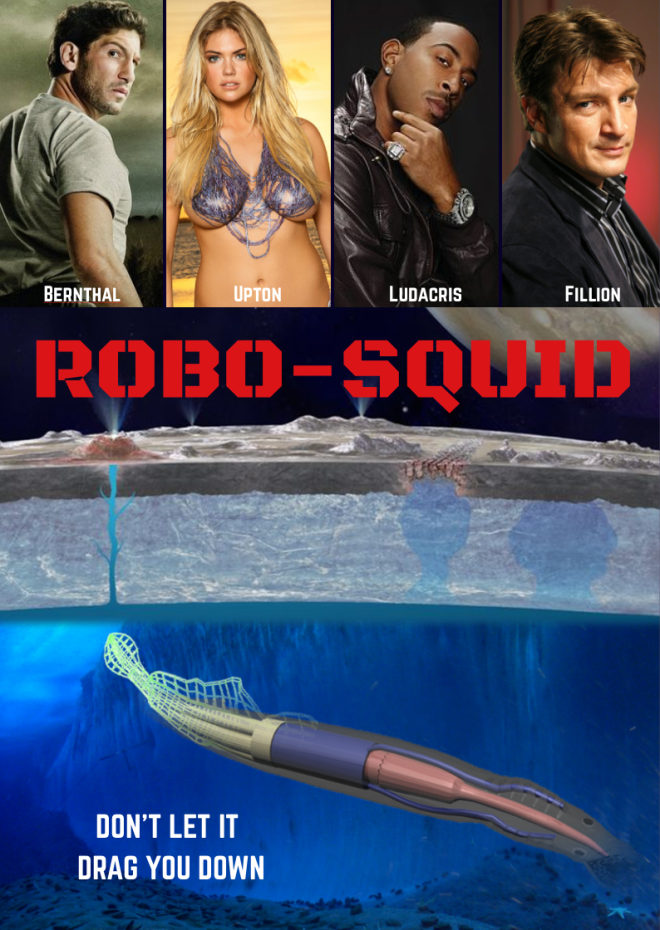
Side Note: If they made Sharknado they can make Robosquid. I grew up loving movies like Anaconda, Congo, and Sphere. I’m picturing the same vibe, starring Nathan Fillion, Jon Bernthal, Ludacris, and Kate Upton. Hey J.J. Abrams and Joss Whedon – Think about it! 😉

Image: KrystianScience

NASA Innovative Advanced Concepts (NIAC)

NASA Innovative Advanced Concepts (NIAC)

The ‘robosquid’ is just one of 15 proposals selected by NASA for study under Phase I of the NASA Innovative Advanced Concepts (NIAC), a program that aims to turn science fiction into science fact through the development of pioneering technologies.

“The latest NIAC selections include a number of exciting concepts,” said Steve Jurczyk, associate administrator for the Space Technology Mission Directorate (STMD) at NASA Headquarters in Washington. “We are working with American innovators to reimagine the future of aerospace and focus our investments on concepts to address challenges of current interests both in space and here on Earth.”

NASA hopes the knowledge gained from these proposed studies will bring it closer to its goal of exploration beyond low-Earth orbit, and missions to asteroids and Mars.

The projects are chosen through a peer-review process that evaluates their potential, technical approach and benefits that can be realized in a reasonable timeframe. All concepts are very early in the development cycle and represent multiple technology areas, including aircraft propulsion, human life support, science instruments, unique robotic concepts and exploring other diverse technology paths needed to meet NASA’s strategic goals.

NIAC Phase I awards are valued at approximately $100,000, providing awardees the funding needed to conduct a nine-month initial definition and analysis study of their concepts.

NASA Wants to Build a ‘Robo-Squid’ to Search for Life on Other Planets – I Say Make a Movie!

NOAA Discovers Terrifying Deep-Sea Creatures After Exploring the Waters Off Puerto Rico

KS_LOGOs2_UnderwaterI have to admit, I’m a bit terrified of deep sea creatures. I mean, 95% of the ocean floor remains unexplored. That is A LOT of room for giant squid to roam. Lucky for me, NOAA decided to explore the waters off of Puerto Rico in search of the deep sea life that haunts my dreams.

From April 9 to April 30, 2015, NOAA Ship Okeanos Explorer explored largely uncharted deep-sea ecosystems and seafloor in the vicinity of Puerto Rico and the U.S. Virgin Islands. What they found – using state of the art technology – will amaze you!

Quartz posted this incredible video to their Facebook page, using footage gathered from NOAA. Some of these creatures are so new – they don’t even have names.

Océano Profundo 2015

Legs 1 and 2 of the mission focused on mapping the seafloor where primarily only low-resolution satellite or topographic data existed previously. Leg 3 of the expedition featured some of the deepest remotely operated vehicle (ROV) dives ever conducted in the region and collected critical deep-water environmental data that will improve ecosystem understanding and inform federal and local resource managers.

Why Puerto Rico?

According to NOAA, a diversity of seafloor features lie just offshore Puerto Rico and the U.S. Virgin Islands that include trenches, seamounts, numerous submarine canyons, valleys, and troughs. These features likely contain valuable and vulnerable ocean resources, but very little is known about them, making this an important area to survey.

It is crucial to explore this area for several reasons:

  • It is tectonically active, with seismic hazards
  • It includes a large section of U.S. Exclusive Economic Zone
  • One of the major fisheries in the area is deepwater snapper, but little is known about snapper populations there
  • It is of potential interest for marine protected area managers, those creating ocean usage planning maps, and sanctuary managers
Mission map showing the operating areas, with priority areas outlined in black, for Leg 3 of Océano Profundo 2015: Exploring Puerto Rico’s Seamounts, Trenches, and Troughs. Map created with ESRI ArcMap software and data displayed is provided by ESRI, Delorme, GEBCO, USGS, NOAA NGDC, and other contributors. Image courtesy of NOAA Okeanos Explorer Program.

Communication Technology

NOAA did a fantastic job of documenting their journey, allowing scientists and the public access to mission logs, daily reports, photos, video, and live underwater video feeds.

During the dives, Okeanos Explorer’s two-body ROV system continuously captured high-definition video, which the ship transmitted to the Office of Ocean Exploration and Research’s website, www.oceanexplorer.noaa.gov, where anyone could follow along in near-real time!

NOAA Ship Okeanos Explorer uses telepresence technology to transmit data in real-time to a shore-based hub where the video is then transmitted to a number of Exploration Command Centers located around the country as well as to any internet enabled device. Access to the video and a suite of Internet-based collaboration tools allow scientists on shore to join the operation in real-time and allows the general public to follow along with the expedition. Image courtesy of the NOAA Okeanos Explorer Program.

Okeanos Explorer

NOAA Ship Okeanos Explorer, “America’s Ship for Ocean Exploration,” is the only federally funded U.S. ship assigned to systematically explore our largely unknown ocean for the purpose of discovery and the advancement of knowledge. Telepresence, using real-time broadband satellite communications, connects the ship and its discoveries live with audiences ashore. Visit the NOAA Marine Operations Center Okeanos Explorer page for operations and crew information 🙂

Video

Rambo the Octopus Knows How to Snap Your Picture – as New Research Reveals How These Creatures Move

KS_LOGOs2_UnderwaterHer name is Rambo, she lives in New Zealand, she takes pictures, and, oh yeah… she is an octopus! In a new viral video released by Sony, you can see Rambo in action, snapping pics of excited guests in exchange for treats – using Sony’s underwater Cyber Shot TX30 camera.

Rambo, who was given the name based on the amount of destruction she caused the first few camera set-ups, lives at the Kelly Tarlton’s Sea Life Aquarium in Auckland. Rambo may be the world’s first professional ‘octographer,’ given the fact each photo costs $1.50 a pop!

The truth is, octopuses are highly intelligent. They open jars, make daring escapes from their tanks, and even dismantle high tech equipment! Click here to watch an octopus break apart a camera.

Mark Vette, Rambo’s trainer, told Cult of Mac, “When we first tried to get her to take a photo, it only took three attempts for her to understand the process. That’s faster than a dog… Actually, it’s faster than a human in some instances.”

Octopuses learn quickly and are highly motivated by food. Rambo was first taught to respond to a buzzer – which meant snack time. Then Vette had to teach her the buzzer meant to take a picture, which resulted in food.

Vette told NPR the hard part wasn’t training Rambo to shoot pictures; the hard part was creating an underwater set-up for the tank that the curious cephalopod wouldn’t destroy.

He told NPR, “She took the camera, ripped it off its hinges, ripped it off everything, smashed it to bits and spat it out.” Hence the name Rambo 🙂


How Does the Octopus Seamlessly Co-ordinate Its Eight Arms?

Good thing octopuses don’t dance, because according to a new study, they have no rhythm.

Researchers from the Hebrew University of Jerusalem used high speed cameras to film octopuses moving around their tank – then analyzed the footage frame-by-frame. What they discovered surprised them.

Scientists found that the octopus moves by shortening and elongating its arms, which creates a pushing thrust. The animal does not move by bending or pulling its arms, as previously thought.

Octopuses have bilateral body symmetry, which means their left side is a mirror image of their right. Most bilateral-symmetric animals face forward when they are moving (except the crab, which walks sideways.) But, octopuses can move in ANY direction without needing to turn their bodies. They just push off a surface and propel themselves wherever they’d like.

“So the octopus only has to decide which arm to use for the pushing – it doesn’t need to decide which direction this arm will push,” explained Dr Levy. “[It has] found a very simple solution to a potentially complicated problem – it just has to pick which arm to recruit.”

While, the octopus clearly has some rad moves, researchers have not been able to spot a pattern, or rhythm to their movement. Levy believes there either is no pattern to discover, or their movement is too complicated for the studies they conducted.

The findings are published in the journal Current Biology.

Push-pull: The footage, captured by Dr Guy Levy, reveals how each arm moves the animal in a particular direction
Video

Frostbite, Amputation, and Adoption: This Rottweiler Was Given a New Lease on Life with Four Prosthetic Paws

KS Nature

This adorable 2-year-old Rottweiler’s name is Brutus, and he gets around using four specially designed prosthetic paws!

Brutus

Brutus was left out in the freezing cold as a puppy and developed frostbite. His owner decided to amputate all four paws, and eventually gave him up for adoption.

Lucky for Brutus, someone noticed him in a store parking lot in Colorado, where he was looking for a new home. Hundreds of people donated money to give Brutus a new lease on life and four new paws! Brutus’ new owner, Laura Aquilina, says she just wants to give Brutus the gift of being a regular dog.

brutus 2

Felix Deurr, an orthopedics professor at Colorado State University, says prosthetics like Brutus’ have only been around for about 15 years and not all dogs get used to them. A study reviewing their effectiveness is due out later this year.

According to NBC News, Brutus is the second dog in history to receive four prosthetic limbs.

Aquilina says if Brutus doesn’t take to the prosthetics, she will move on without them, but by the looks of this video, Brutus is doing just fine!

Brutus video

Frostbite, Amputation, and Adoption: This Rottweiler Was Given a New Lease on Life with Four Prosthetic Paws

Hello Nostalgia: This Device Turns Your iPhone into a GAME BOY!

KS TechnologyIs this real life? First, Nintendo enters the mobile gaming ring, and now, THIS?! It’s time to blow the dust out of your old Game Boy and Game Boy Color cartridges, kids!

Super Mario Bros. Deluxe, Zelda, Pokeman, Donkey Kong Country … I’ve got to figure out what I want to play first!
Super Mario Bros. Deluxe, Zelda, Pokeman, Donkey Kong Country, Tetris, Kirby … I’ve got to figure out what I want to play first!

Hyperkin, an independent video game hardware developer from Los Angeles, recently revealed their plans to release a Game Boy-compatible device for the iPhone 6 Plus. Don’t worry, there are plans for more compatible smartphones in the future!

The Smart Boy began as an April Fool’s joke, but is now a full fledged project designed for consumer release.


smartboy


The Smart Boy, which resembles an old school Nintendo Game Boy, attaches to the bottom of the iPhone 6 Plus, and allows you to play your favorite games in HD. It features the familiar directional pad, start, select, and A + B buttons.

In the beginning, the Smart Boy will only be available in the classic “80’s grey” hue, but more colors may follow.

“We wanted to create a retro device that can be easily adapted into any modern gamer’s arsenal of devices,” said Hyperkin’s product developer, Chris Gallizz

The gameplay itself will output through the iPhone 6 Plus’ own screen, and the Smart Boy will be accessed through an exclusive downloadable Smart Boy app.

If Nintendo is smart, they will see the huge demand for classic gameplay on smartphones, and hopefully team up with Hyperkin (or something similar) in the future.

Hello Nostalgia: This Device Turns Your iPhone into a GAME BOY!

It’s Hard For Little Girls to Find Spaceships, Trains, and Dinos at the Clothing Store – Don’t Worry, Moms Got This!

KS_LOGOs2_PopCultureTwo Washington moms started a science-themed clothing line for girls after they realized they couldn’t find clothes featuring dinosaurs, trains, or rocket-ships in the girls department – I guess that is just little boy territory!

BuddingSTEM, created by Jennifer Muhm and Malorie Catchpole, offers a complete line of girls’ clothes celebrating science, space, dinosaurs, and more; perfect for girls ages 18 months to eight years old.

“STEM” stands for science, technology, engineering and math.

BuddingSTEM

As a young woman obsessed with science, this story really warms my heart. Growing up, I had a few gender neutral hand-me-downs with basic math symbols on them, but nothing as cool as this!

Jennifer Muhm, 37, told ABC News, “We’re not anti-princess. We’re not anti-pink. We’re not anti-girly. We just think there needs to be more than just that offered for our girls.”

Muhm first realized this was a serious issue when her 5 year old daughter wanted to be an astronaut for Halloween in 2013 and they could only find boys modeling the space-themed costume in the catalogue.

She explained to her daughter that she could be anything she wanted to be, but she couldn’t stop thinking about how unfair the situation was. What were little girls supposed to wear that wanted to explore the universe and dig for dinosaurs?

By April 2014, Muhm and Catchpole filed their business registration for buddingSTEM.

BuddingSTEM 2 BuddingSTEM 1

Thanks to a successful Kickstarter campaign, buddingSTEM has raised more than $56,000!

The buddingSTEM clothing line will be available on their website starting in July.

It’s Hard For Little Girls to Find Spaceships, Trains, and Dinos at the Clothing Store – Don’t Worry, Moms Got This!

Festo’s New Robotic Ants, Butterflies, and Chameleon Tongue Will Make You Do a Double Take

KS Technology

Festo has unveiled a slew of new animal-inspired robotic creatures you need to see to believe.

I’d like to introduce you to  Festo’s BionicANTs, eMotionButterflies, and FlexShapeGripper!

BionicANTs – ‘Highly integrated individual systems to solve a common task’

Festo - BionicANTs
CREDIT: FESTO

The BionicANTs not only mimic the delicate anatomy of ants, but also their cooperative behavior. BionicANTs actually work together, under a clear set of rules, to coordinate their actions and movements. They even know when to branch off and use their ‘antennae’ to re-charge at the edge of their work space.

By pushing and pulling together, the ants are able to move an object across a defined area. This way, they are able to move loads that a single ant could not move alone. This technology seems playful, but it could greatly impact factories and production lines in the future.

Why ants? Ants are tough industrious workers that can carry a hundred times their own body weight. They live in big colonies with clear rankings and set rules. Ants know which tasks they need to fulfill, and they can work together to complete them.

eMotionButterflies – ‘Ultralight flying objects with collective behavior’

Festo - eMotionButterflies
CREDIT: FESTO

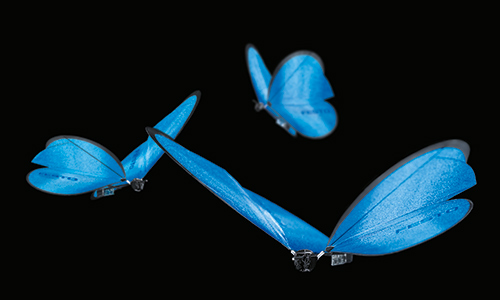
These might be the most beautiful robots I’ve ever seen! You have to admit they look real. Except for the large ‘Festo’ logo printed on their wings 🙂

These artificial butterflies feature highly integrated on-board electronics, allowing them to activate their wings individually with precision. No human pilot is required to control the eMotionButterflies. Thanks to indoor GPS and a complicated camera system, the bionic insects know where to fly and how to avoid collisions.

The wings are curved out of wafer-thin carbon rods and covered with an elastic capacitor film, which helps keep the eMotionButterfly’s weight as low as possible and its flight as natural as possible.

http://https://www.youtube.com/watch?v=1gu3z7w4Vc8

Why butterflies? Butterflies begin the world as caterpillars and later emerge as colorful flying creatures. They have large wings and slim bodies, making them light and aerodynamic.

FlexShapeGripper – ‘Gripping modelled on a chameleon’s tongue’

Festo - FlexShapeGripper
CREDIT: FESTO

Gripping applications have always played a key role in production, which explains Festo’s interest in the chameleon’s highly specialized tongue. The chameleon has the ability to shoot its tongue out light a rubber band and wrap around objects like a suction cup.

The FlexShapeGripper’s water-filled silicone cap allows it to wrap itself around various items in a flexible and form-fitting manner, much like a chameleon!

http://https://www.youtube.com/watch?v=m7l-87r4oOY

Why a chameleon? Chameleons can more their eyes independently of each other and change the color of their skin depending on their mood and temperature. Their unique tongues help them attack and retract prey as quick as lightening

All three of these ‘biomimetic’ devices will be on display at the industry trade show Hannover Messe in April.

Video

Science Fix on Netflix: Top 7 Picks to Watch Tonight

KS TechnologyIf you are anything like me, chances are you spend hours streaming on Netflix. So, before you start season 7 of Gilmore Girls, check out these seriously awesome science-y movies and shows available right now! You might even learn something.

#1 – Particle Fever (2013) 1hr39min

‘The creation of the Higgs boson particle, an elusive key to unlocking secrets of the universe, unfolds on camera in this landmark documentary.’

Particle Fever


I got chills the first time I saw the trailer for Particle Fever. I remember hearing these words: “It could be nothing, other than just understanding everything.” Watch these intelligent and fiercely dedicated people explore the unknown and tackle the largest machine every built.

#2 – Brain Games (2011-2013) 2 Seasons

‘This interactive series uses games, illusions and experiments to illustrate how our brains manufacture our reality and often play tricks on us.’

Brain Games

You think you have a firm grasp on reality, but you have no idea. Brain Games is a truly mind-bending show. It reveals a new way to perceive your world with games, tricks, and eye-opening experiments. Fun for the whole family!

#3 – Nature: Snow Monkeys (2014) 53min

‘In Japan’s frigid Shiga Highlands, a troop of snow monkeys functions in a complex society of rank and privilege where each knows its place.’

Nature: Snow Monkeys

This episode of Nature follows a tribe of snow monkeys through central Japan, showing how they keep friends and family close in order to survive. The shots are absolutely breathtaking, and there is nothing more adorable than snow monkeys relaxing in the arctic hot springs.

Side Note: This episode is narrated by Liam Neeson, which is rad! His voice is soothing and engaging. More like Love Actually Liam, not so much Taken, Taken 2, or Taken 3 – or his new movie Run All Night, which might as well be Taken 4.

#4 – More Than Honey (2012) 1hr35m

‘Already hailed as a definitive work on the subject, this comprehensive documentary examines the disappearance of honeybee populations worldwide.’

More Than Honey

Bees are dying all over the world and they say it’s a mystery. 1/3 of our food wouldn’t even exist without bees. This beautiful documentary is slow-paced but it takes a fascinating look at the dynamics of the hive, pollination, diseases, parasites, the business of bees and their disappearance.

#5 – Cosmos: A Spacetime Odyssey (2014) 1 Season

‘Astrophysicist Neil deGrasse Tyson presents new revelations about time and space in this reboot of the original “Cosmos” documentary series.’

Cosmos

Carl Sagan’s original 1980’s TV show Cosmos: A Personal Voyage made scientific documentaries cool. Tyson is willing to take you on a new Cosmos adventure if you follow his strict rules: “Follow the evidence wherever it leads and question everything. Accept these terms and the cosmos is yours.”

Cosmos: A Spacetime Odyssey can be a little cheesy at times, but for the most part, it is educational, visually stimulating and extremely interesting.

Seth MacFarlaneFun Fact: Animator Seth MacFarlane was instrumental in obtaining network funding for Cosmos: A Spacetime Odyssey and also serves as an executive producer. At the time MacFarlane told Tyson, “I’m at a point in my career where I have some disposable income … and I’d like to spend it on something worthwhile.”


#6 – Nature: Love in the Animal Kingdom (2013) 53m

‘Animals compete with everything they’ve got to find and secure a mate. For many, the all-important bonds they share as a couple are what enable the next generation to survive.’

Nature: Love in the Animal Kingdom

Parts of this episode of Nature actually made me uncomfortable, like I shouldn’t be watching. Mainly, the male sea dragon giving birth, the female gorilla creepily flirting with every male in sight, and the young wolves mating just to be ‘painfully’ interrupted by the female’s angry father.

That being said, what makes this episode so great is probably also what made me squirm. You get a very private, inside look at the way these wild animals dance, sing, flirt, and compete in order to find a mate. It’s highly entertaining.

#7 – Mankind: The Story of All of Us (2012) 1 Season

‘This miniseries charts the rise of civilization, from the first flourishing of life in Mesopotamia through the discovery of America.’

Mankind

Josh Brolin narrates this 12-hour mini-series that provides an in-depth look at the evolution of mankind. I think we often overlook just how incredible we are as a species.

Mankind may try to fit too much into the series, and at times it can feel like a high school history lecture, but it’s also informative and fun to watch. Prepare to learn about our earliest ancestors, farming, tools, weapons, man’s best friend, warfare, the plague, and much more!

Science Fix on Netflix: Top 7 Picks to Watch Tonight