Three crew members aboard the ISS made history this week when they snacked on a salad grown, harvested, and eaten IN SPACE! 🎉🍃
CREDIT: NASA
Published August 10th 2015 via YouTube by NASA Johnson – ‘That’s one small bite for a man, one giant leaf for mankind. Fresh food grown in the microgravity environment of space officially is on the menu for the first time for NASA astronauts on the International Space Station. Astronauts Scott Kelly, Kjell Lindgren and Kimiya Yui of Japan sample the fruits of their labor after harvesting a crop of “Outredgeous” red romaine lettuce from the Veggie plant growth system on the International Space Station.‘
It’s not often you get to see the fully illuminated “dark side” of the moon – but, thanks to a NASA camera aboard the Deep Space Climate Observatory (DSCOVR) satellite, we received a unique view of the moon as it moved in front of the sunlit side of Earth last month. SO cool!
The animation below features actual satellite images of the far side of the moon, illuminated by the sun, as it crosses between the DSCOVR spacecraft’s Earth Polychromatic Imaging Camera (EPIC) and telescope, and the Earth – one million miles away.
EPIC’s job is to constantly monitor the fully illuminated Earth as it rotates. It provides observations of vegetation, cloud height, ozone, and aerosols in the atmosphere. Once EPIC begins regular observations next month, NASA will post daily color images of Earth to a dedicated public website. 🌍
These images were taken between 3:50 p.m. and 8:45 p.m. EDT on July 16, showing the moon moving over the Pacific Ocean near North America. The North Pole is in the upper left corner of the image, reflecting the orbital tilt of Earth from the vantage point of the spacecraft.
NASA’s Marshall Space Flight Center in Huntsville, Alabama, just received a very sophisticated tape dispenser. The latest addition to Marshall’s Composites Technology Center is one of the largest composites manufacturing robots created in America. It will help NASA build the biggest, lightweight composite parts ever made for space vehicles.
The robot’s head has 16 spools of composite fiber tape that it releases in precise patterns to make both small and large objects. As the fibers are released they are heated so that they adhere to various surfaces. The head can be changed out for different projects. Credits: NASA/MSFC/Fred Deaton
According to NASA, composites are the materials of the future for aerospace because they are lighter and cheaper than traditional materials, like metals.
“Marshall has been investing in composites for a long time,” said Preston Jones, deputy director of Marshall’s Engineering Directorate. “This addition to Marshall’s Composites Technology Center provides modern technology to develop low-cost and high-speed manufacturing processes for making large composite rocket structures. We will build and test these structures to determine if they are a good fit for space vehicles that will carry humans on exploration missions to Mars and other places.”
Lightweight composites have the potential to increase the amount of payload that can be carried by a rocket – the lighter the rocket, the more crew, food, equipment, and science instruments the rocket can ferry into space. NASA is doing research to determine whether composites can be part of their new Space Launch System and other exploration spacecraft, such as rovers and landers.
In order to make large composite structures, the robot travels down a 40-foot-long track, placing carbon fibers onto a tooling surface in precise patterns. The head at the end of its 21-foot robot arm holds up to 16 spools of carbon fibers that are as thin as human hairs! The robot will build structures larger than 26 feet (8 meters) in diameter, which are some of the largest composite structures ever built for space.
Click the video below to see the new robotic system in action. 🚀
The new Star Wars Little Golden Books almost make me want to have a baby – almost. 😏 Disney just announced this week that all of the legendary Star Wars movies are about to join the iconic Little Golden Books series for kids.
“The Star Wars franchise has woven itself into the hearts and minds of generations of fans, many of whom read Little Golden Books as children,” said Jeanne Mosure, Senior Vice President, Group Publisher, Disney Publishing Worldwide in a release. “We’re very excited to be incorporating Little Golden Books into our overarching strategy so parents can now introduce their own children to the wonders of the galaxy through this classic format.”
The first six books in this series will be released on July 28: The Phantom Menace, Attack of the Clones, Revenge of the Sith, A New Hope, The Empire Strikes Back and Return of the Jedi. A boxed set of these first six Star Wars Little Golden Books will be available on September 1, 2015. Check out the six covers below!
Space has been all the rage this month! NASA’s New Horizon’s spacecraft made a historic trip to Pluto, the Kepler exoplanet explorer discovered Kepler-452b, and three new crew members successfully joined the ISS. Let me catch you up here! 🌎🚀
Kepler-452b
NASA’s Kepler mission has confirmed the first near-Earth-size planet in the “habitable zone” around a sun-like star. This discovery and the introduction of 11 other new small habitable zone candidate planets mark another milestone in the journey to finding another “Earth.”
Kepler-452b is 60 percent bigger in diameter than Earth and scientists feel there is a good chance its rocky, although its mass and composition are currently unknown.
“We can think of Kepler-452b as an older, bigger cousin to Earth, providing an opportunity to understand and reflect upon Earth’s evolving environment,” said Jon Jenkins, Kepler data analysis lead at NASA, who led the team that discovered Kepler-452b. “It’s awe-inspiring to consider that this planet has spent 6 billion years in the habitable zone of its star; longer than Earth. That’s substantial opportunity for life to arise, should all the necessary ingredients and conditions for life exist on this planet.”
The confirmation of Kepler-452b brings the total number of confirmed planets to 1,030.
This artist’s concept compares Earth (left) to the new planet, called Kepler-452b, which is about 60 percent larger in diameter. Credits: NASA/JPL-Caltech/T. Pyle
Pluto
A newly discovered mountain range lies near the southwestern margin of Pluto’s Tombaugh Regio (Tombaugh Region), situated between flat, icy plains and dark, heavily-cratered terrain. The image below was taken by New Horizons on July 14, 2015 from a distance of 48,000 miles and sent back to Earth on July 20.
Pluto’s largest moon Charon has snagged most of the press lately, but there are two smaller moons – Nix and Hydra – that were the second and third moons to be discovered.
Pluto’s jelly bean shaped moon Nix (left), has a reddish spot that has attracted the interest of mission scientists. Nix is estimated to be 26 miles long and 22 miles wide. Pluto’s awkwardly shaped moon Hydra (right) is 34 miles in length. The black and white image taken by New Horizons on July 14 reveals features as small as 0.7 miles.
International Space Station
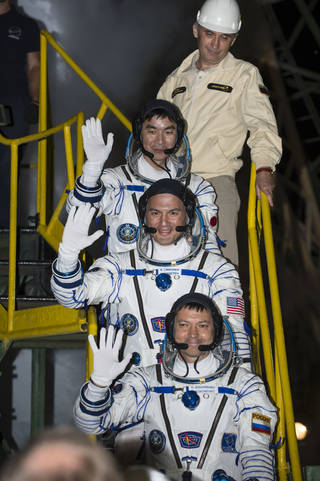
Expedition 44 Flight Engineer Kimiya Yui (JAXA), top; Flight Engineer Kjell Lindgren of NASA, center, and Soyuz Commander Oleg Kononenko (Roscosmos), bottom.Photo Credit: (NASA/Aubrey Gemignani)
Three crew members representing the United States, Russia and Japan have arrived at the International Space Station to continue important research!
NASA astronaut Kjell Lindgren, Russian Federal Space Agency (Roscosmos) cosmonaut Oleg Kononenko and Japan Aerospace Exploration Agency (JAXA) astronaut Kimiya Yui launched from the Baikonur Cosmodrome in Kazakhstan at 5:02 p.m. EDT Wednesday (3:02 a.m., Thursday, July 23 in Baikonur) and docked at the station at 10:45 p.m. They will be aboard the ISS for five months and are expected to return to Earth at the end of December.
The three men join Expedition 44 commander Gennady Padalka of Roscosmos and flight engineers Scott Kelly of NASA and Mikhail Kornienko of Roscosmos, who have been aboard the complex since March 27.
Click the video below to see the successful launch of the Russian Soyuz TMA-17M spacecraft on July 23, from the Baikonur Cosmodrome in Kazakhstan.
It’s official – the world has Pluto fever! NASA’s New Horizons spacecraft just completed its nearly decade long mission to fly by the dwarf planet Pluto. Christmas has come early for the scientific community as the exciting discoveries keep rolling in! What they’ve learned over the past week will blow your mind. 🌖🚀
Pluto observations through the years. Credit: NASA
Icy mountains on Pluto and a new, crisp view of its largest moon, Charon, are among the several discoveries announced Wednesday by NASA’s New Horizons team, just one day after the spacecraft’s first ever Pluto flyby. Here is a collection of incredible photos that highlight just a few of NASA’s recent findings. Feel free to geek out – such an exciting time! 🚀
“Pluto New Horizons is a true mission of exploration showing us why basic scientific research is so important,” said John Grunsfeld, associate administrator for NASA’s Science Mission Directorate in Washington. “The mission has had nine years to build expectations about what we would see during closest approach to Pluto and Charon. Today, we get the first sampling of the scientific treasure collected during those critical moments, and I can tell you it dramatically surpasses those high expectations.”
New close-up images of a region near Pluto’s equator reveal a giant surprise — a range of youthful mountains rising as high as 11,000 feet (3,500 meters) above the surface of the icy body. Credits: NASA/JHU APL/SwRI
Pluto’s tiny potato-shaped moon Hydra emerges from the shadows, revealing its irregularly shaped body characterized by significant brightness variations over the surface. Credit: NASA
Remarkable new details of Pluto’s largest moon Charon are revealed in this image from New Horizons’ Long Range Reconnaissance Imager (LORRI), taken late on July 13, 2015 from a distance of 289,000 miles. Credit: NASA
The latest spectra from New Horizons Ralph instrument reveal an abundance of methane ice, but with striking differences from place to place across the frozen surface of Pluto. Credit: NASA-JHUAPL-SwRI
A portrait from the final approach. Pluto and Charon display striking color and brightness contrast in this composite image from July 11. Credits: NASA-JHUAPL-SWRI
This graphic presents a view of Pluto and Charon as they would appear if placed slightly above Earth’s surface and viewed from a great distance. Recent measurements obtained by New Horizons indicate that Pluto has a diameter of 2370 km, 18.5% that of Earth’s, while Charon has a diameter of 1208 km, 9.5% that of Earth’s. Credit: NASA
New Horizons Flight Controllers celebrate after they received confirmation from the spacecraft that it had successfully completed the flyby of Pluto, Tuesday, July 14, 2015 in the Mission Operations Center (MOC) of the Johns Hopkins University Applied Physics Laboratory (APL), Laurel, Maryland. Photo Credit: NASA/Bill Ingalls
Even President Obama got in on the Pluto action! Twitter: @POTUS
New Horizons has obtained impressive new images of Pluto and its large moon Charon that highlight their compositional diversity. These are not actual color images of Pluto and Charon—they are shown here in exaggerated colors. Image Credit: NASA/APL/SwRI
New Horizons spacecraft. Image/File credit: NASA/Johns Hopkins University Applied Physics Laboratory/Southwest Research Institute/David Napolillo
July is shaping up to be a great month for America. This year we celebrated our independence, U.S.A. won the Women’s World Cup, the U.S. is about to become the first nation to visit Pluto on the 14th, and now, NASA has announced the four astronauts that will usher space travel back to American soil.
Clockwise from top left: Douglas G. Hurley, Sunita L. Williams, Eric A. Boe, and Robert L. Behnken. PHOTOGRAPHER: BILL STAFFORD/NASA
“These distinguished, veteran astronauts are blazing a new trail, a trail that will one day land them in the history books and Americans on the surface of Mars,” said NASA administrator Charles Bolden in a blog post.
Bolden explained that sending commercial flights to space is “all part of our ambitious plan to return space launches to U.S. soil, create good-paying American jobs and advance our goal of sending humans farther into the solar system than ever before.”
Since the space shuttle program was retired in 2011, NASA has relied on Russia to take astronauts to the International Space Station, which costs upwards of $76 million dollars a seat.
Instead, NASA has over 350 American companies working across 36 states on their commercial crew initiative. These four brave men and women will fly on commercially owned and operated spacecraft, built by contractors, not NASA – which will take the cost from $76 million to $58 million per astronaut. This means that every dollar the U.S. invests in commercial crew is a dollar we invest in ourselves, not the Russian economy.
Last year NASA awarded contracts to Boeing and SpaceX to ferry astronauts to the ISS. NASA hopes that by outsourcing the missions to low-Earth orbit they can focus on flying to deep space – even Mars!



 KSTV WEEKLY SCIENCE WRAP UP




 Krystian Science