This Adorable Video of a Baby Otter Learning to Swim Will Make Your Day – Maybe Your Week

KS_LOGOs2_UnderwaterBaby otters are a lot of work. But, if its as cute as this little thing, its probably totally worth it! Chicago’s Shedd Aquarium has a new resident; an orphaned southern otter pup known as Pup 681. Watch as her handlers try to teach her to swim 🙂 SO FLUFFY!

The tiny newborn was discovered orphaned on a California beach in September. She spent the first four weeks of her life at the Monterey Bay Aquarium trying to survive. Once her health improved, she was moved to Shedd in Chigaco.

As of November, Pup 681 weighed just under 6 pounds and was 23 inches long – and raising her hasn’t been easy! Stranded sea otter pups require extensive round-the-clock care. Six to eight animal care experts work on a rotating schedule in order to provide care and attention 24 hours a day, all week long. During this crucial period, she is taught how to develop certain behaviors, such as grooming, feeding, and foraging, as well as regulating her body temperature and swimming.

 “It truly takes a village to rehabilitate a young sea otter. Our animal care team is teaching the pup how to be an otter,” said Tim Binder, vice president of Animal Collections for Shedd

Hopefully this is a chance for the world to learn a little more about the otter population, which is constantly under attack. According the the Monteray Bay Aquarium, sea otters once thrived from Baja California to the Pacific Northwest of North America through Alaskan and Russian waters and into Japan before hunters nearly exterminated them in the 1700s and 1800s. Shedd Aquarium wants Pup 681 to raise awareness and melt people’s hearts.

“This rescued animal provides an opportunity for us to learn more about the biological and behavioral attributes of this threatened species and to encourage people to preserve and protect them in the wild,” said Binder.

This Adorable Video of a Baby Otter Learning to Swim Will Make Your Day – Maybe Your Week

NOAA Discovers Terrifying Deep-Sea Creatures After Exploring the Waters Off Puerto Rico

KS_LOGOs2_UnderwaterI have to admit, I’m a bit terrified of deep sea creatures. I mean, 95% of the ocean floor remains unexplored. That is A LOT of room for giant squid to roam. Lucky for me, NOAA decided to explore the waters off of Puerto Rico in search of the deep sea life that haunts my dreams.

From April 9 to April 30, 2015, NOAA Ship Okeanos Explorer explored largely uncharted deep-sea ecosystems and seafloor in the vicinity of Puerto Rico and the U.S. Virgin Islands. What they found – using state of the art technology – will amaze you!

Quartz posted this incredible video to their Facebook page, using footage gathered from NOAA. Some of these creatures are so new – they don’t even have names.

Océano Profundo 2015

Legs 1 and 2 of the mission focused on mapping the seafloor where primarily only low-resolution satellite or topographic data existed previously. Leg 3 of the expedition featured some of the deepest remotely operated vehicle (ROV) dives ever conducted in the region and collected critical deep-water environmental data that will improve ecosystem understanding and inform federal and local resource managers.

Why Puerto Rico?

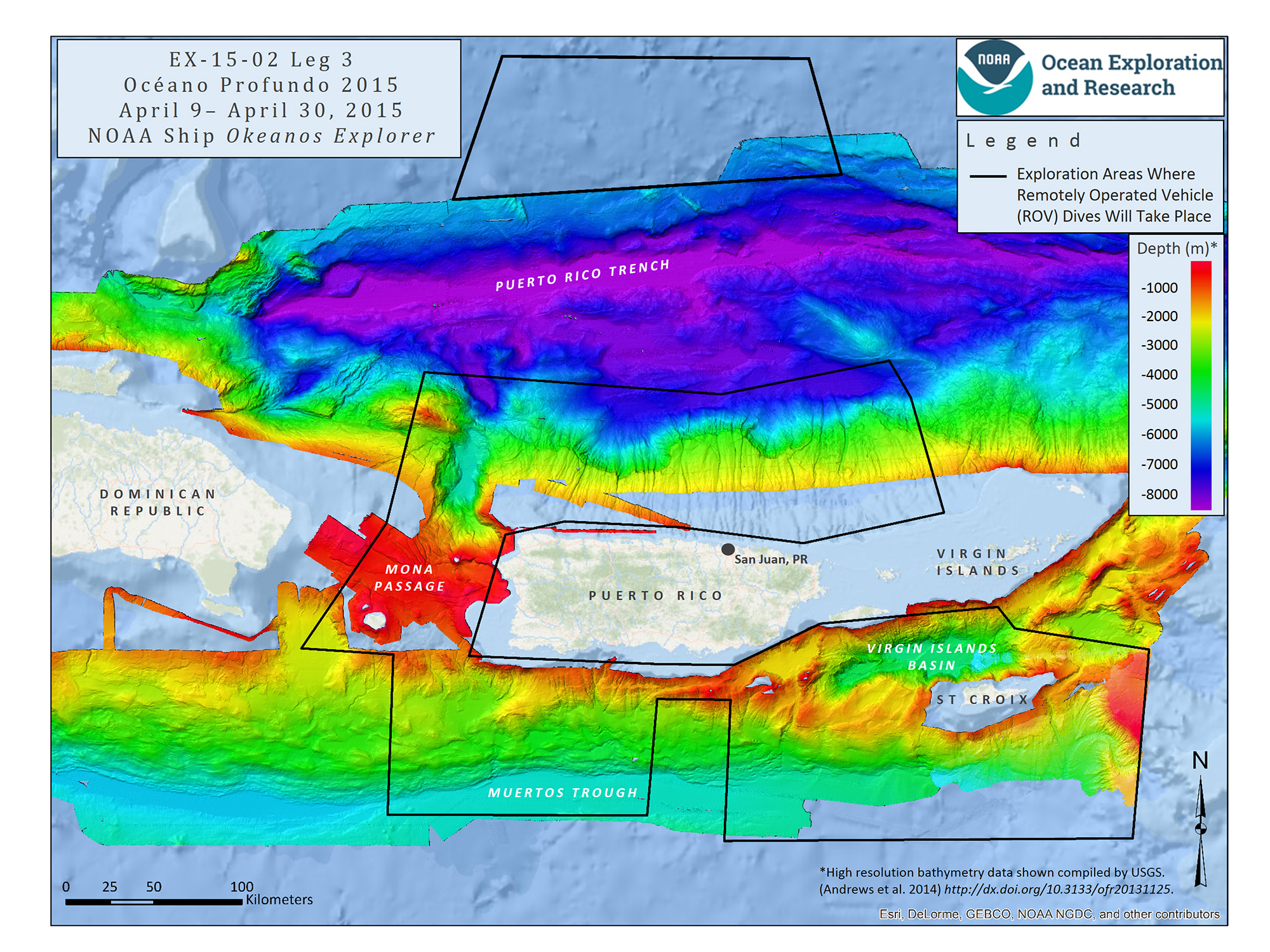
According to NOAA, a diversity of seafloor features lie just offshore Puerto Rico and the U.S. Virgin Islands that include trenches, seamounts, numerous submarine canyons, valleys, and troughs. These features likely contain valuable and vulnerable ocean resources, but very little is known about them, making this an important area to survey.

It is crucial to explore this area for several reasons:

  • It is tectonically active, with seismic hazards
  • It includes a large section of U.S. Exclusive Economic Zone
  • One of the major fisheries in the area is deepwater snapper, but little is known about snapper populations there
  • It is of potential interest for marine protected area managers, those creating ocean usage planning maps, and sanctuary managers
Mission map showing the operating areas, with priority areas outlined in black, for Leg 3 of Océano Profundo 2015: Exploring Puerto Rico’s Seamounts, Trenches, and Troughs. Map created with ESRI ArcMap software and data displayed is provided by ESRI, Delorme, GEBCO, USGS, NOAA NGDC, and other contributors. Image courtesy of NOAA Okeanos Explorer Program.

Communication Technology

NOAA did a fantastic job of documenting their journey, allowing scientists and the public access to mission logs, daily reports, photos, video, and live underwater video feeds.

During the dives, Okeanos Explorer’s two-body ROV system continuously captured high-definition video, which the ship transmitted to the Office of Ocean Exploration and Research’s website, www.oceanexplorer.noaa.gov, where anyone could follow along in near-real time!

NOAA Ship Okeanos Explorer uses telepresence technology to transmit data in real-time to a shore-based hub where the video is then transmitted to a number of Exploration Command Centers located around the country as well as to any internet enabled device. Access to the video and a suite of Internet-based collaboration tools allow scientists on shore to join the operation in real-time and allows the general public to follow along with the expedition. Image courtesy of the NOAA Okeanos Explorer Program.

Okeanos Explorer

NOAA Ship Okeanos Explorer, “America’s Ship for Ocean Exploration,” is the only federally funded U.S. ship assigned to systematically explore our largely unknown ocean for the purpose of discovery and the advancement of knowledge. Telepresence, using real-time broadband satellite communications, connects the ship and its discoveries live with audiences ashore. Visit the NOAA Marine Operations Center Okeanos Explorer page for operations and crew information 🙂

Video

Rambo the Octopus Knows How to Snap Your Picture – as New Research Reveals How These Creatures Move

KS_LOGOs2_UnderwaterHer name is Rambo, she lives in New Zealand, she takes pictures, and, oh yeah… she is an octopus! In a new viral video released by Sony, you can see Rambo in action, snapping pics of excited guests in exchange for treats – using Sony’s underwater Cyber Shot TX30 camera.

Rambo, who was given the name based on the amount of destruction she caused the first few camera set-ups, lives at the Kelly Tarlton’s Sea Life Aquarium in Auckland. Rambo may be the world’s first professional ‘octographer,’ given the fact each photo costs $1.50 a pop!

The truth is, octopuses are highly intelligent. They open jars, make daring escapes from their tanks, and even dismantle high tech equipment! Click here to watch an octopus break apart a camera.

Mark Vette, Rambo’s trainer, told Cult of Mac, “When we first tried to get her to take a photo, it only took three attempts for her to understand the process. That’s faster than a dog… Actually, it’s faster than a human in some instances.”

Octopuses learn quickly and are highly motivated by food. Rambo was first taught to respond to a buzzer – which meant snack time. Then Vette had to teach her the buzzer meant to take a picture, which resulted in food.

Vette told NPR the hard part wasn’t training Rambo to shoot pictures; the hard part was creating an underwater set-up for the tank that the curious cephalopod wouldn’t destroy.

He told NPR, “She took the camera, ripped it off its hinges, ripped it off everything, smashed it to bits and spat it out.” Hence the name Rambo 🙂


How Does the Octopus Seamlessly Co-ordinate Its Eight Arms?

Good thing octopuses don’t dance, because according to a new study, they have no rhythm.

Researchers from the Hebrew University of Jerusalem used high speed cameras to film octopuses moving around their tank – then analyzed the footage frame-by-frame. What they discovered surprised them.

Scientists found that the octopus moves by shortening and elongating its arms, which creates a pushing thrust. The animal does not move by bending or pulling its arms, as previously thought.

Octopuses have bilateral body symmetry, which means their left side is a mirror image of their right. Most bilateral-symmetric animals face forward when they are moving (except the crab, which walks sideways.) But, octopuses can move in ANY direction without needing to turn their bodies. They just push off a surface and propel themselves wherever they’d like.

“So the octopus only has to decide which arm to use for the pushing – it doesn’t need to decide which direction this arm will push,” explained Dr Levy. “[It has] found a very simple solution to a potentially complicated problem – it just has to pick which arm to recruit.”

While, the octopus clearly has some rad moves, researchers have not been able to spot a pattern, or rhythm to their movement. Levy believes there either is no pattern to discover, or their movement is too complicated for the studies they conducted.

The findings are published in the journal Current Biology.

Push-pull: The footage, captured by Dr Guy Levy, reveals how each arm moves the animal in a particular direction
Video