
Space Update: Kepler 452b = Earth 2.0, Pluto’s New Moons + Mountains & Three Men Join the ISS

Krystian Science SpaceSpace has been all the rage this month! NASA’s New Horizon’s spacecraft made a historic trip to Pluto, the Kepler exoplanet explorer discovered Kepler-452b, and three new crew members successfully joined the ISS. Let me catch you up here! 🌎🚀


Kepler-452b

NASA’s Kepler mission has confirmed the first near-Earth-size planet in the “habitable zone” around a sun-like star. This discovery and the introduction of 11 other new small habitable zone candidate planets mark another milestone in the journey to finding another “Earth.”

Kepler-452b is 60 percent bigger in diameter than Earth and scientists feel there is a good chance its rocky, although its mass and composition are currently unknown.

We can think of Kepler-452b as an older, bigger cousin to Earth, providing an opportunity to understand and reflect upon Earth’s evolving environment,” said Jon Jenkins, Kepler data analysis lead at NASA, who led the team that discovered Kepler-452b. “It’s awe-inspiring to consider that this planet has spent 6 billion years in the habitable zone of its star; longer than Earth. That’s substantial opportunity for life to arise, should all the necessary ingredients and conditions for life exist on this planet.”

The confirmation of Kepler-452b brings the total number of confirmed planets to 1,030.

452b Earth Comparison Illustration
This artist’s concept compares Earth (left) to the new planet, called Kepler-452b, which is about 60 percent larger in diameter. Credits: NASA/JPL-Caltech/T. Pyle

Pluto

A newly discovered mountain range lies near the southwestern margin of Pluto’s Tombaugh Regio (Tombaugh Region), situated between flat, icy plains and dark, heavily-cratered terrain. The image below was taken by New Horizons on July 14, 2015 from a distance of 48,000 miles and sent back to Earth on July 20.

Pluto’s largest moon Charon has snagged most of the press lately, but there are two smaller moons – Nix and Hydra – that were the second and third moons to be discovered.

Pluto’s jelly bean shaped moon Nix (left), has a reddish spot that has attracted the interest of mission scientists. Nix is estimated to be 26 miles long and 22 miles wide. Pluto’s awkwardly shaped moon Hydra (right) is 34 miles in length. The black and white image taken by New Horizons on July 14 reveals features as small as 0.7 miles.


International Space Station

Expedition 44 Flight Engineer Kimiya Yui, of the Japan Aerospace Exploration Agency (JAXA), top; Flight Engineer Kjell Lindgren of NASA, center, and Soyuz Commander Oleg Kononenko of the Russian Federal Space Agency (Roscosmos), bottom, wave farewell prior to boarding the Soyuz TMA-17M spacecraft for launch, Thursday, July 23, 2015 at the Baikonur Cosmodrome in Kazakhstan. Kononenko, Lindgren, and Yui will spend the next five months aboard the International Space Station. Photo Credit: (NASA/Aubrey Gemignani)
Expedition 44 Flight Engineer Kimiya Yui (JAXA), top; Flight Engineer Kjell Lindgren of NASA, center, and Soyuz Commander Oleg Kononenko (Roscosmos), bottom.Photo Credit: (NASA/Aubrey Gemignani)

Three crew members representing the United States, Russia and Japan have arrived at the International Space Station to continue important research!

NASA astronaut Kjell Lindgren, Russian Federal Space Agency (Roscosmos) cosmonaut Oleg Kononenko and Japan Aerospace Exploration Agency (JAXA) astronaut Kimiya Yui launched from the Baikonur Cosmodrome in Kazakhstan at 5:02 p.m. EDT Wednesday (3:02 a.m., Thursday, July 23 in Baikonur) and docked at the station at 10:45 p.m. They will be aboard the ISS for five months and are expected to return to Earth at the end of December.

The three men join Expedition 44 commander Gennady Padalka of Roscosmos and flight engineers Scott Kelly of NASA and Mikhail Kornienko of Roscosmos, who have been aboard the complex since March 27.

Click the video below to see the successful launch of the Russian Soyuz TMA-17M spacecraft on July 23, from the Baikonur Cosmodrome in Kazakhstan.
Space Update: Kepler 452b = Earth 2.0, Pluto’s New Moons + Mountains & Three Men Join the ISS

These Tiny Fluffy ‘Sea Bunny’ Slugs Almost Broke the Internet

KS_LOGOs2_UnderwaterWho knew sea slugs could be adorable? The ‘sea bunny’ slug, or Jorunna parva, is a species known for its fluffy bunny-like appearance. No wonder it just gave the internet a heart attack! 💓

cute-bunny-sea-slug-jorunna-parva-11

This little sea slug’s bunny ears are actually rhinophores, or chemosensory organs that help them detect chemicals in the water and also sense changes in currents. And its tiny ‘fluffy’ bunny body (less than 1 inch) is actually covered in caryophyllidia – sensory tubercles, surrounded by tiny needle-like structures called spicules.

Jorunna parva belongs to a group of soft-bodied, marine mollusks called nudibranchs. They are found along the coast of Japan, but have also been spotted in the Indian Ocean and around the Philippines.

This cute underwater rabbit can vary in color from yellow, to orange, to white with black ‘spots.’ All I know is I want one! 🐰

These Tiny Fluffy ‘Sea Bunny’ Slugs Almost Broke the Internet

One-of-a-Kind Mosaics Discovered in Ancient Israeli Synagogue

KS_LOGOs2_HumanI first fell in love with mosaics when I was studying art history in Florence, Italy, from 2008-2009. There is something amazing about small pieces of glass or stone, painstakingly placed together, depicting religious scenes, everyday life, and a civilization’s hope for the future.
I was in awe of the Mausoleum of Galla Placidia in Ravenna, the Christ Pantocrator in Pisa, and the breathtaking mosaics covering the ceiling of St. Mark’s Basilica in Venice. But, we aren’t talking about Italy – today, we are talking about mosaics discovered on the floor of an ancient synagogue in Israel that are very special.

Magness_JodiHuquoqmosaicwithUNCstudents-1721x1940
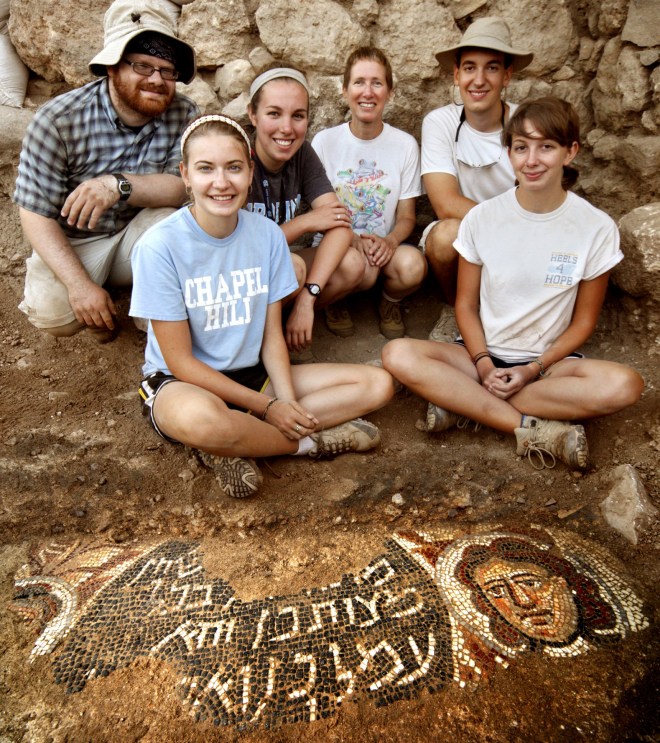
UNC professor Jodi Magness (center) and UNC students (left to right) Brian Coussens, Caroline Carter, Jocelyn Burney, Jonathan Branch, and Kelly Gagnon, with the 2012 Huqoq mosaic. (Photo by Jim Haberman)

Jodi Magness, an archeologist at UNC Chapel Hill, has been leading excavations at the ancient Jewish city of Huqoq in Israel since 2011. After the first mosaics appeared on the floor of a buried synagogue in 2012, Magness and her team have returned to the site every June to uncover more fantastic mosaics.

“The mosaics were a complete surprise,” says Magness. “Synagogues of this particular type—which is best represented by the synagogue at Capernaum just a couple of miles away—typically don’t have mosaic floors. They have flagstone pavements.”

But, that isn’t the only thing that makes these mosaics one-of-a-kind. Magness and her team were surprised by the subject matter, which involves elephants, dancers, and possibly Alexander the Great. Magness feels the images in these mosaics, as well as their high level of artistic quality, make them truly unique. Click here for more details on the mosaics, and click here for information about the Huqoq excavation site!

Archaeologist may have finished up at Huqoq this season, but hopefully next summer they make more exciting discoveries.

One-of-a-Kind Mosaics Discovered in Ancient Israeli Synagogue

KRYSTIAN SCIENCE TV Roundup: Giant Robot Duel, New ‘Gnarly’ Dinosaur, and a Shark Photobomb

KS_LOGOs2_TVbroadcastIN CASE YOU MISSED IT!


1) AMERICA CHALLENGES JAPAN TO A GIANT ROBOT DUEL

2) NEW DINOSAUR ‘WENDICERATOPS’ ROCKS GNARLY HOOKS & HORNS

3) NASA BRINGS SPACE FLIGHTS BACK TO AMERICAN SOIL

&

4) GREAT WHITE SHARK PHOTO-BOMB

Video

PLUTO VIDEO UPDATE: Pluto’s Big Flat Icy Heart and Shocking Mountain Ranges!

KS_LOGOs2_TVbroadcastIt’s official – the world has Pluto fever! NASA’s New Horizons spacecraft just completed its nearly decade long mission to fly by the dwarf planet Pluto. Christmas has come early for the scientific community as the exciting discoveries keep rolling in! What they’ve learned over the past week will blow your mind. 🌖🚀

Krystian Science TV’s Latest Pluto Update


PLUTO VIDEO UPDATE: Pluto’s Big Flat Icy Heart and Shocking Mountain Ranges!

Japan Lets Robots Run the World’s Wackiest New Hotel – There is Even a Dinosaur in a Bow Tie

KS TechnologyWhen you enter Japan’s new Henn-na Hotel you are greeted by an English speaking robotic dinosaur in a bow tie, next to a multi-lingual fembot, ready to check you in. Other robots greet guests and serve coffee – a robot even brings your luggage to your room. They have also ditched traditional room keys for face recognition technology, making them one of the first hotels to do so.

This innovative low-cost hotel claims to be the ultimate destination for efficiency and productivity, which makes sense given the fact that its almost entirely run by ‘state-of-the-art’ environmentally friendly smart robots.

Henn-na Hotel Dinosaur

One night at the Henn-na Hotel, which roughly translates to ‘strange hotel’ in English, starts at 9,000 yen ($80).

The hotel in Sasebo, Japan, opens to the public today. Some feel the robot staff is a bit gimmicky – but the hotel claims the theme is cutting edge and will help them save on labor costs.

A few things robots are not in charge of at the Henn-na Hotel include monitoring security footage and making the beds. 🏨


Japan Lets Robots Run the World’s Wackiest New Hotel – There is Even a Dinosaur in a Bow Tie

Epic Photos Detail Multiple Discoveries from NASA’s New Horizons Pluto Mission

Krystian Science Space

Pluto observations through the years. Credit: NASA

Icy mountains on Pluto and a new, crisp view of its largest moon, Charon, are among the several discoveries announced Wednesday by NASA’s New Horizons team, just one day after the spacecraft’s first ever Pluto flyby. Here is a collection of incredible photos that highlight just a few of NASA’s recent findings. Feel free to geek out – such an exciting time! 🚀

Pluto New Horizons is a true mission of exploration showing us why basic scientific research is so important,” said John Grunsfeld, associate administrator for NASA’s Science Mission Directorate in Washington. “The mission has had nine years to build expectations about what we would see during closest approach to Pluto and Charon. Today, we get the first sampling of the scientific treasure collected during those critical moments, and I can tell you it dramatically surpasses those high expectations.”

Epic Photos Detail Multiple Discoveries from NASA’s New Horizons Pluto Mission

The Only Thing Better Than One Great White on Camera is TWO: Watch Massive Shark Photo-Bomb

KS_LOGOs2_UnderwaterGreat white sharks are only cool when they are gnawing on someone else’s boat. This week, tourists on a South African shark-diving tour got the shock of their lives when they watched one great white take the bait next to their boat – just as a second great white leapt out of the water behind it! I knew sharks couldn’t take selfies, but apparently photo-bombing isn’t out of the question.

RemoSabatini posted the video below to YouTube on July 6, 2015.

In honor of this weeks gnarly shark footage I’d like to post a few amazing pics from Chris and Monique Fallows – who spend 200 days a year at sea.

Photographing great white sharks for 20 years gives Chris and Monique Fallows front row seats on the amazing behavior and secrets of formidable predators few people see. In this post they share ten of their favorite images of great whites.

Gallery

Meet the Astronauts NASA Just Picked to Return Space Launches to U.S. Soil

Krystian Science SpaceJuly is shaping up to be a great month for America. This year we celebrated our independence, U.S.A. won the Women’s World Cup, the U.S. is about to become the first nation to visit Pluto on the 14th, and now, NASA has announced the four astronauts that will usher space travel back to American soil.

Clockwise from top left: Douglas G. Hurley, Sunita L. Williams, Eric A. Boe, and Robert L. Behnken. PHOTOGRAPHER:  BILL STAFFORD/NASA
Clockwise from top left: Douglas G. Hurley, Sunita L. Williams, Eric A. Boe, and Robert L. Behnken.
PHOTOGRAPHER: BILL STAFFORD/NASA

I’d like to introduce you to Robert BehnkenSunita WilliamsEric Boe, and Douglas Hurley. These four astronauts will begin training now with the hopes of launching in 2017.

These distinguished, veteran astronauts are blazing a new trail, a trail that will one day land them in the history books and Americans on the surface of Mars,” said NASA administrator Charles Bolden in a blog post.

Bolden explained that sending commercial flights to space is “all part of our ambitious plan to return space launches to U.S. soil, create good-paying American jobs and advance our goal of sending humans farther into the solar system than ever before.

Since the space shuttle program was retired in 2011, NASA has relied on Russia to take astronauts to the International Space Station, which costs upwards of $76 million dollars a seat.

Instead, NASA has over 350 American companies working across 36 states on their commercial crew initiative. These four brave men and women will fly on commercially owned and operated spacecraft, built by contractors, not NASA – which will take the cost from $76 million to $58 million per astronaut. This means that every dollar the U.S. invests in commercial crew is a dollar we invest in ourselves, not the Russian economy.

Last year NASA awarded contracts to Boeing and SpaceX to ferry astronauts to the ISS. NASA hopes that by outsourcing the missions to low-Earth orbit they can focus on flying to deep space – even Mars!

I can barely contain my excitement!

pumped up


Meet the Astronauts NASA Just Picked to Return Space Launches to U.S. Soil

Newly Discovered Wendiceratops Dinosaur Displays ‘Gnarly’ Hooks and Horns

KS NatureWhen you think epic horned dinosaur you probably think Triceratops – well, think again! Triceratops had a cousin that lived 79 million years ago, making it one of the oldest horned dinosaurs. It’s known as Wendiceratops pinhornensis, and its unique hooks and horns give paleontologists clues about how horned dinosaurs evolved.

Source: Secret Location/PLOS ONE

The dinosaur’s fossilized bones were discovered on the Pinhorn Provincial Grazing Reserve in Alberta by Canadian fossil hunter Wendy Sloboda in 2010 – hence the name Wendiceratops pinhornensis!

While the name might be cute, there is nothing dainty about this 1-ton, 20-foot long dinosaur. It features two large horns on its brow, one horn on its nose, and a highly-decorated frill around its neck that literally curls in on itself giving it the appearance of hooks. Paleontologist David Evans, from the Royal Ontario Museum, explains that this dino’s frill makes it unique.

“The frill is sort of ornamented by a pretty spectacular wave of gnarly hooks that project forward,” Evans says.

Scientists recovered over 200 different bones from virtually all parts of the skeleton (from four different individuals) including multiple, well-preserved pieces that contribute to the fancy ornamented frill. But it’s not just the frill that makes this animal special – it’s the large horn over its nose, which is the earliest occurrence of a prominent nose horn in this dinosaur family.

Michael Ryan, a paleontologist with the Cleveland Museum of Natural History, says “beyond its odd, hook-like frill, Wendiceratops has a unique horn ornamentation above its nose that shows the intermediate evolutionary development between low, rounded forms of the earliest horned dinosaurs.”

Not only does Wendiceratops help scientists understand the early evolution of skull ornamentation – its crazy frill projections and horns make it one of the most striking horned dinosaurs ever found. Wendiceratops pinhornensis is now on display at Toronto’s Royal Ontario Museum.

For more information check out Ryan and Evans’ description of their dinosaur in PLOS ONE.

This slideshow requires JavaScript.

Newly Discovered Wendiceratops Dinosaur Displays ‘Gnarly’ Hooks and Horns