Incredible New Pluto Pic Highlights ‘Arctic’ Peaks and Valleys in Backlit Panorama

Krystian Science SpaceScientists were stunned after viewing the latest images from NASA’s New Horizons spacecraft. Not only is the surface of Pluto covered in large icy mountains, low-lying hazes, and streams of frozen nitrogen – it also looks eerily like the arctic.

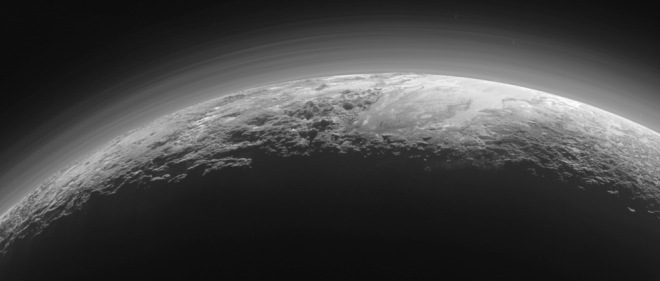
The photo below was taken just 15 minutes after New Horizons made its closest approach to Pluto on July 14, 2015. The spacecraft looked back toward the sun and caught this backlit panorama of Pluto’s rugged mountains and flat icy plains. The backlighting highlights over a dozen layers of haze in Pluto’s atmosphere. Trippy! 🌒

Pluto’s Majestic Mountains, Frozen Plains and Foggy Hazes. Credits: NASA/JHUAPL/SwRI

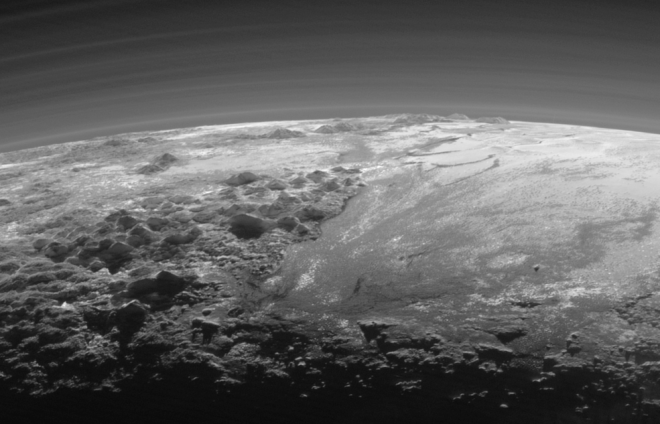
This new view offers a unique look at Pluto’s varied terrains and atmosphere. It was taken by New Horizons’ wide-angle Ralph/Multispectral Visual Imaging Camera (MVIC) on July 14 and downlinked to Earth on Sept. 13. Below is a close up of Pluto’s majestic icy mountains and flat glassy plains. It was taken at a distance of 11,000 miles.

Closer Look: Majestic Mountains and Frozen Plains. Credits: NASA/JHUAPL/SwRI)

This image really makes you feel you are there, at Pluto, surveying the landscape for yourself,” said New Horizons Principal Investigator Alan Stern, of the Southwest Research Institute, Boulder, Colorado. “But this image is also a scientific bonanza, revealing new details about Pluto’s atmosphere, mountains, glaciers and plains.

Near-Surface Haze or Fog on Pluto. Credits: NASA/JHUAPL/SwRI

Let me quickly break down the geography of Pluto’s ‘heart.’ Sputnik Planum is the name of the smooth region on the left of the heart. The white upland region on the right may be coated in nitrogen ice that evaporated from the surface of Sputnik. The box shows the location of the glacier detail image below.

Pluto’s ‘Heart’. Credits: NASA/JHUAPL/SwRI
Valley glaciers on Pluto. Credits: NASA/JHUAPL/SwRI
Image

Pile of Bones in South African Cave Reveal Mysterious New Human Species

KS_LOGOs2_HumanScientists in South Africa have discovered a new species of human, Homo naledi. Its physical attributes are bizarre, its age is unknown, and its burial circumstances are baffling.

Pieces of a skeleton of Homo naledi, a newly discovered human species. Credit John Hawks/University of Wisconsin-Madison, via European Pressphoto Agency
Pieces of a skeleton of Homo naledi, a newly discovered human species. Credit John Hawks/University of Wisconsin-Madison, via European Pressphoto AgencyaqACFV

The bones were collected from a chamber 100 feet below ground within the Rising Star cave system in South Africa’s Cradle of Humankind region, which is known for its human fossils. Some 1,550 specimens of bones and teeth were recovered, belonging to at least 15 different skeletons, but that only represents a fraction of the material at the site. The name H. naledi refers to the cave where the bones were found; “naledi” means “star” in the local Sesotho language.

The research paper published in the journal eLife on September 10th explains that modern humans, or Homo sapiens, are now the only living species in their genus. But as recently as 20,000 years ago there were other species that belonged to the genus Homo. Together with modern humans, these extinct human species, our immediate ancestors and their close relatives are collectively referred to as ‘hominins’.

H. naledi stood at about 5 feet tall, with a small brain, clever hands, and an ape-like torso that was built for walking upright as well as climbing. This unique blend of traits is what expedition leader Dr. Lee Berger of the University of Witwatersrand feels classifies it a new species of human.

Scientists don’t quite know where to place H. naledi on the human family tree. So far, researchers haven’t been able to determine the age of the bones. They could be several million years old or tens of thousands of years old. Also curious is whether or not this primitive creature decided to bury their dead together intentionally.

Click here for an in-depth piece by National Geographic delving into the discovery of H. naledi and how this new species changes the human story.


Pile of Bones in South African Cave Reveal Mysterious New Human Species

New Guinness World Records 2016 Winners Revealed: The Fastest Tortoise, the Man with the Most Teeth, the Heaviest Carrot, and a Huge Gnome Collection

KS_LOGOs2_PopCulture

Guinness World Records has finally released the record holders in the Guinness World Records 2016 edition! They scoured the globe for this year’s biggest achievements, even if some of the awards border on quirky and a little strange (i.e. the giant gnome collection). Scroll through the photos and enjoy. 🏆

“The Guinness World Records 2016 book keeps readers up to date and in the know about the best and brightest in science, sports, entertainment, animals, human achievement and more,” says Guinness World Records Editor-in-Chief Craig Glenday. “By providing a mix of the newest, most amazing records and a splash of the classic titles that readers know and love, the 2016 edition is a great cross-section of humanity’s greatest accomplishments.”

Gallery

My Top Picks For Best Tequila, Food, Dining Views, Salsa, and Service in Sayulita Mexico

KS_LOGOs2_PopCultureSayulita, Mexico, is incredibly sticky, hot, and humid during the off season – with many stormy nights. Most of the locals stay in town, shading themselves under palm trees. Some of the city’s residents choose to venture elsewhere during the months of August and September, renting out their beautiful homes to lucky people like me.

I recently spent a week in Sayulita with my boyfriend and it was magical. Most of the restaurants and shops close down during the time we were there, but we still had plenty to explore. I’ve decided to share a few my favorite places to eat & drink with you! 🌴🌊

© KrystianScience
© KrystianScience

– Best Beach Buy –

Captain Pablo’s is a restaurant right on the water that serves seafood and a few Mexican classics. You can eat inside or out on beach chairs in the sand – each with a little table and umbrella to shield you from the sun. The margaritas were incredibly refreshing and the food was pretty good. I say “best buy” because they are one of the few (if not the only) spots where you can eat right in front of the waves without paying for the space. They call it ‘paying rent.’ All you need to do in order to enjoy their outdoor seating is order some food and drink. Easy enough. Other spots charge 100-500 pesos just to sit down!

– Best Location –

Don Pedro’s easily has the best spot in the city as far as views and location. Surprisingly it doesn’t offer Mexican food, but it does have a nice selection of wine and some tasty North American fare. My boyfriend and I ate here on our first night in town and our last. The first night was 95 degrees and Don Pedro’s was a quick 5 minute walk from the city center, located right on the water with breathtaking views of the surf and neighboring jungle mountains. The fans (and beers) gave us comfort as we watched the sunset. The last night we ran into Don Pedro’s to avoid a huge storm after walking along the beach. They provided the perfect spot to enjoy some wine, watch the rain, and eat good food.

– Best Surprise Meal –

When you think Mexico you don’t think fantastic Mediterranean food – well, think again! Falafel & Friends was so good we ate there twice in a week. Tucked into one of Sayulita’s many cobble-stone side streets is a little falafel shop that blew our minds. Everything is made fresh and the service is great. The chicken wrap was sweet, juicy, and savory. The falafel & hummus platter was to die for. And, as a person who loves a good sauce, they provide you with a selection of hot sauce, tahini, and tzatziki – which I put on everything.

– Best Little Dive Bar –

My heart feels warm and fuzzy when I think about El Barrilito. Located at the base of Gringo Hill (yes, it’s really called that) is a small dive bar with the kindest staff and best house tequila. We ended up here most of the nights we stayed in the city because our Airbnb was at the top of the hill, just 5-10 minutes away. Their kitchen was closed because we came during the peak of the off season, but their friendly service and view of the plaza is all we needed.

– Best Green Salsa & Hospitality –

I think my boyfriend and I agree that this was our favorite local hangout in the city. Aaleyah’s instantly greeted us with free shots of their house tequila and two beers. They escorted us up to their bar where their TV was blasting VH1’s greatest hits. They placed chips and salsa in front of us. But, this wasn’t just any salsa; it was the creamiest green salsa I’ve ever had. Turns out they are famous for it! When we went back to Aaleyah’s we were again greeted with tasty tequila and warm smiles. They even invited me into the kitchen to watch them make their amazing salsa. Garlic, green peppers, and a little oil cooked in a pan. The mixture is then put into a blender with chicken stock powder, cilantro, and lime. You’ve gotta try it out. You can thank me later!

– Best Mexican Meal –

This may come as no surprise, but we ate a ton of Mexican food while in Sayulita. Some was fantastic and some was average. But, one place stood out in our minds as the freshest, cleanest, and tastiest of them all. Mary’s makes one of the best burritos I’ve ever had. In California I tend to like a burrito with tons of melty cheese, heaps of meat, guacamole, scoops of sour cream, and a big oily tortilla. Mary’s makes the opposite. Their pollo supreme burrito was big enough for two, filled with fresh slices of avocado, cabbage, sweet tomatoes, perfectly grilled chicken, beans, and a light layer of white cheese. I hear their tacos are also a must have.

– Best Cocktail & Dance Party –

YamBak knows how to get people to dance. Their nighttime combination of psychedelic imagery, pumping music, and well-crafted cocktails does the trick. The bartenders are attentive and quick, and the atmosphere is cool and artsy. I have to admit that we popped in on a slow night. We played card games at the bar and sipped on tequila, but the rest of the week we walked by this place and it was a big indoor/outdoor party!

– Best Breakfast –

Chocobanana provided a bit of early morning comfort with their amazing breakfast dishes, pastries, smoothies, and coffee drinks. The reviews online admit the food is good but call the dishes “gringo” breakfast. It’s a cheap sit down spot with awesome options for everyone! They have something for kids, vegetarians, big eaters, locals, and tourists alike. I ate the ‘little girl breakfast,’ which included a silver dollar pancake, one strip of bacon, one egg, and a fruit cup.  My boyfriend opted for the ‘paleo breakfast,’ which offered two poached eggs, fresh avocado, and sausage. (Honorable mention: Cafe El Espresso – right across the plaza from Chocobanana)


My Top Picks For Best Tequila, Food, Dining Views, Salsa, and Service in Sayulita Mexico

Nerd Nite San Francisco is the Best $8 You Will Spend All Month: 7 Questions for Co-Founder Bart Bernhardt

KS_LOGOs2_PopCultureNerd Nite SF is proof nerds know how to party. On the third Wednesday of every month nerds of all shapes and sizes gather together to listen to a few lectures and drink a bunch of booze. The crowd that gathers at the Rickshaw Stop on Fell St. in San Francisco is incredibly diverse and yet equally excited to throw back a few brews and learn a thing or two in the process.

Heavy red curtains line the walls and the faint hint of smoke from toasting grilled cheese sandwiches floats in the air. They sell Nerd Nite SF shirts (I have two) next to a booth dedicated to the San Francisco Public Library. My favorite part? Not only does Rickshaw have a full bar, they also have a cocktail of the night themed after one of the presentations. This last Nerd Nite featured a wonderful talk about absinthe, so the cocktail was “The Root of all Evil” – absinthe + root beer. 🍻

Nerd Nite began in Boston in 2003 and has since spread to 90 cities all over the globe. The city of San Francisco has Lucy Laird and Bart Bernhardt to thank for bringing the brainy shenanigans to the Bay Area. Not only is Bart co-founder of Nerd Nite SF, he is also the enthusiastic and hilarious host of the night! I was lucky enough to get the chance to chat with him about Nerd Nite SF’s beginnings, his favorite talks over the years, and how you can bring Nerd Nite to your city.

Nerd Nite May 20
Bart Bernhardt – co-founder and host of Nerd Nite SF (Credit: Krystian Science)

1) What is your role with Nerd Nite SF and how did you initially get involved?

We’re the co-organizers of NNSF, so we book & coach speakers, manage the venue  & A/V, organize field trips, and all that jazz.

Several years ago, Chris Balakrishnan (the founder of Nerd Nite) and Matt Wasowski (head of the Nerd Nite network and NN NYC) went on a national tour and, like nerdy Johnny Appleseeds, wherever they went, little Nerd Nites sprung up in their wake!

In SF, they did their thing at Langton Labs, a really awesome artist/scientist/community living space, and god knows how many people were crammed into this sign-factory-turned-underground-community-center to hear lectures on ornithology, archaeology, and neurobiology. But there was also tons of drinking and laughing and zombies and heckling and me thinking why isn’t this a thing here? I love science and had been to many lecture events and science cafes, and none were as authentic, entertaining, and engaging as this.

I eventually connected with Matt about running a proper Nerd Nite. He introduced me to Lucy, and together we kicked off this little shindig. That was 5? 6? years ago? Something like that.

2) What makes someone a ‘nerd’, and why do you think San Francisco is such a great Nerd Nite city?

Many pixels have been shed over what’s a “nerd”, but I don’t really think too much about it. We’re very inclusive – if you love to learn and self-identify as a nerd for any reason whatsoever, or are even just “nerd-curious”, that’s good enough for us.

The short answer to why Nerd Nite thrives here is because it’s a city filled with young curious people who like to drink! Many are transplants and are looking to find their tribe, and it’s a good way to meet people (in fact, two folks who met at NNSF just got married!). There’s a much longer answer in the curious and wonderful evolution of the Bay Area over the past ~160 years that makes it a uniquely nerdy place.

3) What do you do when you’re not planning for the third Wednesday of the month?

I am involved in innumerable projects and consulting gigs, mostly advertising and data-related. Lucy is the operations director for the SF Silent Film Festival and consultant on all things film exhibition-related.

4) Nerd Nite blends science, comedy, research, and performance… yet it’s accessible and lets be honest, a little boozy. How does Nerd Nite walk the line between informative and fun?

It’s surprisingly easy. We tell speaker candidates that, you know, we’re in a bar and we give you lots of free beer. We want you to have a ton of fun and make jokes and you can even swear if you like, but you also need to be deeply educational. And most people just get that and run with it, especially if they’ve been to a Nerd Nite before. It’s pretty rare that we have to step in and say “You should increase/decrease the depth of this talk” or “crank up the fun”. It happens, but not often. It turns out nerds are often very enthusiastic about their expertise and also like to have fun.

5) You schedule such a wide variety of speakers – what are your guidelines for picking a specific talk?

The benefit of running your own lecture series is that you get to book whatever sounds interesting to you! So that’s a pretty big bias.

Beyond that, we really do try to curate a wide range of topics, presentation styles, genders, depth, and whatnot. I particularly like finding “surprising complexity” presentations – these are talks that take something you think you understand as being simple, if you even think about it at all, but under the tutelage of an expert a fascinating complicated world is revealed. Similarly, I love talks that take a fairly known topic, but approach it from an unexpected angle. I love that stuff.

6) You have seen a lot of interesting talks and colorful characters – what are a few of your favorites?

Oh, wow. So many, and for so many different reasons. From kicking it with an actual #&$@%!ing Apollo 9 astronaut, to science raps that brought down the house, to heavy metal riffs on a homemade lute, to the most endearing ode to the Martian magnetosphere, we have a huge range of favorites. Of the more recent ones, I can think of:

Two months ago, Brendan Rogers came on stage to talk about labor abuse in the fishing industry, and he kicks it off by saying he was a homeless teenager on the streets of SF who needed structure, and that’s why he went into the Coast Guard and worked on ships in the South Pacific, and that’s how he became aware of this issue. And I’m like, holy shit, this guy is legit. I really appreciated that.

Michelle Trautwein from the California Academy of Sciences was talking about face mites, and the sampling methodology they used in a study. And there’s a moment where she’s cracking up, and the audience is laughing, and we’re talking about methodology and I couldn’t be happier. She later said that was the most fun she’s ever had doing science outreach, which is just about the nicest thing anyone could say to us.

Self-described “monsterologist” Brian Engh came on stage in hoodie and saggy pants and grabbed the mic like a rapper — because he is — and proceeded to slay the audience with the phylogenetic trees of dinosaurs and the process he went through to create a realistic representation of a newly published dinosaur fossil in partnership with the paleontologist discoverers.

7) How can someone bring Nerd Nite to their town? If there isn’t one already scheduled?

Contact an existing Nerd Nite boss! I assure you we don’t make much money on this, we do it because we love learning and being part of a joyous community. We’re happy to help you spread the nerdlove, so please reach out and we’ll walk you through what it takes.


Nerd Nite SF is the third Wednesday of every month and it costs just $8 if you get your ticked in advance online! You have a small chance of getting in at the door the night of, but Nerd Nite often sells out, so plan ahead 😎

Nerd Nite San Francisco is the Best $8 You Will Spend All Month: 7 Questions for Co-Founder Bart Bernhardt

SCIENCE VIDEO ROUNDUP: Huge Great White Shark, Booze Reaches the ISS, and a Two-Headed Sea Slug

KS_LOGOs2_TVbroadcastKSTV Weekly Science Wrap Up!


1) ‘Deep Blue’ – The Biggest Great White Shark Caught on Film

2) LA Saves Water with ‘Shade Balls’

3) Whiskey Reaches the ISS

&

4) The World’s First Two-Headed Sea Slug

SCIENCE VIDEO ROUNDUP: Huge Great White Shark, Booze Reaches the ISS, and a Two-Headed Sea Slug

Japanese Distillery Sends Delicious Whiskey to Space to Age in Zero Gravity

Krystian Science SpaceIt’s a good thing I’m not a trusted astronaut aboard the International Space Station, because instead of conducting important experiments and exploring our universe I’d probably be the first person to get drunk in space. Japanese distillery Suntory announced it’s shipping booze to Kibo, Japan’s module on the ISS – you know… for science.

Screen Shot 2015-08-17 at 1.00.16 PM

Suntory’s award-winning whiskey will be off limits to astronauts, the group is just curious how zero gravity might effect the aging process.

H-II Transfer Vehicle No. 5, commonly known as “Kounotori5” or HTV5, launched from JAXA’s Tanegashima Space Center on August 19 carrying alcohol produced by Suntory to the ISS, where experiments on the “development of mellowness” will be conducted. Suntory hopes to find a scientific explanation for what ‘mellows’ alcohol over time.

A company spokesman said that the samples will include both a 21-year-old single malt whiskey (YUM) and a beverage that has just been distilled. The first samples will return to Earth after one year, while the other group of samples will remain in space for at least two years.

Do you want to get your hands on space-aged whiskey? Me too… but,  Suntory says they have no plans to make the unique specimens available for public purchase.

Bill Murray Scotch

Japanese Distillery Sends Delicious Whiskey to Space to Age in Zero Gravity

World’s First Two-Headed Neon ‘Toxic’ Sea Slug Discovered in Borneo

KS Strange ScienceThis neon two-faced sea slug might look like something you’d find in a sci-fi movie, but it was just found right here on Earth! 🐛

Credit: Caters News Agency

The nudibranch – a soft-bodied, marine gastropod mollusk – was discovered by a diver and a team of film-makers at Kapalai, a sandbar off the coast of Sabah in eastern Malaysian Borneo.

These slugs are part of the species nembrotha kubaryana, but are commonly known as neon sea slugs due to their bright orange and green pattern – which warns predators of their toxicity.

The two-headed oddity was found by dive master Nash Baiti while making a new film series called ‘Borneo from Below.’ This amazing slug’s alien malformation was most likely caused by a gene mix up or damage from pollution.

Clay Bryce, a nudibranch expert and marine biologist at the Western Australian Museum in Perth said, ‘I have never seen another two headed marine creature like this before and I have spent 10,000 hours underwater chasing nudibranchs.’

Maybe it’s just me, but I think this one-of-a-kind neon slug is pretty cute! 😝

World’s First Two-Headed Neon ‘Toxic’ Sea Slug Discovered in Borneo

Los Angeles Drops 96 Million ‘Shade Balls’ into the LA Reservoir Turning it into a Massive Ball Pit

KS_LOGOs2_PopCultureIf you asked a 4th grade class how they might solve California’s historic drought crisis, one kid might yell – “turn the water into a Chuck E. Cheese ball pit!” Well, Los Angeles did just that, and the video is pretty fun to watch. Give your inner child a high five and watch the video below. 😎

California is in the middle of its worst drought on record and the Los Angeles Department of Water and Power is doing its part to conserve water. This week, the city finished the final phase of its ‘shade ball’ initiative. LA dropped 96 million plastic black balls onto the surface of its 175 acre water reservoir, which is expected to save them $250 million and prevent the annual loss of over 300 million gallons of water. The shade balls are a cheaper alternative to LA’s other conservation ideas, which included splitting the basin in half or installing massive floating covers.

The LADWP said in a press release, “The small, black plastic balls protect water quality by preventing sunlight-triggered chemical reactions, deterring birds and other wildlife, and protecting water from rain and wind-blown dust.”

The reservoir, located in LADWP’s Van Norman Complex in Sylmar,  holds 3.3 billion gallons of water – enough to supply the entire city of Los Angeles with water for three weeks.

The Los Angeles Department of Water and Power released 96 million black shade balls into the Los Angeles Reservoir to reduce evaporation and deter algal growth. PHOTOGRAPH BY GENE BLEVINS, LA DAILY NEWS/ZUMA WIRE/CORBIS

The project cost a total of $34.5 million, but, at $0.36 each, the shade balls require no construction, parts, labor or maintenance aside from occasional rotation. They are designed to reduce evaporation, cool the water, and make the reservoir less susceptible to algae, bacterial growth, and chemical reactions.

The shade balls are made of black polyethylene and filled with water so they don’t blow away. According to the manufacturers, the balls should last up to 25 years.

Dr. Brian White, a now-retired LADWP biologist, was the first person to think of using shade balls for water quality. The idea came to him when he learned about the application of “bird balls” in ponds along airfield runways.


Los Angeles Drops 96 Million ‘Shade Balls’ into the LA Reservoir Turning it into a Massive Ball Pit

Massive Shark Report: ‘Deep Blue’ is Biggest Great White Caught on Film and Huge Tiger Shark Caught in Australia

KS_LOGOs2_UnderwaterI can’t decide if this footage of what is believed to be the biggest great white shark ever caught on film is terrifying or eerily soothing. Her name is ‘Deep Blue’ and not only is she over 20-FEET long – she may also be pregnant.

The footage was captured by shark researcher Mauricio Hoyos Padilla off Mexico’s Guadalupe Island in 2013, but wasn’t released until now.


When Padilla first spotted ‘Deep Blue’ he wasn’t afraid, he was excited. “When I saw Deep Blue for the first time, there was just one thought on my mind: HOPE. A shark of that size is at least 50 years old and that tells me protection and conservation efforts are working. Deep Blue has been spared from long lines and the inherent dangers of living in the wild,” he wrote.

Padilla wants to raise awareness and help protect these magnificent creatures. New born baby great whites and pregnant females run the risk of getting caught in lines and nets in shallow waters and the illegal trade of shark teeth, jaws, and fins is sadly very lucrative.

This isn’t the first time the world has seen Deep Blue. Discovery featured the large great white in a Shark Week documentary last year.


The news of Deep Blue comes just days after the corpse of an 18-FOOT tiger shark was pulled onto a fishing boat off the coast of Australia. According to reports, Geoff Brooks posted two images of the huge predator to Facebook on Tuesday, claiming that the tiger shark was caught near Lennox Head, on the northern New South Wales coast. But, there is much debate as to exactly when and how the shark was killed.

Massive Shark Report: ‘Deep Blue’ is Biggest Great White Caught on Film and Huge Tiger Shark Caught in Australia