This adorable 2-year-old Rottweiler’s name is Brutus, and he gets around using four specially designed prosthetic paws!
Brutus was left out in the freezing cold as a puppy and developed frostbite. His owner decided to amputate all four paws, and eventually gave him up for adoption.
Lucky for Brutus, someone noticed him in a store parking lot in Colorado, where he was looking for a new home. Hundreds of people donated money to give Brutus a new lease on life and four new paws! Brutus’ new owner, Laura Aquilina, says she just wants to give Brutus the gift of being a regular dog.
Felix Deurr, an orthopedics professor at Colorado State University, says prosthetics like Brutus’ have only been around for about 15 years and not all dogs get used to them. A study reviewing their effectiveness is due out later this year.
According to NBC News, Brutus is the second dog in history to receive four prosthetic limbs.
Aquilina says if Brutus doesn’t take to the prosthetics, she will move on without them, but by the looks of this video, Brutus is doing just fine!
The full “blood moon” lunar eclipse only lasted five minutes! But, people all over the world still managed to capture the epic moment on film. Check out these beautiful photos of the ‘shortest lunar eclipse of the century,’ courtesy of TIME, Yahoo, and Flickr.
Indians watch a lunar eclipse from the banks of River Kuakhai on the outskirts of Bhubaneswar, India, Saturday, April 4, 2015. (AP Photo/Biswaranjan Rout)
COLORADO SPRINGS, CO – APRIL 04: Sky-watchers got a glimpse of the Blood Moon in the shortest eclipse of the century as it sets behind Pikes Peak April 4, 2015 in Colorado Springs. The top edge of the eclipsed moon should appear much brighter than the rest of the orb.(Photo By John Leyba/The Denver Post via Getty Images)
A lunar eclipse is observed above a lion-shaped statue in Urasoe city, Okinawa prefecture, southern Japan, Saturday, April 4, 2015. (AP Photo/Kyodo News) JAPAN OUT, MANDATORY CREDIT
AUCKLAND, NEW ZEALAND – APRIL 04: A blood red moon lights up the sky during a total lunar eclipse on April 4, 2015 in Auckland, New Zealand. The shortest total lunar eclipse, or “blood moon”, of the century will last just a few minutes. (Photo by Phil Walter/Getty Images)
A partially eclipsed full moon sets behind a statue of a Kansa Indian at the Kansas Statehouse, Saturday, April 4, 2015 in Topeka, Kan. (AP Photo/Charlie Riedel)
Lunar eclipse in Las Vegas with stratosphere. Flickr: tslclick
A total lunar eclipse is observed above cherry blossoms in Shiraishi city, Miyagi prefecture, northeastern Japan, Saturday, April 4, 2015. (AP Photo/Kyodo News) JAPAN OUT, MANDATORY CREDIT
The beginning of a total lunar eclipse is seen behind leaves illuminated by a street light in Canberra, Australia, on Saturday, 04 April 2015. A total lunar eclipse occurs when the moon on its way around the Earth moves through the planet’s shadow cast by the sun in opposing position. EPA/LUKAS COCH AUSTRALIA AND NEW ZEALAND OUT
A lunar eclipse is seen from Melbourne, Australia, on Saturday, 04 April 2015. A total lunar eclipse occurs when the moon on its way around the Earth moves through the planet’s shadow cast by the sun in opposing position. EPA/DAVID CROSLING AUSTRALIA AND NEW ZEALAND OUT
A lunar eclipse is seen beside a clock tower at Marina Beach in Chennai, India, Saturday, April 4, 2015. (AP Photo/Arun Sankar K)
Is this real life? First, Nintendo enters the mobile gaming ring, and now, THIS?! It’s time to blow the dust out of your old Game Boy and Game Boy Color cartridges, kids!
Super Mario Bros. Deluxe, Zelda, Pokeman, Donkey Kong Country, Tetris, Kirby … I’ve got to figure out what I want to play first!
Hyperkin, an independent video game hardware developer from Los Angeles, recently revealed their plans to release a Game Boy-compatible device for the iPhone 6 Plus. Don’t worry, there are plans for more compatible smartphones in the future!
The Smart Boy began as an April Fool’s joke, but is now a full fledged project designed for consumer release.
The Smart Boy, which resembles an old school Nintendo Game Boy, attaches to the bottom of the iPhone 6 Plus, and allows you to play your favorite games in HD. It features the familiar directional pad, start, select, and A + B buttons.
In the beginning, the Smart Boy will only be available in the classic “80’s grey” hue, but more colors may follow.
“We wanted to create a retro device that can be easily adapted into any modern gamer’s arsenal of devices,” said Hyperkin’s product developer, Chris Gallizz
The gameplay itself will output through the iPhone 6 Plus’ own screen, and the Smart Boy will be accessed through an exclusive downloadable Smart Boy app.
If Nintendo is smart, they will see the huge demand for classic gameplay on smartphones, and hopefully team up with Hyperkin (or something similar) in the future.
An Arkansas man went to the hospital last May complaining of nausea, fatigue, weakness, and body aches. After doctors conducted a kidney biopsy, they realized his kidneys were failing due to a high number of oxalate crystals found in the tissue.
Black tea is a significant source of oxalate, which is naturally found in many foods, and the 56-year-old man admitted to drinking 16 glasses of iced tea a day!
Researchers believe his excessive beverage habit could be the cause of his kidney failure, but can’t prove iced tea was the culprit.
“There are reports about kidney stones related to high oxalate intake attributed to tea, but to our knowledge there are no reports of biopsy-proven nephropathy [kidney damage] associated with excessive consumption of iced tea,” said one of the report’s co-authors, Dr. Alejandra Mena-Gutierrez, of the University of Arkansas for Medical Sciences in Little Rock.
Although it can’t be proven that iced tea led to this man’s condition, doctors often put kidney stone patients on low-oxalate diets. Beverages that are considered high-oxalate drinks include black tea, dark beer, instant coffee, and Ovaltine.
Unfortunately, the man needed dialysis, and remained on it because the damage to his kidneys was so severe.
This plant has managed to grow for nearly 55 years on just one ‘drink’ of water and limited outside contact, eventually forming its own ecosystem.
David Latimer planted the garden on Easter Sunday in 1960. He placed compost, water, and spiderwort (Tradescantia) sprouts into a 10-gallon jug. 12 years later, he gave the plants a quick ‘drink,’ before sealing it for good. With that one exception, the garden has remained totally sealed – all it needs is plenty of sunlight!
Latimer spent over 40 years doing nothing more than rotating the bottle occasionally in the sun, as the plants grew isolated in the bottle. The question is, how did the plants survive? Turns out, it created its own ecosystem, effectively using photosynthesis to recycle nutrients!
You too can create your own ecosystem. All you need is a large bottle, potting soil, pebbles or stones, and plants. Watch the video below to find out how to make your own terrarium 🙂 I apologize ahead of time for the cheesy music.
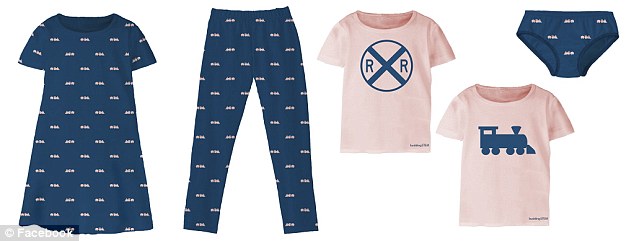
Two Washington moms started a science-themed clothing line for girls after they realized they couldn’t find clothes featuring dinosaurs, trains, or rocket-ships in the girls department – I guess that is just little boy territory!
BuddingSTEM, created by Jennifer Muhm and Malorie Catchpole, offers a complete line of girls’ clothes celebrating science, space, dinosaurs, and more; perfect for girls ages 18 months to eight years old.
“STEM” stands for science, technology, engineering and math.
As a young woman obsessed with science, this story really warms my heart. Growing up, I had a few gender neutral hand-me-downs with basic math symbols on them, but nothing as cool as this!
Jennifer Muhm, 37, told ABC News, “We’re not anti-princess. We’re not anti-pink. We’re not anti-girly. We just think there needs to be more than just that offered for our girls.”
Muhm first realized this was a serious issue when her 5 year old daughter wanted to be an astronaut for Halloween in 2013 and they could only find boys modeling the space-themed costume in the catalogue.
She explained to her daughter that she could be anything she wanted to be, but she couldn’t stop thinking about how unfair the situation was. What were little girls supposed to wear that wanted to explore the universe and dig for dinosaurs?
By April 2014, Muhm and Catchpole filed their business registration for buddingSTEM.
Thanks to a successful Kickstarter campaign, buddingSTEM has raised more than $56,000!
The buddingSTEM clothing line will be available on their website starting in July.
Festo has unveiled a slew of new animal-inspired robotic creatures you need to see to believe.
I’d like to introduce you to Festo’s BionicANTs, eMotionButterflies, and FlexShapeGripper!
BionicANTs – ‘Highly integrated individual systems to solve a common task’
CREDIT: FESTO
The BionicANTs not only mimic the delicate anatomy of ants, but also their cooperative behavior. BionicANTs actually work together, under a clear set of rules, to coordinate their actions and movements. They even know when to branch off and use their ‘antennae’ to re-charge at the edge of their work space.
By pushing and pulling together, the ants are able to move an object across a defined area. This way, they are able to move loads that a single ant could not move alone. This technology seems playful, but it could greatly impact factories and production lines in the future.
Why ants? Ants are tough industrious workers that can carry a hundred times their own body weight. They live in big colonies with clear rankings and set rules. Ants know which tasks they need to fulfill, and they can work together to complete them.
eMotionButterflies – ‘Ultralight flying objects with collective behavior’
CREDIT: FESTO
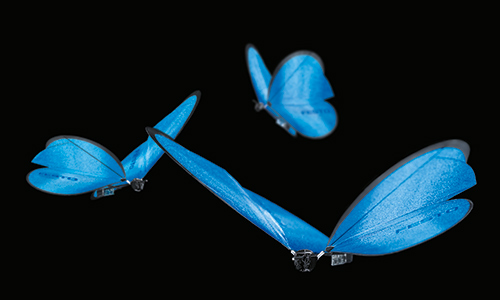
These might be the most beautiful robots I’ve ever seen! You have to admit they look real. Except for the large ‘Festo’ logo printed on their wings 🙂
These artificial butterflies feature highly integrated on-board electronics, allowing them to activate their wings individually with precision. No human pilot is required to control the eMotionButterflies. Thanks to indoor GPS and a complicated camera system, the bionic insects know where to fly and how to avoid collisions.
The wings are curved out of wafer-thin carbon rods and covered with an elastic capacitor film, which helps keep the eMotionButterfly’s weight as low as possible and its flight as natural as possible.
Why butterflies? Butterflies begin the world as caterpillars and later emerge as colorful flying creatures. They have large wings and slim bodies, making them light and aerodynamic.
FlexShapeGripper – ‘Gripping modelled on a chameleon’s tongue’
CREDIT: FESTO
Gripping applications have always played a key role in production, which explains Festo’s interest in the chameleon’s highly specialized tongue. The chameleon has the ability to shoot its tongue out light a rubber band and wrap around objects like a suction cup.
The FlexShapeGripper’s water-filled silicone cap allows it to wrap itself around various items in a flexible and form-fitting manner, much like a chameleon!
Why a chameleon? Chameleons can more their eyes independently of each other and change the color of their skin depending on their mood and temperature. Their unique tongues help them attack and retract prey as quick as lightening
All three of these ‘biomimetic’ devices will be on display at the industry trade show Hannover Messe in April.
Have you ever wanted to be recruited by Xavier’s School for Gifted Youngsters? Well, that’s not terribly realistic, but you can totally LOOK like an X-Men!
New night enhancement eyedrops were tested by a group of independent researchers known as Science for the Masses, based in California, with lead researcher Gabriel Licina as their guinea pig.
Researcher Gabriel Licina (Credit: Science for the Masses)
Researcher Gabriel Licina (Credit: Science for the Masses)
Researcher Gabriel Licina (Credit: Science for the Masses)
These liquid black drops are a simple combination of Chlorin e6 (Ce6) and insulin in saline, with the addition of dimethlysulfoxide (DMSO). The drops were based on a patent filed in 2012 that claimed this mixture, when applied to the eye, will absorb to the retina and act to increase vision in low light.
Eyedrop Chemical Breakdown: Ce6 has light amplification properties, and has been used as a therapy agent in cancer treatment. The insulin is used to allow absorption of the Ce6 into the chamber of the eye. DMSO is used in cell preservation and in medication application. In this case, its primary ability is to cause increased permeability of the cellular membrane, allowing free passage for the chemicals in the eye drops to reach the eye.
Licina’s eyes were flushed with saline to remove any micro-debris or contaminants. Then they were actually pinned open to remove the ability to blink. Ce6 was then added to the eye via micropippette. After the drops disappeared he was given special lenses and black sunglasses to ensure increased low light conditions and reduce the potential for bright light exposure.
The drops began to work in as little as one hour, with the effects lasting for many hours afterwards. Licina was able to see more than 164 feet (50 meters) in almost total darkness. And it looks like it didn’t even hurt! Licina told Mic, “To me, it was quick, greenish-black blur across my vision, and then it dissolved into my eyes.”
Licina and four subjects from the control group (people who did not use the drops) were taken to a ‘darkened area’ for testing. Three forms of subjective testing were performed. These consisted of symbol recognition by distance, symbol recognition on varying background colors, and the ability to identify moving subjects.
Turns out, Licina’s special vision allowed him to recognize symbols the control group couldn’t see! The Ce6 drops allowed Licina to identify distant figures 100% of the time, while the control group got it right just 33% of the time.
But, as cool as this experiment sounds, these revolutionary drops have people worried. Increased light amplification may cause damage to the eye if used improperly. Science for the Masses stresses the fact they conducted this experiment for research and informative purposes only. So don’t try this at home.
CLICK HERE to view the full report from Science for the Masses.
We are familiar with amphibians and reptiles that can change color, but this frog can actually change the texture of its skin! This unique feature makes it the only vertebrate known to do so.
Dubbed the ‘Punk Rocker’ frog, or Pristimantis mutabilis, the marble-sized amphibian lives in the rain forest of Ecuador. It was discovered by scientist Katherine Krynak in 2009. According to National Geographic, Krynak spotted the frog while on a nighttime walk, and decided to bring the thorny specimen back for closer observation. Once she got home, she saw the frog was slimy and smooth, not what she expected! Eventually, the spines reemerged, and Krynak realized she had made an incredible discovery.
Scientists believe the shifting skin texture serves as a form of camouflage in the wild, helping the frog blend into its mossy environment.
PHOTOGRAPHS BY JUAN M. GUAYASAMIN (RIGHT) AND LUCAS BUSTAMANTE (LEFT), THE ZOOLOGICAL JOURNAL OF THE LINNEAN SOCIETY
After 9 years, Krynak and her colleagues finally gathered enough data to prove it was a new species. Now, the frog finally has a formal name: the mutable rainfrog, or Pristimantis mutabilis. But, we’re going to keep calling it the ‘Punk Rocker’ frog 🙂
A baby sloth bear was born at NaturZoo Rheine in Germany in December, but it was kept under wraps so the newborn could bond with its mother in peace.
Little Niko, born to his mother Devi and father Franz, greeted the world on December 6, 2014.
The first few months of a sloth bear’s life are crucial. According to NaturZoo Rheine’s Facebook page, newborn sloth bears are blind, nearly hairless, and about the size of a guinea pig. Niko spent the first few months of his life alone with his mother in a dark, sound-proof room, under the watchful eye of a hidden camera. At that age, his father is kept separate because he is considered a threat to the baby’s health.
Sloth bear births in zoos are very rare and caring for them can be challening. According to NaturZoo Rheine, there are just 25 sloth bears currently living in European zoos.
Niko is just now beginning to explore his outdoor surroundings, so stay tuned to the NaturZoo Rheine Facebook page for updates!
This slideshow requires JavaScript.
Photo: National Geographic
The reclusive sloth bear lives in the forests of South Asia, feeding on fruits, flowers, termites, ants, and other insects. They have special long, curved claws that allow them to dig deep into nest mounds to find food.
These nocturnal animals tend to keep to themselves. They usually rock a shaggy black coat with a cream-colored snout, and their chest is occasionally marked with a light ‘V’ or ‘Y’ design.
Sloth bears can live up to 40 years in the wild and grow to be nearly 300 pounds! Unfortunately, sloth bears are incredibly vulnerable, threatened by habitat loss and sometimes capture.
Fun Fact: Sloth bears carry their cubs on their back! This is considered a unique trait among bears.












 Krystian Science