Celebrities and Scientists Want Us to Get Serious About Blowing Up Asteroids

Krystian Science SpaceAsteroid Day was this week, and in honor of the completely unknown holiday, campaigners issued a call to action – we must spend more time and money trying to blow up speeding space rocks 🚀

Lord Rees, the astronomer royal, and Brian May, from the rock group Queen, added their names to the 100X declaration (along with Peter Gabriel, Richard Dawkins, Brian Cox and Eileen Collins). They also spoke with the Guardian about this pressing issue.

Video

Will This Flag Represent Planet Earth on Mars in 2025?

Krystian Science Space

Image: OSKAR PERNEFELDT

Each of the Apollo missions that touched down on the Moon planted an American flag in the soil. What if, instead of planting a flag that represented our country, we planted a flag that represented our WORLD? 🌎

Oskar Pernefeldt of the Beckmans College of Design in Stockholm, Sweden, has proposed one simple blue flag to represent all of planet Earth as part of his graduation project.

Here is the symbolic explanation, according to Pernefeldt: “Centered in the flag, seven rings form a flower – a symbol of the life on Earth. The rings are linked to each other, which represents how everything on our planet, directly or indirectly, are linked. The blue field represents water which is essential for life – also as the oceans cover most of our planet’s surface. The flower’s outer rings form a circle which could be seen as a symbol of Earth as a planet and the blue surface could represent the universe.”

Pernefeldt’s flag is designed to represent planet Earth and help remind people that we all share this planet, regardless of national boundaries. I’m in love with this idea! It is part of the reason I love following the International Space Station. The ISS is one of those magical places where multiple nationalities come together to work towards a common goal, no matter what country they call home.

These photos provide a glimpse into the future if Pernefeldt’s vision ever became a reality.

This slideshow requires JavaScript.

Click the video below for a more detailed explanation of how the International Flag of Planet Earth was constructed.

Construction video of The International Flag of Planet Earth.
The video is a part of the graduation project by Oskar Pernefeldt, 2015.

Animation by: Johan Fredriksson / http://www.fredrikssondesign.se


Will This Flag Represent Planet Earth on Mars in 2025?

Enjoy These Breathtaking Photos From Space as We Prepare to Welcome Three ISS Crew Members Back to Earth

Krystian Science SpaceThe space community has fully embraced social media and sharing online, which is truly a treat for the world! Day-to-day life on the International Space Station is something very few people get to experience. Plus, the view from up there is simply one-of-a-kind. NASA’s flickr account is updated frequently, pulling from Twitter, Facebook, Instagram, and other internet accounts. I’ve decided to post a few of my favorites in honor of the three space station members set to return to earth in a few days! 🚀

NASA astronaut Terry Virts (left) Commander of Expedition 43 on the International Space Station along with crewmates Russian cosmonaut Anton Shkaplerov (center) and ESA (European Space Agency) astronaut Samantha Cristoforetti on May 6, 2015 perform a checkout of their Russian Soyuz spacesuits in preparation for the journey back to Earth. Credits: NASA
NASA astronaut Terry Virts (left) Commander of Expedition 43 on the International Space Station along with crewmates Russian cosmonaut Anton Shkaplerov (center) and ESA (European Space Agency) astronaut Samantha Cristoforetti on May 6, 2015 perform a checkout of their Russian Soyuz spacesuits in preparation for the journey back to Earth.
Credits: NASA

The three ISS crew members pictured above are scheduled to depart the orbiting laboratory on Thursday, June 11, after more than six months in space performing scientific research and technology demonstrations. We will be welcoming back Russian cosmonaut Anton Shkaplerov, NASA astronaut Terry Virts, and my girl crush, Italian born ESA astronaut Samantha Cristoforetti. For a full schedule of their anticipated departure/arrival click here.

NASA Television will air converge of their departure and return to Earth. Coverage begins at 10:40 a.m. EDT Wednesday, June 10, when Expedition 43 Commander Terry Virts of NASA hands over command of the space station to cosmonaut Gennady Padalka of the Russian Federal Space Agency (Roscosmos).

Gallery

NASA Selects 9 Crucial Science Instruments for Mission to Jupiter’s Icy Moon Europa

Krystian Science SpaceJupiter’s moon Europa has excited the space community with its bizarre icy surface and thick frozen crust. NASA’s Galileo mission in the late 1990’s provided strong evidence that a large ocean exists under its surface. If this ocean exists, it could have more than twice as much water as Earth – even though its roughly the size of Earth’s moon! It’s the perfect place to look for present day life beyond the planet we call home – given the right tools, of course.

Thirty-three proposals were submitted by researchers for instruments to study Europa. NASA selected nine for a mission that will launch in 2020.

Europa Surface
Strange features on Europa’s icy surface suggest a warm interior. NASA’s Galileo mission obtained this unique view of the surface. Galileo was only able to survey a small fraction of the surface in color at high resolution; high-resolution imaging on a future mission to Jupiter’s moon could capture way more! Credits: NASA/JPL-Caltech

NASA’s fiscal year 2016 budget request includes $30 million to formulate a mission to Europa, including the payload of scientific instruments announced yesterday (May 26).

“This is a giant step in our search for oases that could support life in our own celestial backyard,” said Curt Niebur, Europa program scientist at NASA Headquarters in Washington. “We’re confident that this versatile set of science instruments will produce exciting discoveries on a much-anticipated mission.”

The NASA selectees are… drumroll, please!

Plasma Instrument for Magnetic Sounding (PIMS) — principal investigator Dr. Joseph Westlake of Johns Hopkins Applied Physics Laboratory (APL), Laurel, Maryland. This instrument works in conjunction with a magnetometer and is key to determining Europa’s ice shell thickness, ocean depth, and salinity by correcting the magnetic induction signal for plasma currents around Europa.

Interior Characterization of Europa using Magnetometry (ICEMAG) — principal investigator Dr. Carol Raymond of NASA’s Jet Propulsion Laboratory (JPL), Pasadena, California. This magnetometer will measure the magnetic field near Europa and – in conjunction with the PIMS instrument – infer the location, thickness and salinity of Europa’s subsurface ocean using multi-frequency electromagnetic sounding.

Mapping Imaging Spectrometer for Europa (MISE) — principal investigator Dr. Diana Blaney of JPL. This instrument will probe the composition of Europa, identifying and mapping the distributions of organics, salts, acid hydrates, water ice phases, and other materials to determine the habitability of Europa’s ocean.

Europa Imaging System (EIS) — principal investigator Dr. Elizabeth Turtle of APL. The wide and narrow angle cameras on this instrument will map most of Europa at 50 meter (164 foot) resolution, and will provide images of areas of Europa’s surface at up to 100 times higher resolution.

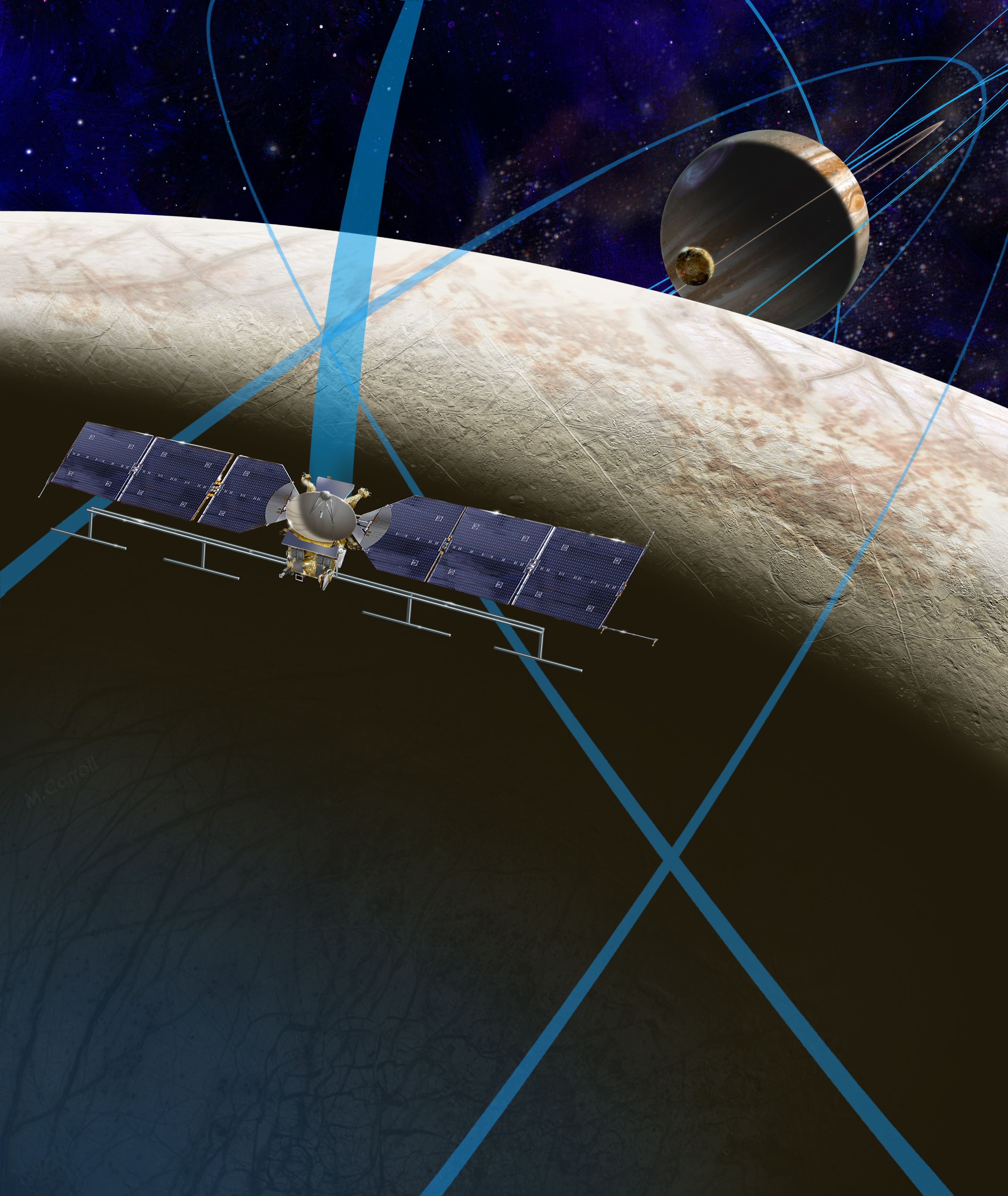
This artist's rendering shows a concept for a future NASA mission to Europa in which a spacecraft would make multiple close flybys of the icy Jovian moon, thought to contain a global subsurface ocean. Credits: NASA/JPL-Caltech
This artist’s rendering shows a concept for a future NASA mission to Europa in which a spacecraft would make multiple close flybys of the icy Jovian moon, thought to contain a global subsurface ocean. Credits: NASA/JPL-Caltech

Radar for Europa Assessment and Sounding: Ocean to Near-surface (REASON) — principal investigator Dr. Donald Blankenship of the University of Texas, Austin. This dual-frequency ice penetrating radar instrument is designed to characterize and sound Europa’s icy crust from the near-surface to the ocean, revealing the hidden structure of Europa’s ice shell and potential water within.

Europa Thermal Emission Imaging System (E-THEMIS) — principal investigator Dr. Philip Christensen of Arizona State University, Tempe. This “heat detector” will provide high spatial resolution, multi-spectral thermal imaging of Europa to help detect active sites, such as potential vents erupting plumes of water into space.

MAss SPectrometer for Planetary EXploration/Europa (MASPEX) — principal investigator Dr. Jack (Hunter) Waite of the Southwest Research Institute (SwRI), San Antonio. This instrument will determine the composition of the surface and subsurface ocean by measuring Europa’s extremely tenuous atmosphere and any surface material ejected into space.

Ultraviolet Spectrograph/Europa (UVS) — principal investigator Dr. Kurt Retherford of SwRI. This instrument will adopt the same technique used by the Hubble Space Telescope to detect the likely presence of water plumes erupting from Europa’s surface. UVS will be able to detect small plumes and will provide valuable data about the composition and dynamics of the moon’s rarefied atmosphere.

SUrface Dust Mass Analyzer (SUDA) — principal investigator Dr. Sascha Kempf of the University of Colorado, Boulder. This instrument will measure the composition of small, solid particles ejected from Europa, providing the opportunity to directly sample the surface and potential plumes on low-altitude flybys.


Can’t get enough of Europa? Click here for the latest news on the Europa mission!

NASA Selects 9 Crucial Science Instruments for Mission to Jupiter’s Icy Moon Europa

NASA Names Massive Strange Star in the Milky Way Something ‘NASTY’

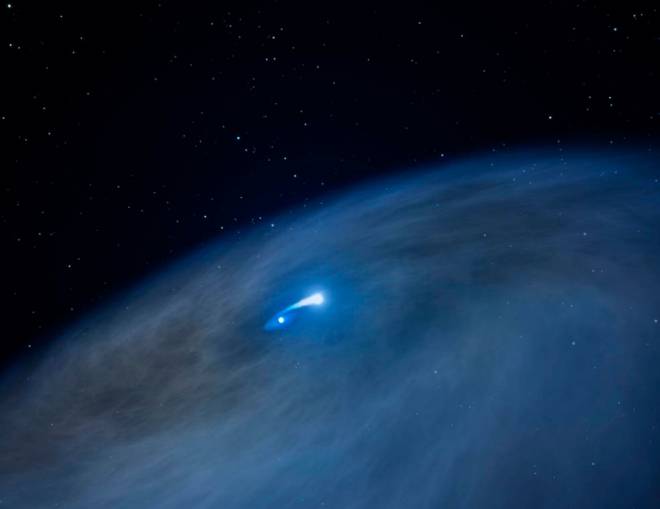
Krystian Science SpaceAstonomers using NASA’s Hubble Space Telescope have discovered surprising new information regarding a massive, one-of-a-kind star, whose behavior has never been seen before in our Milky Way galaxy. The star’s new nickname, ‘Nasty 1,’ is a play on its official catalog name, ‘NaSt1’ – because the rapidly aging star is just that weird.

Credits: NASA/Hubble
The star’s catalogue name, NaSt1, is derived from the first two letters of each of the two astronomers who discovered it in 1963, Jason Nassau and Charles Stephenson. Credits: NASA/Hubble
Image: Hubble Site
Image: Hubble Site

Nasty 1 was originally identified as a Wolf-Rayet star when it was first discovered several decades ago. Wolf-Rayet stars are incredibly hot, massive stars (20x larger than our sun) with a high rate of mass loss – some believe they represent a final burst of activity before a huge star begins to die.

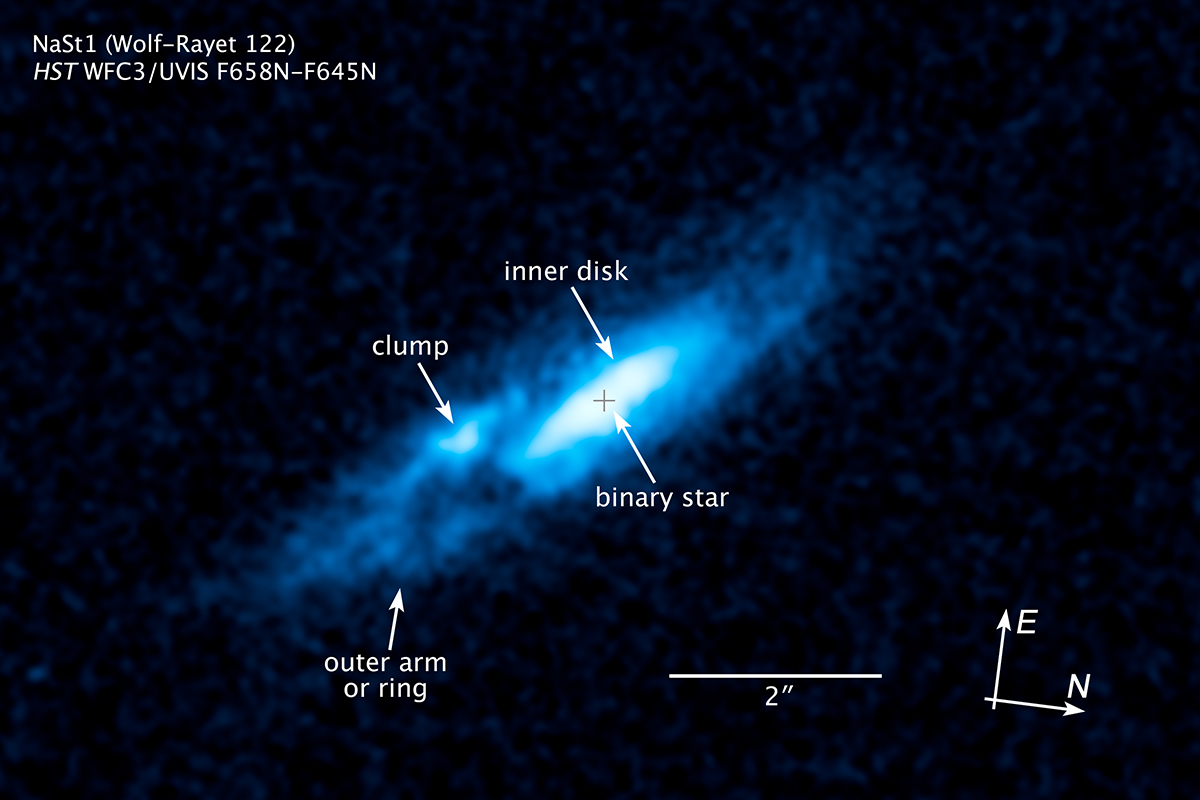
The thing is, Nasty 1 doesn’t look like your usual Word-Rayet star. Astronomers expected to see twin lobes of gas flowing from opposite sides of the star. Instead, they saw a pancake shaped disc of gas encircling the star that is nearly 2 trillion miles wide! This disc could be the result of a binary interaction – which there are very few examples of in the galaxy because this phase is so short-lived.

The Team’s Scenario: A massive star evolves very quickly, and as it begins to run out of hydrogen, it swells up. Its outer hydrogen envelope becomes more loosely bound and vulnerable to gravitational stripping, or a type of stellar cannibalism, by a nearby companion star. In that process, the more compact companion star winds up gaining mass, and the original massive star loses its hydrogen envelope, exposing its helium core to become a Wolf-Rayet star.

But the mass transfer process in mammoth binary systems isn’t always efficient. Some of the stripped matter can spill out during the gravitational tussle between the stars, creating a disk around the binary.

“That’s what we think is happening in Nasty 1,” Mauerhan said. “We think there is a Wolf-Rayet star buried inside the nebula, and we think the nebula is being created by this mass-transfer process. So this type of sloppy stellar cannibalism actually makes Nasty 1 a rather fitting nickname… what evolutionary path the star will take is uncertain, but it will definitely not be boring”

The team’s results will appear May 21 in the online edition of the Monthly Notices of the Royal Astronomical Society.

faf18f8529005d2ee542825e00f7f7db870069c225a88473cc83fe2f358f2163


NASA Names Massive Strange Star in the Milky Way Something ‘NASTY’

NASA Wants to Build a ‘Robo-Squid’ to Search for Life on Other Planets – I Say Make a Movie!

KS Technology

NASA’s latest proposal looks like a sci-fi film in the making. The project calls for the use of a soft-robotic rover that resembles a squid -tentacles included- for missions that can’t be accomplished with conventional power systems.

The ‘robosquid’ looks like an eel with a short antenna on its back. The antenna harvests power from locally changing magnetic fields. Ideally, NASA would like to enable amphibious exploration (both land and sea) of gas-giant moons like Europa!

This artist's rendering depicts 2015 NIAC Phase I Fellow Mason Peck's soft-robotic rover for planetary environments for missions that cannot be accomplished with conventional power systems. It resembles a squid, with tentacle-like structures that serve as electrodynamic 'power scavengers' to harvest power from locally changing magnetic fields. The goal is to enable amphibious exploration of gas-giant moons like Europa. Credits: NASA/Cornell University/NSF
This artist’s rendering depicts 2015 NIAC Phase I Fellow Mason Peck’s soft-robotic rover for planetary environments for missions that cannot be accomplished with conventional power systems. It resembles a squid, with tentacle-like structures that serve as electrodynamic ‘power scavengers’ to harvest power from locally changing magnetic fields. The goal is to enable amphibious exploration of gas-giant moons like Europa. Credits: NASA/Cornell University/NSF

Side Note: If they made Sharknado they can make Robosquid. I grew up loving movies like Anaconda, Congo, and Sphere. I’m picturing the same vibe, starring Nathan Fillion, Jon Bernthal, Ludacris, and Kate Upton. Hey J.J. Abrams and Joss Whedon – Think about it! 😉

Image: KrystianScience

NASA Innovative Advanced Concepts (NIAC)

NASA Innovative Advanced Concepts (NIAC)

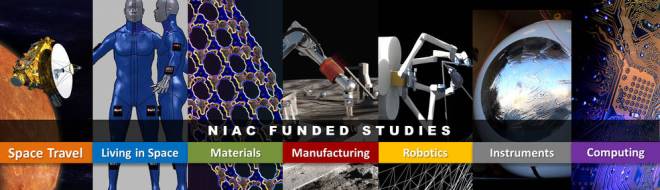
The ‘robosquid’ is just one of 15 proposals selected by NASA for study under Phase I of the NASA Innovative Advanced Concepts (NIAC), a program that aims to turn science fiction into science fact through the development of pioneering technologies.

“The latest NIAC selections include a number of exciting concepts,” said Steve Jurczyk, associate administrator for the Space Technology Mission Directorate (STMD) at NASA Headquarters in Washington. “We are working with American innovators to reimagine the future of aerospace and focus our investments on concepts to address challenges of current interests both in space and here on Earth.”

NASA hopes the knowledge gained from these proposed studies will bring it closer to its goal of exploration beyond low-Earth orbit, and missions to asteroids and Mars.

The projects are chosen through a peer-review process that evaluates their potential, technical approach and benefits that can be realized in a reasonable timeframe. All concepts are very early in the development cycle and represent multiple technology areas, including aircraft propulsion, human life support, science instruments, unique robotic concepts and exploring other diverse technology paths needed to meet NASA’s strategic goals.

NIAC Phase I awards are valued at approximately $100,000, providing awardees the funding needed to conduct a nine-month initial definition and analysis study of their concepts.

NASA Wants to Build a ‘Robo-Squid’ to Search for Life on Other Planets – I Say Make a Movie!

Epic Photos of the “Red Moon” and Shortest Eclipse of the Century

Krystian Science Space

The full “blood moon” lunar eclipse only lasted five minutes! But, people all over the world still managed to capture the epic moment on film. Check out these beautiful photos of the ‘shortest lunar eclipse of the century,’ courtesy of TIME, Yahoo, and Flickr.

Gallery

It’s Hard For Little Girls to Find Spaceships, Trains, and Dinos at the Clothing Store – Don’t Worry, Moms Got This!

KS_LOGOs2_PopCultureTwo Washington moms started a science-themed clothing line for girls after they realized they couldn’t find clothes featuring dinosaurs, trains, or rocket-ships in the girls department – I guess that is just little boy territory!

BuddingSTEM, created by Jennifer Muhm and Malorie Catchpole, offers a complete line of girls’ clothes celebrating science, space, dinosaurs, and more; perfect for girls ages 18 months to eight years old.

“STEM” stands for science, technology, engineering and math.

BuddingSTEM

As a young woman obsessed with science, this story really warms my heart. Growing up, I had a few gender neutral hand-me-downs with basic math symbols on them, but nothing as cool as this!

Jennifer Muhm, 37, told ABC News, “We’re not anti-princess. We’re not anti-pink. We’re not anti-girly. We just think there needs to be more than just that offered for our girls.”

Muhm first realized this was a serious issue when her 5 year old daughter wanted to be an astronaut for Halloween in 2013 and they could only find boys modeling the space-themed costume in the catalogue.

She explained to her daughter that she could be anything she wanted to be, but she couldn’t stop thinking about how unfair the situation was. What were little girls supposed to wear that wanted to explore the universe and dig for dinosaurs?

By April 2014, Muhm and Catchpole filed their business registration for buddingSTEM.

BuddingSTEM 2 BuddingSTEM 1

Thanks to a successful Kickstarter campaign, buddingSTEM has raised more than $56,000!

The buddingSTEM clothing line will be available on their website starting in July.

It’s Hard For Little Girls to Find Spaceships, Trains, and Dinos at the Clothing Store – Don’t Worry, Moms Got This!

Even the Sky is Begging For a Green Beer on St. Patrick’s Day!

Krystian Science Space

NASA has reported that a severe geomagnetic storm is underway and luckily Sebastian Saarloos captured these amazing “St. Patrick’s Day Auroras” at Donnelly Creek, Alaska on March 17, 2015.

This slideshow requires JavaScript.

“The auroras were amazing last night and it was the most color that I’ve ever seen. The auroras also lasted longer than usual. Often I’ll see red or purples for a few minutes but last night it lasted hours. The only reason I stopped photographing was because I was physically exhausted from walking through knee deep snow and fighting 35 mph winds. It was quite warm at 30 f, so cold wasn’t a factor, and the adrenaline kept me warm. I’m looking forward to another great night tonight, but last night will be hard to live up to. The equipment used was a Nikon D810, Rokinon 14mm f/2.8 Super Wide Angle Lens, and a tripod.” – Sebastian Saarloos

You can see more images from Sebastian here: www.facebook.com/SebastianSaarloos


NASA also celebrated St. Patty’s Day by posting a photo of Ireland. This image taken by the Moderate Resolution Imaging Spectroradiometer on NASA’s Aqua satellite shows the Emerald Isle in all its green glory.

Credit: NASA/MODIS RAPID RESPONSE TEAM
Gallery

Science Fix on Netflix: Top 7 Picks to Watch Tonight

KS TechnologyIf you are anything like me, chances are you spend hours streaming on Netflix. So, before you start season 7 of Gilmore Girls, check out these seriously awesome science-y movies and shows available right now! You might even learn something.

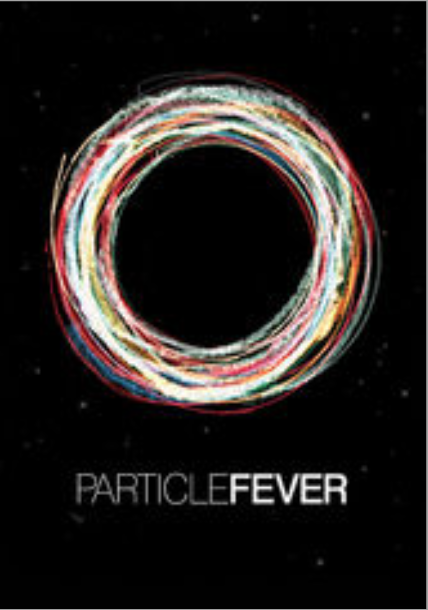
#1 – Particle Fever (2013) 1hr39min

‘The creation of the Higgs boson particle, an elusive key to unlocking secrets of the universe, unfolds on camera in this landmark documentary.’

Particle Fever


I got chills the first time I saw the trailer for Particle Fever. I remember hearing these words: “It could be nothing, other than just understanding everything.” Watch these intelligent and fiercely dedicated people explore the unknown and tackle the largest machine every built.

#2 – Brain Games (2011-2013) 2 Seasons

‘This interactive series uses games, illusions and experiments to illustrate how our brains manufacture our reality and often play tricks on us.’

Brain Games

You think you have a firm grasp on reality, but you have no idea. Brain Games is a truly mind-bending show. It reveals a new way to perceive your world with games, tricks, and eye-opening experiments. Fun for the whole family!

#3 – Nature: Snow Monkeys (2014) 53min

‘In Japan’s frigid Shiga Highlands, a troop of snow monkeys functions in a complex society of rank and privilege where each knows its place.’

Nature: Snow Monkeys

This episode of Nature follows a tribe of snow monkeys through central Japan, showing how they keep friends and family close in order to survive. The shots are absolutely breathtaking, and there is nothing more adorable than snow monkeys relaxing in the arctic hot springs.

Side Note: This episode is narrated by Liam Neeson, which is rad! His voice is soothing and engaging. More like Love Actually Liam, not so much Taken, Taken 2, or Taken 3 – or his new movie Run All Night, which might as well be Taken 4.

#4 – More Than Honey (2012) 1hr35m

‘Already hailed as a definitive work on the subject, this comprehensive documentary examines the disappearance of honeybee populations worldwide.’

More Than Honey

Bees are dying all over the world and they say it’s a mystery. 1/3 of our food wouldn’t even exist without bees. This beautiful documentary is slow-paced but it takes a fascinating look at the dynamics of the hive, pollination, diseases, parasites, the business of bees and their disappearance.

#5 – Cosmos: A Spacetime Odyssey (2014) 1 Season

‘Astrophysicist Neil deGrasse Tyson presents new revelations about time and space in this reboot of the original “Cosmos” documentary series.’

Cosmos

Carl Sagan’s original 1980’s TV show Cosmos: A Personal Voyage made scientific documentaries cool. Tyson is willing to take you on a new Cosmos adventure if you follow his strict rules: “Follow the evidence wherever it leads and question everything. Accept these terms and the cosmos is yours.”

Cosmos: A Spacetime Odyssey can be a little cheesy at times, but for the most part, it is educational, visually stimulating and extremely interesting.

Seth MacFarlaneFun Fact: Animator Seth MacFarlane was instrumental in obtaining network funding for Cosmos: A Spacetime Odyssey and also serves as an executive producer. At the time MacFarlane told Tyson, “I’m at a point in my career where I have some disposable income … and I’d like to spend it on something worthwhile.”


#6 – Nature: Love in the Animal Kingdom (2013) 53m

‘Animals compete with everything they’ve got to find and secure a mate. For many, the all-important bonds they share as a couple are what enable the next generation to survive.’

Nature: Love in the Animal Kingdom

Parts of this episode of Nature actually made me uncomfortable, like I shouldn’t be watching. Mainly, the male sea dragon giving birth, the female gorilla creepily flirting with every male in sight, and the young wolves mating just to be ‘painfully’ interrupted by the female’s angry father.

That being said, what makes this episode so great is probably also what made me squirm. You get a very private, inside look at the way these wild animals dance, sing, flirt, and compete in order to find a mate. It’s highly entertaining.

#7 – Mankind: The Story of All of Us (2012) 1 Season

‘This miniseries charts the rise of civilization, from the first flourishing of life in Mesopotamia through the discovery of America.’

Mankind

Josh Brolin narrates this 12-hour mini-series that provides an in-depth look at the evolution of mankind. I think we often overlook just how incredible we are as a species.

Mankind may try to fit too much into the series, and at times it can feel like a high school history lecture, but it’s also informative and fun to watch. Prepare to learn about our earliest ancestors, farming, tools, weapons, man’s best friend, warfare, the plague, and much more!

Science Fix on Netflix: Top 7 Picks to Watch Tonight