This Bottle Garden Planted in 1960 Has Survived Nearly 55 Years on One Drink of Water

KS Nature This plant has managed to grow for nearly 55 years on just one ‘drink’ of water and limited outside contact, eventually forming its own ecosystem.

David Latimer planted the garden on Easter Sunday in 1960. He placed compost, water, and spiderwort (Tradescantia) sprouts into a 10-gallon jug. 12 years later, he gave the plants a quick ‘drink,’ before sealing it for good. With that one exception, the garden has remained totally sealed – all it needs is plenty of sunlight!

Latimer spent over 40 years doing nothing more than rotating the bottle occasionally in the sun, as the plants grew isolated in the bottle. The question is, how did the plants survive? Turns out, it created its own ecosystem, effectively using photosynthesis to recycle nutrients!

You too can create your own ecosystem. All you need is a large bottle, potting soil, pebbles or stones, and plants. Watch the video below to find out how to make your own terrarium 🙂 I apologize ahead of time for the cheesy music.

This Bottle Garden Planted in 1960 Has Survived Nearly 55 Years on One Drink of Water

Festo’s New Robotic Ants, Butterflies, and Chameleon Tongue Will Make You Do a Double Take

KS Technology

Festo has unveiled a slew of new animal-inspired robotic creatures you need to see to believe.

I’d like to introduce you to  Festo’s BionicANTs, eMotionButterflies, and FlexShapeGripper!

BionicANTs – ‘Highly integrated individual systems to solve a common task’

Festo - BionicANTs
CREDIT: FESTO

The BionicANTs not only mimic the delicate anatomy of ants, but also their cooperative behavior. BionicANTs actually work together, under a clear set of rules, to coordinate their actions and movements. They even know when to branch off and use their ‘antennae’ to re-charge at the edge of their work space.

By pushing and pulling together, the ants are able to move an object across a defined area. This way, they are able to move loads that a single ant could not move alone. This technology seems playful, but it could greatly impact factories and production lines in the future.

Why ants? Ants are tough industrious workers that can carry a hundred times their own body weight. They live in big colonies with clear rankings and set rules. Ants know which tasks they need to fulfill, and they can work together to complete them.

eMotionButterflies – ‘Ultralight flying objects with collective behavior’

Festo - eMotionButterflies
CREDIT: FESTO

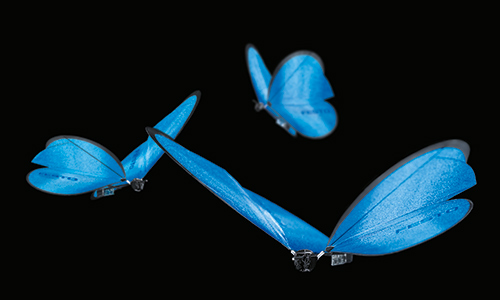
These might be the most beautiful robots I’ve ever seen! You have to admit they look real. Except for the large ‘Festo’ logo printed on their wings 🙂

These artificial butterflies feature highly integrated on-board electronics, allowing them to activate their wings individually with precision. No human pilot is required to control the eMotionButterflies. Thanks to indoor GPS and a complicated camera system, the bionic insects know where to fly and how to avoid collisions.

The wings are curved out of wafer-thin carbon rods and covered with an elastic capacitor film, which helps keep the eMotionButterfly’s weight as low as possible and its flight as natural as possible.

http://https://www.youtube.com/watch?v=1gu3z7w4Vc8

Why butterflies? Butterflies begin the world as caterpillars and later emerge as colorful flying creatures. They have large wings and slim bodies, making them light and aerodynamic.

FlexShapeGripper – ‘Gripping modelled on a chameleon’s tongue’

Festo - FlexShapeGripper
CREDIT: FESTO

Gripping applications have always played a key role in production, which explains Festo’s interest in the chameleon’s highly specialized tongue. The chameleon has the ability to shoot its tongue out light a rubber band and wrap around objects like a suction cup.

The FlexShapeGripper’s water-filled silicone cap allows it to wrap itself around various items in a flexible and form-fitting manner, much like a chameleon!

http://https://www.youtube.com/watch?v=m7l-87r4oOY

Why a chameleon? Chameleons can more their eyes independently of each other and change the color of their skin depending on their mood and temperature. Their unique tongues help them attack and retract prey as quick as lightening

All three of these ‘biomimetic’ devices will be on display at the industry trade show Hannover Messe in April.

Video

Baby Sloth Bear Birth Sneaks Under the Radar in Germany

KS NatureA baby sloth bear was born at NaturZoo Rheine in Germany in December, but it was kept under wraps so the newborn could bond with its mother in peace.

Little Niko, born to his mother Devi and father Franz, greeted the world on December 6, 2014.

The first few months of a sloth bear’s life are crucial. According to NaturZoo Rheine’s Facebook page, newborn sloth bears are blind, nearly hairless, and about the size of a guinea pig. Niko spent the first few months of his life alone with his mother in a dark, sound-proof room, under the watchful eye of a hidden camera. At that age, his father is kept separate because he is considered a threat to the baby’s health.

Sloth bear births in zoos are very rare and caring for them can be challening. According to NaturZoo Rheine, there are just 25 sloth bears currently living in European zoos.

Niko is just now beginning to explore his outdoor surroundings, so stay tuned to the NaturZoo Rheine Facebook page for updates!

This slideshow requires JavaScript.

Photo: National Geographic

The reclusive sloth bear lives in the forests of South Asia, feeding on fruits, flowers, termites, ants, and other insects. They have special long, curved claws that allow them to dig deep into nest mounds to find food.

These nocturnal animals tend to keep to themselves. They usually rock a shaggy black coat with a cream-colored snout, and their chest is occasionally marked with a light ‘V’ or ‘Y’ design.

Sloth bears can live up to 40 years in the wild and grow to be nearly 300 pounds! Unfortunately, sloth bears are incredibly vulnerable, threatened by habitat loss and sometimes capture.

Fun Fact: Sloth bears carry their cubs on their back! This is considered a unique trait among bears.

Gallery

Science Fix on Netflix: Top 7 Picks to Watch Tonight

KS TechnologyIf you are anything like me, chances are you spend hours streaming on Netflix. So, before you start season 7 of Gilmore Girls, check out these seriously awesome science-y movies and shows available right now! You might even learn something.

#1 – Particle Fever (2013) 1hr39min

‘The creation of the Higgs boson particle, an elusive key to unlocking secrets of the universe, unfolds on camera in this landmark documentary.’

Particle Fever


I got chills the first time I saw the trailer for Particle Fever. I remember hearing these words: “It could be nothing, other than just understanding everything.” Watch these intelligent and fiercely dedicated people explore the unknown and tackle the largest machine every built.

#2 – Brain Games (2011-2013) 2 Seasons

‘This interactive series uses games, illusions and experiments to illustrate how our brains manufacture our reality and often play tricks on us.’

Brain Games

You think you have a firm grasp on reality, but you have no idea. Brain Games is a truly mind-bending show. It reveals a new way to perceive your world with games, tricks, and eye-opening experiments. Fun for the whole family!

#3 – Nature: Snow Monkeys (2014) 53min

‘In Japan’s frigid Shiga Highlands, a troop of snow monkeys functions in a complex society of rank and privilege where each knows its place.’
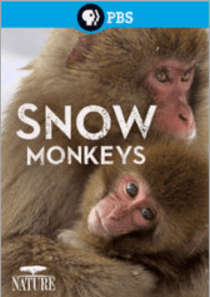
Nature: Snow Monkeys

This episode of Nature follows a tribe of snow monkeys through central Japan, showing how they keep friends and family close in order to survive. The shots are absolutely breathtaking, and there is nothing more adorable than snow monkeys relaxing in the arctic hot springs.

Side Note: This episode is narrated by Liam Neeson, which is rad! His voice is soothing and engaging. More like Love Actually Liam, not so much Taken, Taken 2, or Taken 3 – or his new movie Run All Night, which might as well be Taken 4.

#4 – More Than Honey (2012) 1hr35m

‘Already hailed as a definitive work on the subject, this comprehensive documentary examines the disappearance of honeybee populations worldwide.’
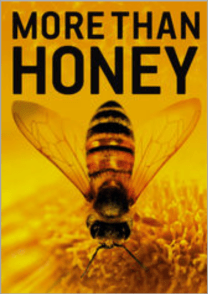
More Than Honey

Bees are dying all over the world and they say it’s a mystery. 1/3 of our food wouldn’t even exist without bees. This beautiful documentary is slow-paced but it takes a fascinating look at the dynamics of the hive, pollination, diseases, parasites, the business of bees and their disappearance.

#5 – Cosmos: A Spacetime Odyssey (2014) 1 Season

‘Astrophysicist Neil deGrasse Tyson presents new revelations about time and space in this reboot of the original “Cosmos” documentary series.’

Cosmos

Carl Sagan’s original 1980’s TV show Cosmos: A Personal Voyage made scientific documentaries cool. Tyson is willing to take you on a new Cosmos adventure if you follow his strict rules: “Follow the evidence wherever it leads and question everything. Accept these terms and the cosmos is yours.”

Cosmos: A Spacetime Odyssey can be a little cheesy at times, but for the most part, it is educational, visually stimulating and extremely interesting.

Seth MacFarlaneFun Fact: Animator Seth MacFarlane was instrumental in obtaining network funding for Cosmos: A Spacetime Odyssey and also serves as an executive producer. At the time MacFarlane told Tyson, “I’m at a point in my career where I have some disposable income … and I’d like to spend it on something worthwhile.”


#6 – Nature: Love in the Animal Kingdom (2013) 53m

‘Animals compete with everything they’ve got to find and secure a mate. For many, the all-important bonds they share as a couple are what enable the next generation to survive.’

Nature: Love in the Animal Kingdom

Parts of this episode of Nature actually made me uncomfortable, like I shouldn’t be watching. Mainly, the male sea dragon giving birth, the female gorilla creepily flirting with every male in sight, and the young wolves mating just to be ‘painfully’ interrupted by the female’s angry father.

That being said, what makes this episode so great is probably also what made me squirm. You get a very private, inside look at the way these wild animals dance, sing, flirt, and compete in order to find a mate. It’s highly entertaining.

#7 – Mankind: The Story of All of Us (2012) 1 Season

‘This miniseries charts the rise of civilization, from the first flourishing of life in Mesopotamia through the discovery of America.’

Mankind

Josh Brolin narrates this 12-hour mini-series that provides an in-depth look at the evolution of mankind. I think we often overlook just how incredible we are as a species.

Mankind may try to fit too much into the series, and at times it can feel like a high school history lecture, but it’s also informative and fun to watch. Prepare to learn about our earliest ancestors, farming, tools, weapons, man’s best friend, warfare, the plague, and much more!
Science Fix on Netflix: Top 7 Picks to Watch Tonight