NASA Selects 9 Crucial Science Instruments for Mission to Jupiter’s Icy Moon Europa

Krystian Science SpaceJupiter’s moon Europa has excited the space community with its bizarre icy surface and thick frozen crust. NASA’s Galileo mission in the late 1990’s provided strong evidence that a large ocean exists under its surface. If this ocean exists, it could have more than twice as much water as Earth – even though its roughly the size of Earth’s moon! It’s the perfect place to look for present day life beyond the planet we call home – given the right tools, of course.

Thirty-three proposals were submitted by researchers for instruments to study Europa. NASA selected nine for a mission that will launch in 2020.

Europa Surface
Strange features on Europa’s icy surface suggest a warm interior. NASA’s Galileo mission obtained this unique view of the surface. Galileo was only able to survey a small fraction of the surface in color at high resolution; high-resolution imaging on a future mission to Jupiter’s moon could capture way more! Credits: NASA/JPL-Caltech

NASA’s fiscal year 2016 budget request includes $30 million to formulate a mission to Europa, including the payload of scientific instruments announced yesterday (May 26).

“This is a giant step in our search for oases that could support life in our own celestial backyard,” said Curt Niebur, Europa program scientist at NASA Headquarters in Washington. “We’re confident that this versatile set of science instruments will produce exciting discoveries on a much-anticipated mission.”

The NASA selectees are… drumroll, please!

Plasma Instrument for Magnetic Sounding (PIMS) — principal investigator Dr. Joseph Westlake of Johns Hopkins Applied Physics Laboratory (APL), Laurel, Maryland. This instrument works in conjunction with a magnetometer and is key to determining Europa’s ice shell thickness, ocean depth, and salinity by correcting the magnetic induction signal for plasma currents around Europa.

Interior Characterization of Europa using Magnetometry (ICEMAG) — principal investigator Dr. Carol Raymond of NASA’s Jet Propulsion Laboratory (JPL), Pasadena, California. This magnetometer will measure the magnetic field near Europa and – in conjunction with the PIMS instrument – infer the location, thickness and salinity of Europa’s subsurface ocean using multi-frequency electromagnetic sounding.

Mapping Imaging Spectrometer for Europa (MISE) — principal investigator Dr. Diana Blaney of JPL. This instrument will probe the composition of Europa, identifying and mapping the distributions of organics, salts, acid hydrates, water ice phases, and other materials to determine the habitability of Europa’s ocean.

Europa Imaging System (EIS) — principal investigator Dr. Elizabeth Turtle of APL. The wide and narrow angle cameras on this instrument will map most of Europa at 50 meter (164 foot) resolution, and will provide images of areas of Europa’s surface at up to 100 times higher resolution.
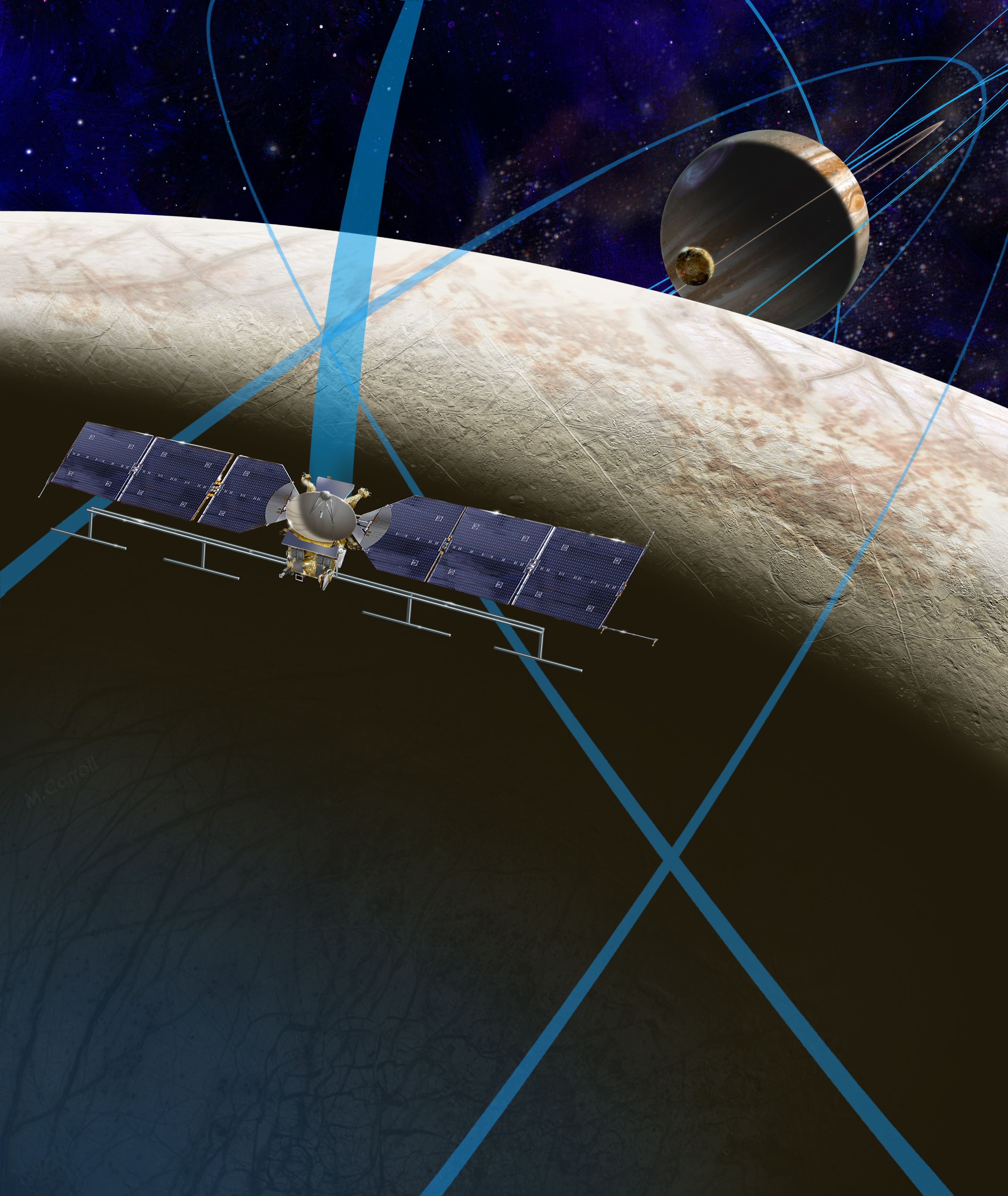
This artist's rendering shows a concept for a future NASA mission to Europa in which a spacecraft would make multiple close flybys of the icy Jovian moon, thought to contain a global subsurface ocean. Credits: NASA/JPL-Caltech
This artist’s rendering shows a concept for a future NASA mission to Europa in which a spacecraft would make multiple close flybys of the icy Jovian moon, thought to contain a global subsurface ocean. Credits: NASA/JPL-Caltech

Radar for Europa Assessment and Sounding: Ocean to Near-surface (REASON) — principal investigator Dr. Donald Blankenship of the University of Texas, Austin. This dual-frequency ice penetrating radar instrument is designed to characterize and sound Europa’s icy crust from the near-surface to the ocean, revealing the hidden structure of Europa’s ice shell and potential water within.

Europa Thermal Emission Imaging System (E-THEMIS) — principal investigator Dr. Philip Christensen of Arizona State University, Tempe. This “heat detector” will provide high spatial resolution, multi-spectral thermal imaging of Europa to help detect active sites, such as potential vents erupting plumes of water into space.

MAss SPectrometer for Planetary EXploration/Europa (MASPEX) — principal investigator Dr. Jack (Hunter) Waite of the Southwest Research Institute (SwRI), San Antonio. This instrument will determine the composition of the surface and subsurface ocean by measuring Europa’s extremely tenuous atmosphere and any surface material ejected into space.

Ultraviolet Spectrograph/Europa (UVS) — principal investigator Dr. Kurt Retherford of SwRI. This instrument will adopt the same technique used by the Hubble Space Telescope to detect the likely presence of water plumes erupting from Europa’s surface. UVS will be able to detect small plumes and will provide valuable data about the composition and dynamics of the moon’s rarefied atmosphere.

SUrface Dust Mass Analyzer (SUDA) — principal investigator Dr. Sascha Kempf of the University of Colorado, Boulder. This instrument will measure the composition of small, solid particles ejected from Europa, providing the opportunity to directly sample the surface and potential plumes on low-altitude flybys.


Can’t get enough of Europa? Click here for the latest news on the Europa mission!

NASA Selects 9 Crucial Science Instruments for Mission to Jupiter’s Icy Moon Europa

NASA Names Massive Strange Star in the Milky Way Something ‘NASTY’

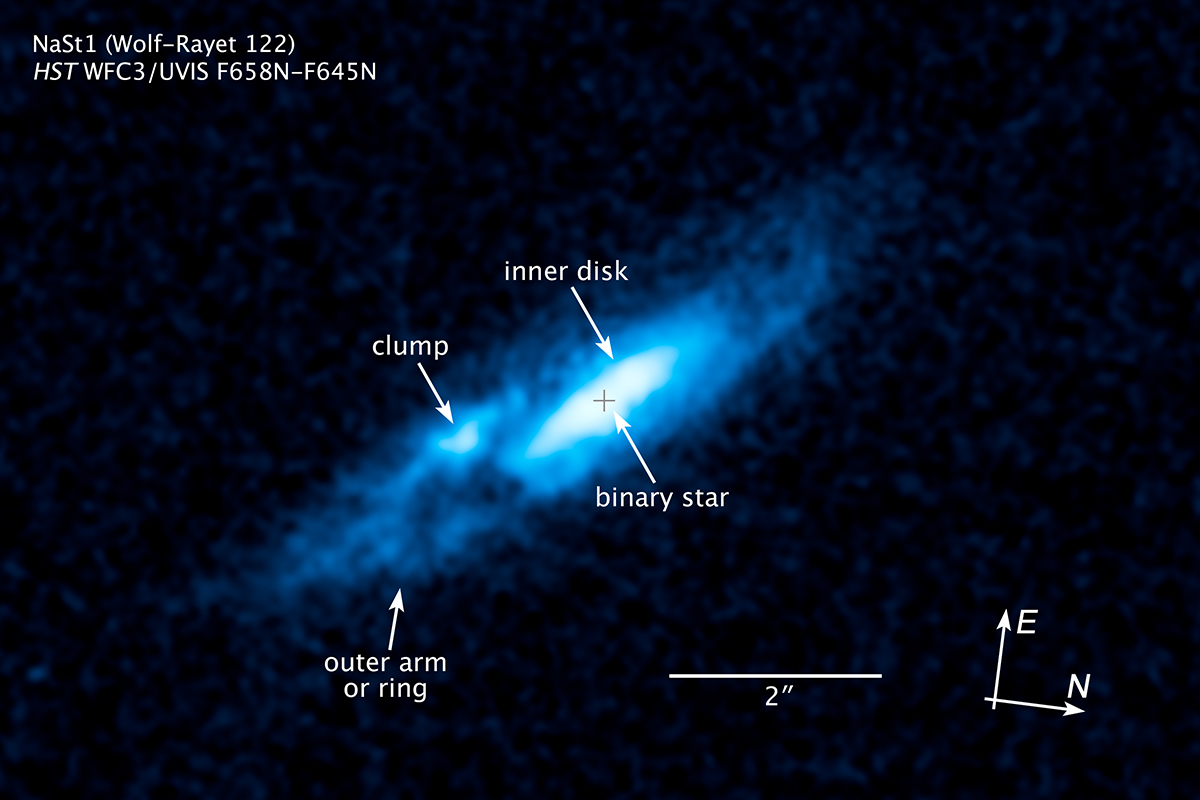
Krystian Science SpaceAstonomers using NASA’s Hubble Space Telescope have discovered surprising new information regarding a massive, one-of-a-kind star, whose behavior has never been seen before in our Milky Way galaxy. The star’s new nickname, ‘Nasty 1,’ is a play on its official catalog name, ‘NaSt1’ – because the rapidly aging star is just that weird.
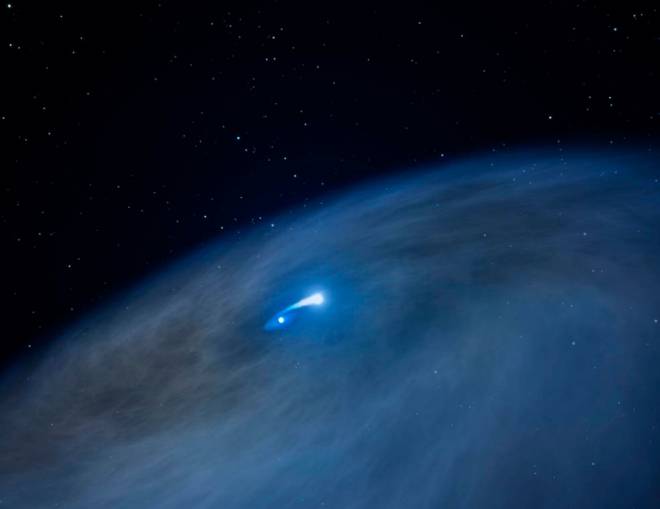
Credits: NASA/Hubble
The star’s catalogue name, NaSt1, is derived from the first two letters of each of the two astronomers who discovered it in 1963, Jason Nassau and Charles Stephenson. Credits: NASA/Hubble
Image: Hubble Site
Image: Hubble Site

Nasty 1 was originally identified as a Wolf-Rayet star when it was first discovered several decades ago. Wolf-Rayet stars are incredibly hot, massive stars (20x larger than our sun) with a high rate of mass loss – some believe they represent a final burst of activity before a huge star begins to die.

The thing is, Nasty 1 doesn’t look like your usual Word-Rayet star. Astronomers expected to see twin lobes of gas flowing from opposite sides of the star. Instead, they saw a pancake shaped disc of gas encircling the star that is nearly 2 trillion miles wide! This disc could be the result of a binary interaction – which there are very few examples of in the galaxy because this phase is so short-lived.

The Team’s Scenario: A massive star evolves very quickly, and as it begins to run out of hydrogen, it swells up. Its outer hydrogen envelope becomes more loosely bound and vulnerable to gravitational stripping, or a type of stellar cannibalism, by a nearby companion star. In that process, the more compact companion star winds up gaining mass, and the original massive star loses its hydrogen envelope, exposing its helium core to become a Wolf-Rayet star.

But the mass transfer process in mammoth binary systems isn’t always efficient. Some of the stripped matter can spill out during the gravitational tussle between the stars, creating a disk around the binary.

“That’s what we think is happening in Nasty 1,” Mauerhan said. “We think there is a Wolf-Rayet star buried inside the nebula, and we think the nebula is being created by this mass-transfer process. So this type of sloppy stellar cannibalism actually makes Nasty 1 a rather fitting nickname… what evolutionary path the star will take is uncertain, but it will definitely not be boring”

The team’s results will appear May 21 in the online edition of the Monthly Notices of the Royal Astronomical Society.

faf18f8529005d2ee542825e00f7f7db870069c225a88473cc83fe2f358f2163


NASA Names Massive Strange Star in the Milky Way Something ‘NASTY’

NASA Wants to Build a ‘Robo-Squid’ to Search for Life on Other Planets – I Say Make a Movie!

KS Technology

NASA’s latest proposal looks like a sci-fi film in the making. The project calls for the use of a soft-robotic rover that resembles a squid -tentacles included- for missions that can’t be accomplished with conventional power systems.

The ‘robosquid’ looks like an eel with a short antenna on its back. The antenna harvests power from locally changing magnetic fields. Ideally, NASA would like to enable amphibious exploration (both land and sea) of gas-giant moons like Europa!

This artist's rendering depicts 2015 NIAC Phase I Fellow Mason Peck's soft-robotic rover for planetary environments for missions that cannot be accomplished with conventional power systems. It resembles a squid, with tentacle-like structures that serve as electrodynamic 'power scavengers' to harvest power from locally changing magnetic fields. The goal is to enable amphibious exploration of gas-giant moons like Europa. Credits: NASA/Cornell University/NSF
This artist’s rendering depicts 2015 NIAC Phase I Fellow Mason Peck’s soft-robotic rover for planetary environments for missions that cannot be accomplished with conventional power systems. It resembles a squid, with tentacle-like structures that serve as electrodynamic ‘power scavengers’ to harvest power from locally changing magnetic fields. The goal is to enable amphibious exploration of gas-giant moons like Europa. Credits: NASA/Cornell University/NSF

Side Note: If they made Sharknado they can make Robosquid. I grew up loving movies like Anaconda, Congo, and Sphere. I’m picturing the same vibe, starring Nathan Fillion, Jon Bernthal, Ludacris, and Kate Upton. Hey J.J. Abrams and Joss Whedon – Think about it! 😉

Image: KrystianScience

NASA Innovative Advanced Concepts (NIAC)

NASA Innovative Advanced Concepts (NIAC)

The ‘robosquid’ is just one of 15 proposals selected by NASA for study under Phase I of the NASA Innovative Advanced Concepts (NIAC), a program that aims to turn science fiction into science fact through the development of pioneering technologies.

“The latest NIAC selections include a number of exciting concepts,” said Steve Jurczyk, associate administrator for the Space Technology Mission Directorate (STMD) at NASA Headquarters in Washington. “We are working with American innovators to reimagine the future of aerospace and focus our investments on concepts to address challenges of current interests both in space and here on Earth.”

NASA hopes the knowledge gained from these proposed studies will bring it closer to its goal of exploration beyond low-Earth orbit, and missions to asteroids and Mars.

The projects are chosen through a peer-review process that evaluates their potential, technical approach and benefits that can be realized in a reasonable timeframe. All concepts are very early in the development cycle and represent multiple technology areas, including aircraft propulsion, human life support, science instruments, unique robotic concepts and exploring other diverse technology paths needed to meet NASA’s strategic goals.

NIAC Phase I awards are valued at approximately $100,000, providing awardees the funding needed to conduct a nine-month initial definition and analysis study of their concepts.

NASA Wants to Build a ‘Robo-Squid’ to Search for Life on Other Planets – I Say Make a Movie!

Even the Sky is Begging For a Green Beer on St. Patrick’s Day!

Krystian Science Space

NASA has reported that a severe geomagnetic storm is underway and luckily Sebastian Saarloos captured these amazing “St. Patrick’s Day Auroras” at Donnelly Creek, Alaska on March 17, 2015.

This slideshow requires JavaScript.

“The auroras were amazing last night and it was the most color that I’ve ever seen. The auroras also lasted longer than usual. Often I’ll see red or purples for a few minutes but last night it lasted hours. The only reason I stopped photographing was because I was physically exhausted from walking through knee deep snow and fighting 35 mph winds. It was quite warm at 30 f, so cold wasn’t a factor, and the adrenaline kept me warm. I’m looking forward to another great night tonight, but last night will be hard to live up to. The equipment used was a Nikon D810, Rokinon 14mm f/2.8 Super Wide Angle Lens, and a tripod.” – Sebastian Saarloos

You can see more images from Sebastian here: www.facebook.com/SebastianSaarloos


NASA also celebrated St. Patty’s Day by posting a photo of Ireland. This image taken by the Moderate Resolution Imaging Spectroradiometer on NASA’s Aqua satellite shows the Emerald Isle in all its green glory.

Credit: NASA/MODIS RAPID RESPONSE TEAM
Gallery